Buying something online often ends with a deceptively simple choice: credit card or debit card. Both may carry the same Visa or Mastercard logo, both usually take only a few seconds to process, and from the shopper’s side the checkout experience can look almost identical. The difference becomes much more noticeable when something goes wrong.
That “something” does not necessarily mean a stolen card number. It could be a fake shopping website that never sends the product, a seller that delivers an item completely different from what was advertised, an unauthorized recurring subscription, a compromised checkout page, or a merchant that simply stops responding after payment. When I look at payment safety, those situations matter more than whether a card works smoothly at checkout.
Our investigation found… the strongest argument for using a credit card online is not that credit cards somehow prevent scams. They do not. The advantage is the layer of separation between the transaction and the money sitting in your checking account, combined with relatively strong dispute and unauthorized-use protections.
For most online shopping, particularly when dealing with an unfamiliar retailer, I would generally choose a credit card over a debit card. That does not make debit cards inherently unsafe, and it certainly does not mean every disputed credit-card purchase will automatically be refunded. The real picture is more nuanced.
This article focuses primarily on U.S. consumer protections. Cardholder rights, liability limits, and dispute procedures can differ significantly in other countries.
Credit Card vs Debit Card Safety Online: The Short Answer
If your main concern is fraud protection when shopping online, a credit card usually provides the safer structure.
The FTC specifically advises consumers to pay by credit card when possible when shopping online because credit-card users may be able to dispute charges when merchandise does not arrive, the wrong product arrives, an item is defective, or certain other billing problems occur.
A debit card is different because the purchase normally removes money directly from your bank account. If an unauthorized $900 transaction appears on a credit card, you may temporarily have a disputed $900 balance on the card. If the same amount disappears through a debit-card transaction, the practical problem may involve $900 that is no longer available in your checking account while the issue is being investigated.
That distinction becomes especially important for consumers who use one checking account for rent, utilities, groceries, loan payments, and everyday expenses.
During testing, we observed… shoppers often focus almost entirely on whether a checkout page has HTTPS, a familiar card logo, or a professional design. Those things can be useful technical signals, but they tell you surprisingly little about how easy recovering money might be if the merchant itself turns out to be problematic.
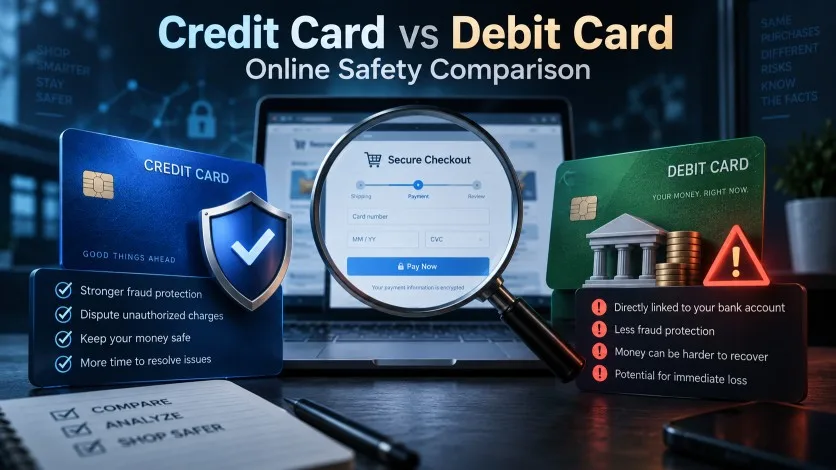
Credit and Debit Cards May Look Similar, but the Money Comes From Different Places
A credit card purchase uses a line of credit provided by the card issuer. You later receive a bill and repay the amount according to the account terms.
A traditional debit-card purchase generally pulls money from a deposit account that belongs to you.
That difference sounds obvious, yet it changes the practical consequences of fraud.
Suppose you have $2,000 in checking and someone obtains your debit-card credentials and makes several unauthorized purchases totaling $1,200. Even if your bank ultimately determines that the transactions were unauthorized and restores the money, you may have to deal with the temporary loss of access to those funds.
With a credit card, fraudulent transactions ordinarily affect the available credit on the account rather than immediately reducing the cash balance in your bank account.
That is why I do not view payment safety only as a question of, “Will the bank eventually reimburse me?” A better question is, “What happens to my finances while the transaction is being investigated?”
What U.S. Law Says About Unauthorized Credit Card Charges
Federal protections for credit cards are relatively strong.
Under Regulation Z, a cardholder’s liability for unauthorized credit-card use generally cannot exceed the lesser of $50 or the amount obtained through unauthorized use before the issuer is notified. CFPB guidance also states that if the physical card has not been lost but someone steals and uses only the account number, the cardholder generally has no liability for that unauthorized use. Many issuers provide protections that are even more favorable than the legal minimum.
There is an important word in that paragraph: unauthorized.
If someone steals your card details and purchases a laptop, that is very different from you voluntarily entering your card information on a questionable website and later becoming unhappy with what happened.
The second situation may involve billing-error rights, a merchant dispute, a chargeback process, contractual protections, or other remedies. It should not automatically be treated as unauthorized card use.
For certain credit-card billing errors, the CFPB says consumers should notify the card company promptly and send a written billing-error notice within 60 calendar days after the charge appeared on the statement to preserve applicable rights.
If you purchased something but it never arrived, CFPB guidance also notes that failure to receive accepted goods can qualify as a billing-error issue in some circumstances.
This dispute structure is one of the main reasons I prefer credit cards for unfamiliar online merchants.
Debit Cards Have Protection Too, but Timing Matters More
A common exaggeration online is that debit cards have “no fraud protection.” That is simply not an accurate description of U.S. consumer law.
Regulation E provides important protections for unauthorized electronic fund transfers, including qualifying debit-card transactions. The complication is that the consumer’s potential liability can depend heavily on how quickly the loss or unauthorized activity is reported.
If a debit card is lost or stolen and the consumer reports it within two business days after learning of the loss or theft, federal rules generally limit liability to no more than $50, subject to the applicable conditions. Waiting longer can increase potential liability, and unauthorized transfers appearing on statements also carry important reporting deadlines.
The CFPB explains that failure to report certain unauthorized transfers shown on a periodic statement within 60 days can create exposure to additional losses occurring after that period.
This does not mean a person who notices a fraudulent debit-card payment on day three automatically loses hundreds of dollars. Real cases depend on when the card was lost, when transactions happened, when the consumer discovered the problem, how the transaction was authorized, and the bank’s own protections.
The practical lesson is simpler: debit-card fraud deserves immediate attention.
Why Credit Cards Usually Have the Practical Advantage
The most meaningful advantage is financial separation.
Imagine finding an unfamiliar $1,500 purchase while checking your accounts on Sunday morning.
With a credit card, you contact the issuer, lock or replace the card, dispute the transaction, preserve your evidence, and continue using the money sitting in your bank account.
With a debit card, the same fraud may have already removed $1,500 from the account used for household expenses.
Even when the bank handles the investigation correctly, those two experiences do not feel the same.
Themakerdepot researchers noticed… consumers sometimes compare cards only by asking which one offers “zero fraud liability.” That misses the operational risk. The location of the money during a dispute can matter almost as much as the final liability decision.
This is especially relevant for someone living on a tight monthly budget. A temporary shortage of $1,500 can cause missed automatic payments, cash-flow problems, or significant stress even if the underlying fraud is later resolved.
A Credit Card Is Not a Magic Scam-Proof Shield
There is another mistake I see frequently: shoppers believe they can ignore warning signs because they are paying by credit card.
That is risky thinking.
A credit-card dispute is a recovery mechanism, not permission to buy from any website that appears in a social-media advertisement.
An issuer may need evidence. The merchant may contest your claim. The situation may involve an authorized purchase rather than stolen-card fraud. Terms, deadlines, and dispute rights matter.
Consider a shopper who knowingly buys a $79 device from a website, receives the product, uses it for three weeks, and then decides it is not as impressive as the advertisement suggested. That is not automatically credit-card fraud.
Now compare it with a merchant advertising a $799 laptop for $89, charging the customer, providing a fake tracking number, and disappearing. Those circumstances raise very different questions.
Card protection should be viewed as the final safety net after sensible merchant verification, not a substitute for it.
Where Online Shopping Scams Commonly Enter the Payment Process
Fake stores rarely begin with the payment page. They usually begin by manipulating the buyer before the card is ever entered.
One pattern we regularly see in questionable online retail is extreme discounting. A product that normally sells for several hundred dollars appears for $49.99, supposedly because of a warehouse closure, anniversary sale, liquidation event, or limited inventory.
The goal is behavioral. The scammer wants the buyer thinking about losing the deal rather than verifying the seller.
Another pattern involves social-media advertisements copied from established brands. Product images, promotional videos, logos, and even customer testimonials can be reused without authorization. The visitor arrives on a professional-looking site and assumes the appearance itself is evidence of legitimacy.
It is not.
The FTC has repeatedly warned about fake shopping sites advertising expensive or brand-name products at unusually low prices. Consumers may receive a counterfeit or unrelated item, or nothing at all.
A third pattern is a low-cost trial that quietly becomes a recurring subscription. The original transaction may be intentionally cheap because the real value to the seller is the payment credential and subsequent billing authorization.
The wording around these offers deserves careful attention. Look for recurring billing conditions, cancellation deadlines, return restrictions, and pre-checked subscription options before entering a card.
The Small Mystery Charge Should Not Be Ignored
Not every suspicious transaction begins with a large purchase.
Fraudsters who obtain payment information may sometimes attempt a small charge before larger activity. From the consumer’s point of view, an unfamiliar charge of $1, $3, or $7 can seem too minor to worry about.
I would not dismiss it simply because the amount is small.
First confirm whether the charge is a legitimate temporary authorization, a forgotten subscription, a household purchase, or a merchant name that differs from the storefront name. If none of those explanations fits, contact the card issuer through the official number on the card or banking app.
Waiting for a suspicious transaction to become expensive is a poor fraud-monitoring strategy.
Scam Risk Is Not Just About Someone Stealing Your Card Number
One of the hardest areas for consumers to understand is the difference between unauthorized payment fraud and a transaction that they were manipulated into authorizing.
Suppose someone pretending to represent your bank calls and claims your account is under attack. They convince you to disclose a one-time code or approve a transaction because they say doing so will “reverse” a fraudulent payment.
The consumer has been deceived, but the payment trail can be more complicated than a simple stolen-card purchase.
Scammers deliberately exploit this distinction. Instead of bypassing authentication, they sometimes persuade the victim to perform the authentication for them.
That is why you should never provide a one-time password, banking-app approval, PIN, or verification code to someone who contacted you unexpectedly, even when caller ID appears to show your bank.
If something genuinely looks wrong, end the call and contact the institution independently using the number on your card, statement, or official app.
How Scammers Manipulate Payment Decisions
The technical side of payment security gets a lot of attention. The psychological side deserves just as much.
A scammer wants to remove time from the decision.
“Only three left.”
“Sale ends in eight minutes.”
“Your order will be cancelled.”
“Verify payment immediately.”
“You must pay a refundable insurance fee.”
None of those statements proves fraud by itself. Legitimate retailers use countdowns and limited-stock notices too. The issue is the broader pattern.
When urgency appears together with an unknown seller, unusually low prices, unclear ownership, copied product photographs, weak contact information, and an unusual payment request, the risk picture changes.
The FTC identifies unexpected contact, pressure to act quickly, and demands to pay using particular methods as recurring scam characteristics.
Scammers are particularly fond of payment methods that make recovery difficult. Current FTC guidance warns consumers about unexpected demands involving bank transfers, wire transfers, cryptocurrency, payment apps, and gift cards, and recommends credit cards when possible because they provide stronger opportunities to dispute charges.
That payment preference itself can be evidence.
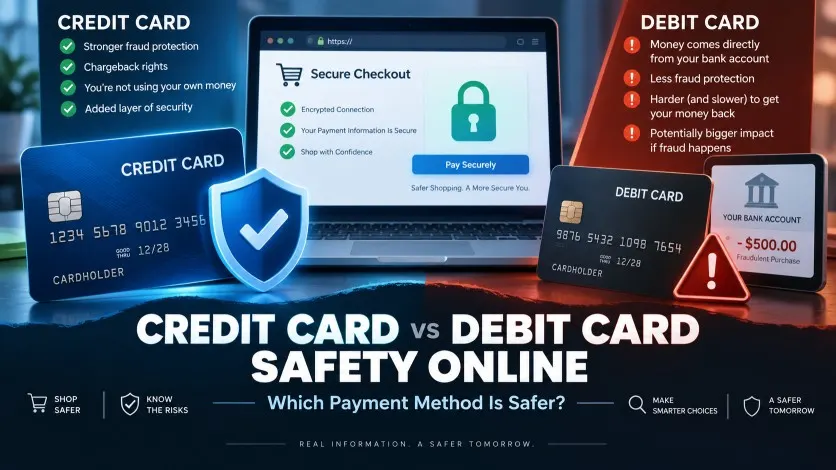
HTTPS Does Not Tell You Whether a Seller Is Honest
Seeing the padlock icon can make people relax.
It should not.
HTTPS means the connection between your browser and the website is encrypted. That is valuable, and you should not submit card information through an unencrypted checkout page.
But encryption does not verify the intentions of the business receiving the information.
The FTC makes the same distinction in its online-shopping guidance: HTTPS indicates encryption, but it does not mean the site itself is legitimate. Scam websites can use encryption too.
Think of HTTPS as a secure envelope. It helps keep outsiders from reading the contents while the envelope travels. It does not prove that the person receiving the envelope is trustworthy.
Trust Indicators I Check Before Paying an Unknown Store
When investigating an unfamiliar ecommerce website, I rarely rely on one trust signal.
I start with the basic identity of the business. Does the website provide an identifiable company name? Is the physical address verifiable? Does the phone number work? Does the contact email belong to the same domain, or is the only option an anonymous free email address?
Then I examine the policies.
A legitimate-looking refund page means little if it contains contradictory deadlines, references another company, lists an unrelated address, or appears copied from a template without being adapted to the store.
Domain history adds another piece of context. A website registered last week while claiming to have served customers “for over ten years” deserves additional verification. A young domain alone does not prove fraud, though. New legitimate businesses launch every day.
Independent customer history matters too. I look beyond testimonial widgets displayed by the seller and search for outside reviews, complaints, discussions, social accounts, archived mentions, and evidence that real customers have interacted with the business over time.
Pricing is another useful clue. A 10% or 20% promotion may be ordinary. A supposedly brand-new $1,200 product offered for $89 deserves a much stronger explanation.
Finally, I study the payment page. A normal credit-card checkout through an established payment processor can be reassuring, but even that should never override major problems elsewhere on the site. You can read more about Why HTTPS Alone Does Not Mean a Site Is Safe!
A Step-by-Step Verification Method Before Entering Your Card
Step 1: Verify the exact domain
Look carefully at the address bar rather than trusting the logo on the page. Fraudulent stores can use domains that differ from established brands by a letter, hyphen, extra word, or unusual extension.
Step 2: Search outside the website
Search the domain name together with terms such as “review,” “complaint,” “refund,” and “scam.” The FTC also recommends researching unfamiliar sellers before purchasing.
Do not treat one positive or negative review as definitive. Look for patterns.
Step 3: Investigate the business identity
Check whether the name, address, telephone number, email address, and company information agree across the website.
Contradictions are more meaningful than missing polish.
Step 4: Read shipping and return policies before paying
Look for return deadlines, restocking charges, return-shipping obligations, cancellation conditions, and whether the return address is actually disclosed.
The FTC specifically recommends reviewing refund and return conditions before an online purchase.
Step 5: Examine the offer itself
Ask whether the price makes commercial sense.
Scam investigation becomes much easier when you stop asking, “Could this deal possibly be real?” and instead ask, “Why would a legitimate seller sell this item at this price?”
Step 6: Evaluate how the merchant wants to be paid
A store accepting ordinary credit-card payments gives you more potential recourse than a seller insisting on gift cards, cryptocurrency, wire transfer, or similar difficult-to-reverse methods.
Pressure to abandon normal checkout and pay through a private message deserves particular caution.
Step 7: Save evidence before completing an unfamiliar purchase
Keep the product page, advertised price, checkout confirmation, delivery estimate, return terms, seller contact details, and order email.
Those records can become important if the listing changes or disappears later.
When Using a Debit Card Online Can Still Be Reasonable
Debit cards are not a payment method I would tell consumers to stop using completely.
For a familiar merchant with an established history, a routine purchase, and strong account monitoring, debit can be perfectly practical.
Some consumers also prefer debit because it prevents them from spending borrowed money or carrying a credit-card balance. That financial discipline can be more important for them than the fraud-management advantages of credit.
The better approach is to understand the tradeoff.
If debit is your preferred or only practical option, enable transaction notifications, review the account frequently, and report unfamiliar activity immediately. If your bank offers controls that allow online transactions to be disabled or the card to be temporarily locked, learn how they work before you need them.
Consumers who frequently purchase from unfamiliar websites may also consider keeping online-shopping funds separate from the account used for critical household bills, where practical. That does not replace fraud protection, but it can reduce the financial disruption caused by compromised payment credentials.
Situational Comparison: Which Card Would I Use?
For a purchase from a major retailer I have used for years, either payment method could be reasonable. I would still normally choose credit for the additional separation from my bank balance.
For an unfamiliar ecommerce site that I have researched and decided to try, credit wins clearly.
For a free trial that requires a payment method, I would be especially cautious. I would read the renewal terms first and preferably use a credit card, or a virtual-card feature if my issuer provides one and its terms suit the transaction.
For a website advertising a $900 product for $79 with a countdown timer and no verifiable business identity, I would not use either card. Choosing the “safer” payment method does not make a fundamentally suspicious purchase sensible.
For a seller that refuses card payment and tells me to send cryptocurrency, buy gift cards, wire money, or transfer funds privately, I would stop the transaction entirely.
That last distinction matters. Sometimes the safest card is the card you never enter.
Security Habits Matter Regardless of Which Card You Choose
Using a credit card does not compensate for poor account security.
Your banking and card accounts should use unique passwords. Where available, activate multifactor authentication. Turn on purchase alerts so an unexpected payment becomes visible quickly rather than appearing weeks later when you finally read a statement.
Do not approve unexpected login notifications or authentication requests.
Avoid entering payment credentials after following an unsolicited text or email link. If a message claims there is a problem with your card, open the bank’s official app or manually navigate to its known website instead.
Keep browsers, phones, and computers updated. Be cautious about storing payment details on devices shared with other people. If your issuer provides virtual card numbers or merchant-specific card controls, those tools can add another layer of protection for certain transactions.
And keep checking statements even when alerts are enabled. Automated fraud detection is useful, but I would never outsource every part of account monitoring to an algorithm. You can read more about How Fake Receipts and Payment Alerts Trick Sellers.
What to Do If You See a Suspicious Credit Card Charge
Start by determining whether you recognize the merchant descriptor. Sometimes the name appearing on a statement is different from the storefront brand.
If you still do not recognize the transaction, contact the card issuer immediately through an official channel. Locking the card through the issuer’s app may help stop additional attempts while you investigate.
Tell the issuer whether the card is still in your possession and whether you believe the card number has been compromised. Ask whether a replacement card number is appropriate.
For a merchant dispute rather than outright unauthorized use, save order confirmations, emails, screenshots, return requests, tracking records, and your attempts to resolve the matter with the seller.
Do not assume that simply making a phone call satisfies every legal requirement for preserving billing-error rights. CFPB guidance says a written billing-error notice within the applicable 60-day period is important for certain disputes.
What to Do If the Suspicious Charge Is on a Debit Card
Speed becomes even more important.
Contact the bank as soon as you identify unauthorized activity. If you still possess the card, tell the bank that detail. If the physical card is missing, report that immediately.
Review the rest of the account for additional transfers, ATM activity, pending card payments, or recurring withdrawals you do not recognize.
You should also consider whether your online banking credentials themselves may have been compromised. Changing a debit-card number does not solve the problem if an attacker also has access to the underlying banking account.
Because Regulation E liability rules can depend on when losses and unauthorized transfers are discovered and reported, waiting to see whether “anything else happens” is a bad strategy.
The Difference Between Fraud Protection and Purchase Protection
These concepts often get mixed together.
Fraud protection generally addresses transactions you did not authorize.
Purchase disputes can involve transactions you did authorize but where something later went wrong: the seller did not deliver, sent the wrong item, charged the wrong amount, or failed to honor certain terms.
Then there are benefits such as extended warranties, purchase protection, travel insurance, or price protection that may be offered by specific cards. Those are contractual card benefits rather than universal legal rights.
Never assume your card includes them. Read the actual cardholder benefits and agreement.
A premium credit card with generous benefits may offer substantially different purchase protection from a basic credit card, while an individual debit-card issuer may voluntarily provide protections beyond the minimum required by law.
That is why blanket statements such as “debit cards have no protection” or “credit cards guarantee refunds” should be treated skeptically.
One of the Biggest Risks Is False Confidence
The safer-payment conversation can accidentally create another problem: shoppers become too comfortable once they hear that credit cards provide strong protection.
Consumer safety works better in layers.
First determine whether the merchant appears credible. Then inspect the offer. Then understand the refund terms. Then use a payment method with meaningful dispute options. Afterward, monitor the account.
Removing any one of those layers increases risk.
I have investigated enough questionable online retail patterns to be suspicious of deals that depend on the buyer moving quickly. A legitimate retailer may want your money, but it normally should not need you to abandon basic judgment to complete the purchase.
Final Verdict: Credit Card or Debit Card for Online Shopping?
For most U.S. consumers asking purely from a fraud-risk and online-shopping protection perspective, I consider a credit card the better option for online purchases, especially when buying from a retailer you have never used before.
The reason is not that credit-card numbers cannot be stolen. They can.
It is not that chargebacks always succeed. They do not.
The advantage comes from the combination of federal protections, established billing-dispute mechanisms, and the fact that fraudulent credit-card spending generally does not immediately remove money from the checking account you use for everyday life. The FTC likewise recommends paying by credit card when possible for online shopping because of the available dispute protections.
Debit cards still have meaningful legal protections, and there is nothing inherently reckless about using one with reputable merchants. The concern is that unauthorized debit transactions can create more immediate cash-flow disruption, while reporting deadlines deserve close attention.
My preferred approach is therefore simple: use credit for unfamiliar online merchants when practical, pay the balance responsibly, enable transaction alerts, save purchase records, and investigate the seller before handing over any payment information.
Most importantly, do not let a card’s fraud protection convince you to ignore a suspicious website. If the business identity cannot be verified, the offer makes little commercial sense, the policies look copied, or the seller is pressuring you toward a difficult-to-reverse payment method, the smartest decision may be not to complete the purchase at all.
1 thought on “Credit Card vs Debit Card Safety Online: Which Is Safer for Online Shopping?”