A refund normally sounds like good news. You bought something that did not arrive, canceled a subscription, returned a product, or were charged incorrectly, and now someone says your money is coming back. That positive expectation is exactly what makes refund scams unusually effective.
Unlike many fraud attempts, a refund scam does not always begin with fear. Sometimes it begins with relief. The person contacting you may already know that you made a purchase, complained about a service, lost money previously, or requested a cancellation. They may even know approximately how much money was involved. That background information makes the conversation feel less like a random scam call and more like legitimate customer support.
After looking closely at the way these schemes operate, I think the most dangerous part is not the refund story itself. It is the sequence that follows. The supposed representative gradually moves the victim away from normal refund procedures and toward something no legitimate refund should require: remote computer access, an upfront processing fee, a bank transfer, cryptocurrency, gift cards, a payment-app transfer, or the return of an alleged “accidental overpayment.”
The Federal Trade Commission specifically warns about refund and recovery scammers who contact people who have already lost money and claim they can recover it for a fee. The FBI has also documented versions where scammers impersonate technical-support companies, manipulate what victims see in their bank accounts, and convince them that a refund was accidentally too large.
This guide explains how refund scams actually work, why intelligent people can still get caught by them, and how I would verify a refund before giving anyone access to money, banking information, or a device.
What Is a Refund Scam?
A refund scam is a fraud scheme in which someone uses the promise, appearance, or supposed processing of a refund to obtain money, account access, sensitive information, or control over a victim’s device.
There are several variations, and they should not all be treated as identical. One scammer may pretend that an antivirus subscription was renewed accidentally. Another may claim a government agency has recovered money from a fraudulent company. Someone else may send a fake check for more than the victim is supposedly owed and then demand that the difference be returned.
The common thread is that the victim is placed in a situation where receiving money somehow requires sending money, revealing sensitive credentials, installing software, or following unusual financial instructions.
That should immediately change the way the situation is evaluated.
A genuine merchant refund normally moves money in one direction: from the merchant or payment processor back toward the customer. There can certainly be legitimate identity checks or processing delays, but a normal refund should not suddenly require you to buy gift cards, withdraw cash, transfer cryptocurrency, or give a stranger remote control of your computer.
Why Refund Scams Can Feel More Convincing Than Ordinary Phishing
A basic phishing message often asks the recipient to believe something entirely new: “Your bank account has been compromised” or “You have won a prize.” A refund scam can be more persuasive because it may attach itself to something the victim already recognizes.
Suppose you recently canceled a software subscription. Two days later, an email says your renewal went through anyway and asks you to call for a refund. The story fits your situation well enough that skepticism can drop.
Scammers also understand something important about consumer behavior. People tend to scrutinize requests to send money more carefully than offers to give money back. The word “refund” lowers the emotional barrier.
Our investigation found… the strongest refund schemes tend to combine familiarity with urgency. The scammer gives the victim enough recognizable information to create trust, then introduces a reason the refund has to be processed immediately.
This may sound like:
“Your subscription renewed automatically.”
“Your previous payment qualifies for reimbursement.”
“We recovered funds belonging to you.”
“We accidentally refunded $5,000 instead of $500.”
“Your refund will expire unless it is processed today.”
Individually, those statements are not proof of fraud. What matters is what the person asks you to do next.
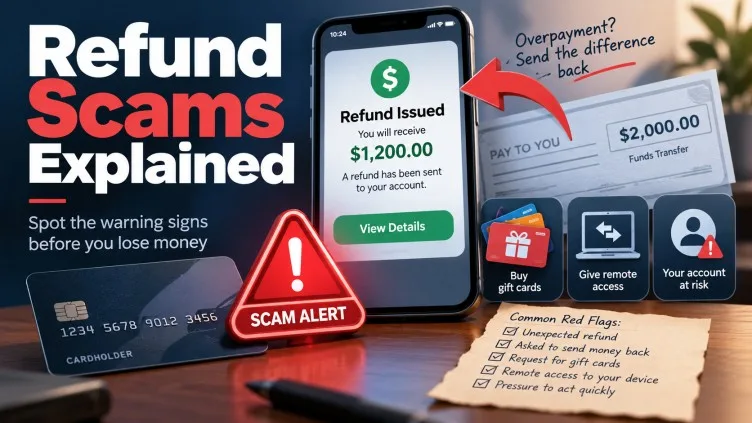
The Fake Subscription Refund Pattern
One of the more recognizable versions begins with a fake invoice or renewal notice.
The victim receives an email, text, or occasionally a phone call claiming that a subscription to antivirus software, technical support, device protection, or another service has renewed for several hundred dollars.
The message then offers an easy solution: call a number immediately to cancel the payment.
This is where the real scam starts.
According to FTC guidance on tech-support scams, fraudulent renewal messages sometimes impersonate recognizable brands and direct the recipient to call a number to dispute the supposed charge. Once the victim calls, the scammer may request remote access to the computer, direct the victim to a fake website, or request financial information under the claim that it is needed to issue the refund.
There is a simple verification step people often skip: check whether the alleged charge exists.
If an email says you were billed $399 for a service, do not begin by calling the number in the email. Open your bank or credit-card account independently. If no $399 charge exists, there is nothing to refund.
That one check can collapse the entire story.
The “We Refunded Too Much” Trick
This is the refund scam pattern I would consider especially dangerous because it creates a sense of personal responsibility.
After establishing remote access, the scammer claims to send the victim a refund. The victim may then see what appears to be a deposit in an online banking account.
The scammer suddenly reacts with panic.
Perhaps the refund should have been $300 but supposedly became $3,000. The representative says they will lose their job unless the customer sends back the extra $2,700.
At that moment, the psychology changes completely. The victim no longer feels like someone protecting their own money. They feel as though they are holding money belonging to someone else.
The FBI has documented a version where scammers manipulate transfers between a victim’s own accounts to create the appearance of a refund. The victim then sends supposedly excess money back to the criminal, even though no external refund was actually deposited.
Later variations have included victims being told to return money through wire transfers, prepaid cards, cryptocurrency, bank transfers, payment apps, or even cash shipments.
The safest response is remarkably simple: do not send anything back based solely on what a caller tells you or what appears on a screen they can remotely control.
Disconnect the call, end remote access, and independently contact your bank.
Remote Access Changes the Entire Risk Level
If someone says they need remote access to your computer to “process” a refund, I would treat that request as a serious warning sign.
Legitimate support teams sometimes use remote-support software for genuine troubleshooting. That is why remote-access requests are not automatically criminal in every context. A technician helping diagnose a computer may reasonably use such software after you independently contacted the company through a verified channel.
Refund processing is different.
There is normally no reason for an unknown caller to watch you open online banking in order to return money to your card.
During testing, we observed… how quickly a seemingly harmless customer-service conversation can become dangerous once banking access and screen control enter the process. At that stage, the person on the other end may be able to see balances, account numbers, saved passwords, authentication prompts, or other information that was never necessary for a refund.
The FBI specifically advises consumers not to download software or give computer control to unknown individuals who contacted them.
If someone insists that remote access is necessary, stop the transaction and independently verify the company.
Refund and Recovery Scams Target Previous Victims
There is another category that deserves separate attention because the victim may genuinely have been scammed before.
Weeks or months after losing money, someone contacts the victim claiming to work for a recovery service, government agency, consumer organization, investigation team, or law firm.
The caller seems unusually informed. They may know the original scam type, approximate loss, or other details.
That does not necessarily mean they are legitimate.
The FTC warns that refund and recovery scammers can obtain information about previous victims and then contact them with promises of recovering lost money. The scammer eventually demands a fee or requests financial information supposedly needed to process the recovery.
In July 2026, the FBI also warned about criminals impersonating the Internet Crime Complaint Center and re-targeting previous fraud victims. The reported tactics included spoofed websites and misleading promotional material intended to create a false sense of legitimacy.
This creates an uncomfortable but necessary rule: being accurately told that you were previously scammed does not prove the new caller is trying to help you.
Government Refund Impersonation Deserves Extra Skepticism
Government names create authority, and scammers know it.
A caller may claim to represent the FTC, FBI, a state agency, court settlement administrator, or another official body and say money has been recovered for you.
Real government refund programs do exist. That fact makes impersonation easier.
The FTC states that information about its legitimate refund programs can be verified through its official refund pages and that it does not require people to pay money or provide sensitive financial information to receive an FTC refund.
This is why independent verification matters so much.
If someone says, “I’m calling from the FTC,” the correct verification method is not asking them to prove it. Hang up, find the official agency website yourself, obtain the phone number there, and verify the matter independently.
Caller ID is not reliable proof either. The FTC warns that phone numbers and caller names can be spoofed.
A convincing display on your phone is therefore evidence of very little.
The Fake Refund Check Variation
Another pattern uses a physical or electronic check.
You may be told that a company owes you $600 but accidentally sends a check for $2,600. The sender apologizes and asks you to deposit the check, keep your $600, and return the remaining $2,000.
The account may initially show the funds as available.
That is where people make a costly assumption: available funds do not necessarily mean the check has been permanently verified.
The FTC warns that fake checks can take time to be discovered. If the victim sends the excess money back before the fraudulent check is identified, the check may later be reversed while the money sent to the scammer remains gone.
A legitimate business that genuinely sends the wrong refund has accounting procedures for correcting the error. It should not need a customer to turn an accounting mistake into a gift-card purchase, crypto transfer, or urgent personal wire.
Warning Signs I Would Take Seriously
No single unusual detail proves fraud, but several warning signs appearing together dramatically increase concern.
Requests for upfront “administration,” “release,” “processing,” “tax,” or “recovery” fees deserve particular scrutiny. A refund that requires you to pay before receiving your own money is fundamentally different from a normal merchant refund.
Other strong red flags include being told to install remote-control software, log into online banking while another person can view your screen, transfer supposedly excess refund money elsewhere, buy gift cards, use cryptocurrency, send cash, disclose one-time passwords, or keep the conversation secret from your bank.
Pressure also matters.
Scammers frequently create consequences for slowing down. You may be told that the refund expires in an hour, a representative will lose their job, your account will be frozen, or legal action will begin if you do not return the money immediately.
Legitimate financial errors can require correction, but they do not become more legitimate because someone is shouting about a deadline.
How I Would Verify a Refund Step by Step
Step 1: Verify That the Original Transaction Exists
Before discussing a refund, locate the underlying payment.
Open your banking or credit-card account using the normal app or website, not a link sent in the refund message. Match the merchant name, amount, and date.
If there is no original charge, the refund story is already questionable.
Step 2: Contact the Merchant Independently
Do not rely on the contact details contained in an unexpected refund message.
Type the company’s known website address yourself or use contact information from a previous legitimate receipt. For card transactions, you can also call the phone number printed on the card.
Ask whether a refund has actually been initiated.
This simple separation between the incoming message and your verification channel is one of the strongest anti-scam techniques available.
Step 3: Ask How the Refund Will Be Returned
Most ordinary merchant refunds return to the original payment method.
That does not mean every legitimate company follows identical procedures, but an unusual change deserves explanation.
For example, if you paid $89 using a credit card and the supposed representative says the only way to receive the refund is by installing remote-access software and opening your bank account, the process no longer resembles an ordinary card refund.
Step 4: Verify Money With Your Financial Institution
If someone claims that a large deposit reached your account, especially while they have remote access to your device, stop relying on the screen in front of you.
Contact your bank independently.
Ask whether the transaction represents an actual external credit, an internal account transfer, a pending item, or something else.
Do this before moving any money.
Step 5: Refuse Unusual Repayment Methods
If the company truly made an overpayment, tell them you will discuss correction through your bank or the original payment system.
Do not purchase gift cards.
Do not convert the difference into cryptocurrency.
Do not send cash.
Do not wire money to an unrelated account simply because a caller insists that this is the company’s “refund correction department.”
A real accounting error does not require you to abandon ordinary accounting channels.
Why Scammers Create Emotional Responsibility
Refund scams often use a different emotional lever from conventional fraud.
Instead of simply threatening the victim, the scammer may portray themselves as the person at risk.
“I accidentally entered an extra zero.”
“My manager will fire me.”
“The money will be deducted from my salary.”
“Please don’t tell the bank because I’ll lose my job.”
This is manipulative for a reason.
Once the victim feels responsible for another person’s employment or financial wellbeing, the decision stops feeling like a banking transaction. It becomes an ethical emergency.
Themakerdepot researchers noticed… that this guilt-based structure is particularly effective because the scammer may temporarily stop behaving like a salesperson and begin acting like a frightened employee asking for personal help.
That emotional change should itself be treated as a warning.
A real company’s refund mistake is a company accounting problem. Customers should not be pressured into privately repairing it through irreversible payments. You can read more about What We Actually Found After Digging Into This Blood Sugar Supplement Site.
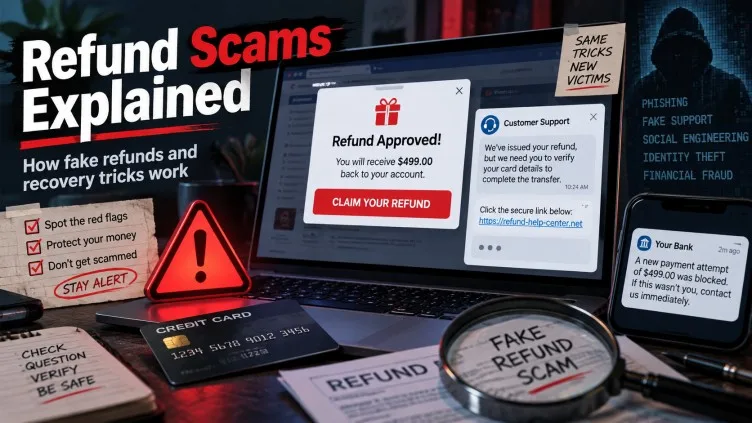
A Real Refund Versus a Suspicious Refund
The difference is usually clearer when you compare the process rather than the language.
A legitimate retailer may email you saying your $74.99 return has been processed to the Visa card used for purchase and advise you that the bank may need several days to post it.
A suspicious “refund department” may say you have $74.99 coming back but first needs remote access to your computer, your online banking page, and a security code.
Both conversations use the word refund. Only one follows a normal financial path.
The same reasoning applies to recovery services. A real attorney or professional service may have fees governed by an engagement agreement and applicable rules. That is not the same as an unsolicited caller guaranteeing recovery of money you lost and demanding cryptocurrency before the funds can allegedly be released.
Context matters.
That is why I would avoid simplistic rules like “every refund call is fake.” The better question is whether the procedure makes financial and operational sense.
What Trust Indicators Actually Matter?
A professional-looking email signature is weak evidence.
So is a logo, toll-free number, government seal, company name, caller ID display, or polished website. All of these can be copied or spoofed.
Stronger trust indicators are independently verifiable relationships.
Can you reach the company through contact details you already knew before the refund message arrived? Does your original merchant account show the refund? Can your bank verify the deposit? Does an alleged government refund appear on the agency’s official website? Is the communication consistent with the original payment method?
Those checks require the scammer’s story to match systems the scammer does not control.
That is much more useful than asking the scammer to send additional “proof.”
What If Money Has Already Been Sent?
Speed matters.
The FTC recommends contacting the financial company involved as soon as possible and asking whether the payment can be stopped, reversed, or refunded. The appropriate route depends on whether the money was sent through a bank transfer, card, wire service, payment app, gift card, or other method.
If an unauthorized electronic transfer appears on a bank account, notify the bank or credit union promptly. Current CFPB guidance explains that unauthorized electronic fund transfers may carry federal protections, with the exact liability depending partly on the circumstances and how quickly the consumer reports the problem.
This distinction is important: a transaction you personally authorized after being deceived and an unauthorized transaction initiated by somebody else may not be treated identically. Do not guess which category applies. Explain the complete circumstances to the financial institution.
If remote-access software was installed, disconnect the device from the network, remove unauthorized remote-access tools, change important passwords from a clean device, and review email and financial accounts for changes. If banking credentials or sensitive identity information were exposed, additional security steps may be necessary.
Victims in the United States can also report suspected fraud to the FTC through ReportFraud.ftc.gov, and relevant internet-enabled fraud can be reported to the FBI’s Internet Crime Complaint Center. You can read more about Credit Card vs Debit Card Safety Online.
What Not to Do After Being Scammed
The period immediately after a financial loss creates another vulnerability.
People naturally begin searching for recovery services, legal help, chargeback assistance, investigators, and anyone claiming to know how to retrieve stolen funds.
That urgency can expose them to a second scam.
Be especially skeptical of anyone who contacts you first and already knows about the loss. Do not assume they are trustworthy simply because they possess details of what happened.
Do not pay another stranger to “unlock” recovered cryptocurrency, release a government settlement, pay tax on money that has supposedly been found, or access a special blockchain recovery system.
And be careful with guarantees.
Professional investigators, attorneys, banks, and law-enforcement agencies can help in appropriate circumstances, but legitimate parties generally cannot honestly guarantee that stolen funds will be recovered.
Security Habits That Make Refund Scams Harder to Pull Off
I recommend mentally separating receiving money from giving access.
If someone is refunding you, ask why they would need information unrelated to sending that refund.
Why do they need control of your screen?
Why do they need your email password?
Why do they need the one-time security code your bank explicitly told you not to share?
Why do they need you to move money from savings into checking?
Why does a refund require purchasing gift cards?
Questions like these expose inconsistencies quickly.
Another useful habit is using a second channel for verification. If the request arrives by phone, verify through the official website. If it arrives by email, check your banking app independently. If the caller claims to represent your bank, end the call and dial the number printed on your card.
Scammers want to control the entire information environment. Independent verification breaks that control.
Situational Example: The $499 Antivirus Refund
Imagine receiving an email saying an antivirus package renewed for $499.
The email looks polished and includes a recognizable company logo. It tells you to call immediately if you did not authorize the renewal.
Instead of calling, you check your credit card.
There is no $499 charge.
At this point, you already have a strong reason not to engage.
Now imagine you call anyway. The representative asks you to install remote-support software so they can cancel the renewal. They then tell you to log into online banking because the refund cannot be returned directly to the card.
Those additional steps do not make the story stronger. They make it substantially weaker.
The correct investigative question is not, “Does the representative sound professional?”
It is, “Why has refunding a card payment turned into remote access to my bank account?”
Situational Example: The $8,000 Recovery Call
Consider another situation.
Someone previously lost $8,000 in an investment fraud. Three months later, a caller claims to work with a recovery department and knows the amount lost.
The caller says $6,500 has been recovered but requires a $650 “release charge.”
This may feel different because there really was an $8,000 loss.
That is precisely why the approach can work.
The FTC warns that recovery scammers specifically target people who have already lost money and may possess information about the previous fraud.
Before paying anything, verify the organization independently. Search for the agency or company through sources unrelated to the caller. If they claim to represent law enforcement or government, obtain the agency’s official contact details yourself.
Never treat knowledge of your previous loss as proof of legitimacy.
Risk Analysis: When Should Concern Become Serious?
I would consider the risk relatively low when you initiated contact with a known merchant, the refund appears inside your existing customer account, it returns to the original payment method, and nobody requests sensitive credentials or additional payments.
Risk increases when communication arrives unexpectedly, especially if the sender wants you to move outside the merchant’s normal support system.
The risk becomes much more serious when several elements combine: remote access, banking login requests, emotional pressure, overpayment claims, secrecy instructions, cryptocurrency, gift cards, wire transfers, or upfront recovery charges.
The combination matters more than a single clue.
A legitimate company can send a poorly written email. A genuine representative can make a mistake. Refunds can take time. Banks can display transactions confusingly.
Consumer safety analysis should leave room for those possibilities.
But when a refund process begins requiring actions that primarily benefit the person supposedly sending the refund, skepticism is justified.
Expert Verdict: How Consumers Should Think About Refund Scams
Refund scams succeed because receiving money feels safer than spending it. That assumption is exactly what consumers need to challenge.
A refund should be evaluated like any other financial transaction. Verify who initiated it, confirm the original charge, independently contact the company, check the payment method, and never let an unexpected caller control the device or information you use to verify their story.
The strongest warning sign is usually not the refund offer itself. It is what comes afterward.
If someone supposedly owes you money but requires an upfront fee, cryptocurrency payment, gift cards, remote computer access, a wire transfer, bank-login session, cash shipment, or repayment of a mysterious “extra refund,” stop and verify everything independently.
There are genuine merchant refunds, real settlement payments, legitimate chargebacks, and authentic government refund programs. Consumer protection works best when we avoid both extremes: blindly trusting every refund message or automatically assuming every refund problem is fraudulent.
The practical middle ground is verification.
Check the transaction yourself. Contact institutions using independently sourced details. Keep control of your computer. Never allow urgency or guilt to override financial safeguards.
A legitimate refund should survive those checks. A refund scam usually depends on preventing you from making them.