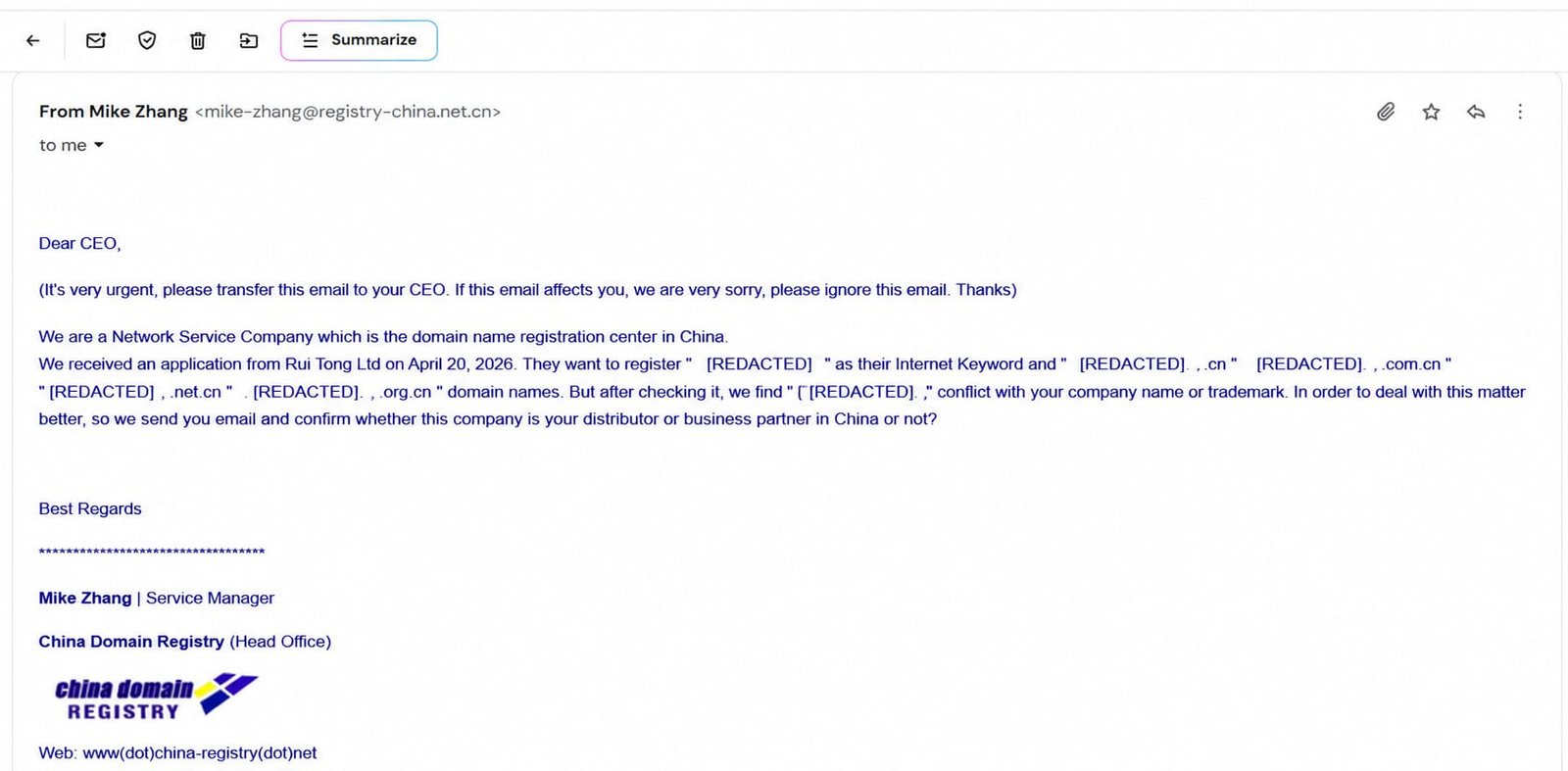
Website owners who have managed a blog, online store, media site, or business domain for a few years eventually encounter a strange type of email. It often arrives with an urgent subject line, mentions a company in China attempting to register domain names related to your brand, and pressures you to respond quickly.
At first glance, the message can feel surprisingly legitimate. Here is the sender email: mike-zhang@registry-china.net.cn
The sender usually claims to represent a Chinese domain registration authority or internet registry company. They may mention that another business is trying to register versions of your domain using extensions such as “.cn,” “.com.cn,” or “.net.cn.” The email often includes phone numbers, office addresses, and professional-looking signatures to create an appearance of authenticity.
For someone unfamiliar with this tactic, the situation can appear serious. After all, protecting a brand name online matters, especially for businesses that rely on search traffic, customer trust, or digital branding.
But after investigating dozens of similar cases over the years, a clear pattern emerges: many of these emails follow a well-known domain registration scare tactic that has circulated globally for a long time.
That does not automatically mean every message is fraudulent. Some domain registration agencies do contact businesses for legitimate reasons. Still, the overwhelming majority of these unsolicited “Chinese domain conflict” emails share nearly identical characteristics that experienced security researchers and domain professionals recognize immediately.
The email received by the many company owner strongly resembles this broader pattern.
Why These Emails Exist in the First Place
The core objective behind these messages is usually simple: pressure website owners into purchasing unnecessary domain extensions.
The email typically claims that another company is attempting to register domains connected to your brand name. In this case, the sender alleged that a business called “Rui Tong Ltd” wanted to register several Chinese domain extensions related to different brand/Company owner.
That wording is not accidental.
The message is designed to trigger a fear-based reaction. Website owners naturally worry about:
- brand impersonation
- counterfeit websites
- trademark conflicts
- phishing risks
- SEO confusion
- customer trust issues
Scammers understand this psychology extremely well.
The fear of losing brand control often pushes people into making rushed decisions. Some recipients end up paying hundreds or even thousands of dollars for domain packages they never actually needed.
What makes this tactic effective is that it mixes technical language with urgency. Many recipients are not domain industry experts, so the message sounds plausible enough to create uncertainty.
That uncertainty is exactly what the sender wants.
The Structure of the Email Reveals a Lot
One interesting detail about these emails is how consistent they are across different industries.
The wording changes slightly from sender to sender, but the structure remains remarkably similar.
Common elements include: Their email- mike-zhang@registry-china.net.cn
- “Please transfer this email to your CEO”
- “Very urgent”
- claims of trademark conflict
- references to Chinese domain extensions
- mention of another company applying first
- pressure to respond quickly
- professional-looking signatures
- international phone numbers
- vague registry claims
The email sent to brand owner follows this pattern closely.
There is also another subtle observation worth mentioning. Legitimate domain registries generally do not operate like investigative trademark enforcement agencies. They typically process registrations through registrars and automated systems. It is unusual for a real registry authority to proactively warn businesses around the world in this personalized manner.
That mismatch between how real registries operate and how these emails are written is one of the first warning signs experienced researchers notice. Check recently reviews article on trickymagazine
The “CEO” Tactic Is Psychological
One line appears frequently in these messages:
“Please transfer this email to your CEO.”
This wording serves multiple purposes.
First, it attempts to elevate the seriousness of the message. Anything involving the CEO sounds important by default.
Second, scammers often assume that smaller companies may not fully understand domain registration procedures. Mentioning executives creates pressure and authority.
Third, it subtly encourages internal panic. Employees who receive the email may forward it upward without properly evaluating whether the message itself makes sense.
This kind of social engineering is extremely common in online fraud campaigns. Attackers do not always rely on malware or hacking tools. Sometimes they simply manipulate urgency, hierarchy, and uncertainty.
The Use of Chinese Domain Extensions Creates Fear
The mention of “.cn” domains is intentional.
Many website owners outside China are unfamiliar with how Chinese domain registrations work. That lack of familiarity creates confusion, which scammers exploit.
The email often implies that:
- someone could steal your brand
- customers may become confused
- your trademark rights may be affected
- your business reputation could suffer
While domain impersonation can absolutely happen in some situations, these emails usually exaggerate the threat heavily.
In practice, most businesses do not need to purchase every possible international domain extension. Large corporations sometimes do so for brand protection, but small publishers, bloggers, and independent websites rarely face serious harm from unrelated regional domain registrations.
The fear itself becomes the sales tactic.
A Closer Look at the “Registry” Claims
Another investigative detail worth discussing is the use of names like:
- China Domain Registry
- China Internet Registry
- Asia Domain Registration Center
- Chinese Network Information Center
These names are intentionally generic and authoritative-sounding.
Some of these companies may technically operate as domain resellers or intermediaries. Others appear to exist mainly to send aggressive marketing emails.
The problem is not necessarily that the company exists. The issue is whether the email creates misleading urgency or false implications to pressure purchases.
Real domain authorities usually do not:
- contact random foreign businesses repeatedly
- warn brands about “conflicts” in this dramatic style
- ask for immediate defensive registrations
- frame the situation like a legal emergency
That distinction matters.
Why So Many Website Owners Fall for It
It is easy to dismiss these emails as obvious scams after seeing them multiple times. But for newer website owners, the message can feel genuinely alarming.
Imagine running:
- an eCommerce store
- a growing blog
- a startup
- a media brand
- a digital agency
Then suddenly receiving an email claiming another company may register your brand in China.
Many people panic because they assume:
- there may be legal consequences
- trademark rights are at risk
- SEO problems could emerge
- counterfeit stores could appear
The emotional reaction often overrides logical verification.
Scammers depend on this exact moment.
Interestingly, the emails rarely contain direct threats. Instead, they create uncertainty and allow the recipient’s imagination to fill in the worst-case scenarios.
That subtle approach tends to work better than obvious intimidation. The recent trends topic on fraud in the United States is on the trickymagazine
How Legitimate Domain Protection Usually Works
To understand why these emails are suspicious, it helps to compare them with how legitimate brand protection actually functions.
Real corporate domain protection strategies usually involve:
- trademark registrations
- legal monitoring services
- official registrar partnerships
- internal brand protection teams
- proactive defensive registrations
These processes are structured and professional.
Companies generally decide in advance which international domains they want to secure. They do not wait for random warning emails from unknown third parties.
Additionally, official registrars typically communicate through established customer relationships, not unsolicited fear-based outreach.
A Pattern Seen Across Thousands of Emails
One important investigative observation is repetition.
Over the years, almost identical domain conflict emails have been reported globally. Different names are used, different companies are mentioned, and various phone numbers appear, but the underlying template remains surprisingly consistent.
Some versions claim:
- a company in China is registering your trademark
- another business wants your Asian domains
- your brand name is under review
- urgent authorization is required
In many cases, recipients later report being offered expensive domain packages after replying.
That consistency strongly suggests a broader marketing or scam ecosystem rather than isolated legitimate trademark procedures.
Could Someone Actually Register Your Brand in China?
Technically, yes.
Someone can register domain names containing your brand if those domains are available and trademark protections do not prevent it.
But that fact alone does not validate these emails.
Here is the nuance many people miss: domain registration disputes are common globally, yet legitimate companies do not typically discover them through cold emails from unknown registry representatives.
If brand protection is genuinely important to your business, the better approach is:
- monitor your trademarks properly
- use trusted registrars
- register critical domains proactively
- consult legal professionals when necessary
Fear-based emails are not reliable brand protection systems.
Signs the Email May Be Part of a Scam or Aggressive Sales Tactic
Several warning indicators stood out during analysis of the email received by the company owner.
Excessive urgency
The repeated emphasis on urgency is a classic social engineering technique.
Generic wording
The message could easily be reused for thousands of businesses by changing only the domain name.
Authority language
Phrases like “registration center” and “head office” are meant to sound official.
Suspicious business logic
Real registries rarely pause registrations simply to notify unrelated companies abroad.
Emotional pressure
The email subtly encourages defensive action before proper verification.
Unsolicited outreach
Unexpected legal-style warnings from unknown organizations should always be verified independently.
None of these signs alone prove malicious intent. But collectively, they create a pattern commonly associated with questionable domain marketing schemes.
What Website Owners Should Actually Do
One of the most practical responses is simply staying calm.
Panic leads to rushed decisions, unnecessary purchases, and poor judgment.
If you receive one of these emails, consider the following steps instead.
Verify the sender independently
Do not rely solely on contact details provided in the email itself.
Research:
- company history
- domain age
- independent reviews
- scam reports
- business registration details
Many recipients discover that similar complaints already exist online.
Check your trademark status
If your brand is commercially important, evaluate whether formal trademark registration makes sense.
Trademark protection is usually more valuable long term than reacting to random domain scare emails.
Review whether you actually need foreign domains
Not every website needs:
- .cn
- .com.cn
- .net.cn
- .org.cn
For many small publishers and blogs, those domains provide little practical value.
Avoid rushed payments
Scammers often rely on fast emotional reactions.
Take time to:
- research
- compare registrars
- evaluate actual risk
- speak with professionals if needed
Use reputable registrars only
If you do decide to purchase international domains, use established registrars with transparent pricing and support.
The Psychology Behind This Scam Pattern
One reason this tactic continues surviving year after year is because it targets a very specific emotional weakness: fear of losing ownership.
Website owners spend years building:
- rankings
- trust
- branding
- authority
- customer recognition
The idea that another company could suddenly register related domains creates anxiety.
Scammers exploit this attachment carefully.
Interestingly, the tactic resembles certain fake trademark scams seen in other industries. The sender positions themselves as a helpful intermediary while indirectly creating the fear that motivates the purchase.
That psychological structure appears repeatedly in online fraud ecosystems.
Why Consumer Awareness Matters Here
The broader issue extends beyond domain names.
These emails demonstrate how modern scams increasingly rely on:
- technical confusion
- authority impersonation
- partial truths
- urgency
- business anxiety
Not every scam today looks like obvious phishing.
Some schemes operate in gray areas where the sender may technically sell a real product while using manipulative tactics to pressure buyers unnecessarily.
That distinction matters because many victims later feel embarrassed reporting incidents that were not traditional “hacks.”
Consumer awareness is the strongest defense.
The more website owners understand how these tactics operate, the less effective they become.
An Investigative Observation Worth Mentioning
One recurring detail seen in many domain scare emails is the lack of personalization.
Despite appearing urgent, the messages often:
- contain awkward phrasing
- use generic legal language
- reference broad trademark concerns
- avoid specifics about actual trademark filings
That inconsistency is revealing.
Trickymagazine researchers noticed, Real legal or registry disputes usually involve concrete documentation, identifiable procedures, and verifiable records. Scam-style emails often remain intentionally vague because vagueness allows them to target large numbers of recipients efficiently.
That scalability is a hallmark of many online fraud operations.
Final Verdict
Our investigation found, After analyzing the email received by team and comparing it with long-running patterns reported across the domain industry, the message strongly resembles a common domain registration scare tactic frequently used to pressure businesses into purchasing unnecessary international domains.
There is no clear evidence that an immediate legal threat exists simply because such an email was received.
The message contains multiple characteristics commonly associated with manipulative domain marketing campaigns:
- urgency
- authority-style wording
- vague registry claims
- emotional pressure
- unsolicited outreach
- defensive registration fear tactics
Website owners should treat these emails carefully, verify claims independently, and avoid making rushed purchases based solely on fear.
At the same time, businesses with valuable trademarks should still take sensible brand protection steps through legitimate registrars and formal trademark processes rather than relying on unsolicited warnings from unknown organizations.
In most cases, the safest response is simple:
research first, stay calm, and do not let urgency override verification.