A buyer messages you about a phone, laptop, camera, furniture item, or something else you are selling online. The conversation seems normal. They agree to the price without much negotiation, ask for your payment details, and a few minutes later send a screenshot showing that the money has been transferred. An email may arrive at almost the same time saying the payment was successful. The buyer then asks you to ship the item immediately because they are “in a hurry.”
There is only one problem: the money never actually arrived.
This is the basic structure behind fake payment confirmation scams, but the versions circulating online are becoming far more convincing than the crude fake screenshots many people associate with this type of fraud. Some messages imitate well-known payment services closely, some create believable-looking transaction IDs, and others combine fake emails with social engineering designed to make sellers feel that checking the payment again would somehow be rude or unnecessary.
After examining how these schemes are structured, one point matters more than anything else: a payment notification is not the same thing as a payment. A screenshot is not money. An email is not money. Even a message carrying the branding of a legitimate payment company should never replace verification inside your actual account.
The Federal Trade Commission specifically warns sellers about scammers who claim to have paid through mobile payment apps and then send fake payment notifications, hoping the seller will release the item before realizing no money was received.
What Is a Fake Payment Confirmation Scam?
A fake payment confirmation scam happens when someone creates the appearance that a payment has been sent even though the seller has not actually received usable funds.
The deception can arrive through an email, text message, messaging app, screenshot, fake banking interface, forged receipt, or even a legitimate-looking payment request generated through a real financial service. The purpose is usually to persuade the seller to ship merchandise, provide a service, issue a refund, or send additional money before independently checking the transaction.
That last part is important. The scam normally succeeds because the victim verifies the message about the payment rather than verifying the payment itself.
A genuine-looking receipt may contain the correct seller name, transaction amount, product description, payment-service logo, timestamp, reference number, and even security language. None of those details proves that funds have actually reached the recipient.
PayPal itself warns users about fake payment confirmations, invoices, money requests, phishing emails, and messages designed to resemble genuine service notifications. Its guidance repeatedly tells users to check activity through the official account rather than trusting links, phone numbers, or instructions contained in suspicious communications.
Why These Scams Can Look Surprisingly Convincing
People often imagine scam messages as badly written emails filled with spelling errors. Those still exist, but judging legitimacy solely by grammar is becoming increasingly unreliable.
A criminal does not need to duplicate an entire payment network. They only need to reproduce what the seller expects to see for a few seconds.
Think about what happens during a normal online sale. The seller is usually concentrating on the buyer, the product, shipping arrangements, and whether the transaction will go smoothly. If an email suddenly appears with a familiar logo and the exact amount expected, the seller’s brain naturally connects the two events.
That is the psychological opening.
Our investigation found… that the more effective versions of this scam frequently combine several pieces of believable information rather than depending on a single obviously fake receipt. The scammer may know your name, email address, selling price, item description, and city because you already provided that information during the transaction.
Once those details are inserted into a professional-looking payment notice, the document feels personalized. Personalization creates trust, even though none of that information confirms that money moved between accounts.
Pattern One: The Fake Payment Email
This is probably the most recognizable version.
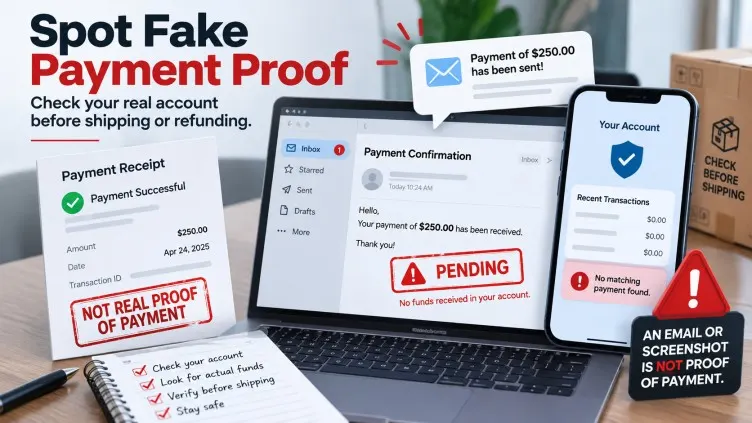
A seller provides an email address associated with a payment service. Shortly afterward, an email appears claiming that a payment of $400, $750, or another expected amount has been received.
The email may say something like the funds are “secured,” “successfully transferred,” or “temporarily held until shipment confirmation.” It may even instruct the seller to provide a tracking number before the funds become available.
This creates a believable story because legitimate payment services really can have pending transactions, disputes, security reviews, or account holds under certain circumstances.
The difference is where that information appears.
If a legitimate payment provider has placed a transaction on hold, you should normally be able to see the transaction or relevant account status after independently opening the official app or website and signing into your account. A random email claiming that funds exist when your authenticated account shows no transaction deserves serious suspicion.
Do not use the email’s button to check.
Open the payment application yourself or manually enter the provider’s known website address. PayPal specifically recommends this approach when dealing with suspicious messages.
Pattern Two: The Edited Screenshot
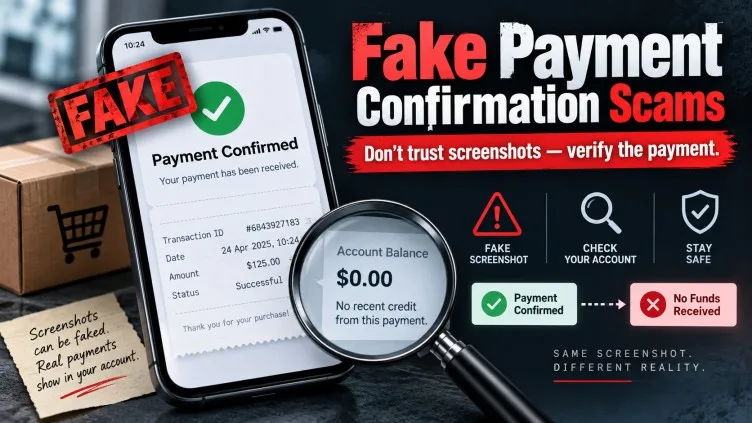
Screenshots deserve almost no evidentiary weight in online transactions.
Creating a convincing fake payment screenshot no longer requires sophisticated graphic-design skills. Text, amounts, names, timestamps, transaction references, account balances, and payment statuses can all be manipulated.
Some scammers do not even edit an image. They may transfer a tiny amount between accounts they control, capture a legitimate confirmation screen, and alter only the recipient name or value.
Imagine selling a used laptop for $900. The buyer sends an image showing:
“Payment Successful — $900 Sent.”
Everything looks correct. Your name is visible. The time roughly matches your conversation. The buyer immediately says, “Please confirm and ship because I need it tomorrow.”
The correct response is not to study the screenshot more carefully.
The correct response is to ignore the screenshot and check your account.
If there is no corresponding transaction inside your actual account, the screenshot changes nothing.
Pattern Three: The Fake “Business Account Upgrade”
This variation adds a second stage to the fraud.
The seller receives an email claiming that the buyer has sent money but that the seller cannot receive it because their account has reached a limit or needs to be upgraded to a business account.
The message might claim the buyer must send an additional amount — perhaps $300 or $500 — to “expand” the seller’s receiving limit. The scammer then pretends to send that additional payment.
Now the seller supposedly owes the buyer the extra amount back.
For example, you are selling something for $500. A fake email says the buyer sent $500, but your account requires another $300 before it can receive business payments. The buyer claims to send $800 total and pressures you to return the extra $300.
No original payment may exist at all.
The seller can therefore lose $300 without ever receiving the $500 purchase price.
This is where fake payment confirmation scams overlap with overpayment scams. PayPal warns users about overpayment schemes in which someone appears to pay too much and then requests money back, while the FTC has also documented bogus refund and fake-check overpayment patterns.
Pattern Four: “I Accidentally Paid You Twice”
This version relies on politeness.
The buyer suddenly claims that they made an error.
“I sent $600 twice. Please return one payment.”
They may provide two screenshots or two email notifications as proof. Sometimes they become extremely apologetic, which makes the seller feel pressure to solve the supposed mistake quickly.
Never refund money simply because another person says they overpaid.
Check the actual transaction history first.
If your account shows only one payment, there is obviously nothing to refund. If it shows two payments, verify the status of both transactions and follow the payment provider’s official refund process rather than independently sending money to another account.
That distinction matters. Sending a completely new payment is not always equivalent to refunding the original transaction.
Pattern Five: Fake Escrow and “Funds Waiting for Shipment”
Another persuasive story involves supposed escrow protection.
A buyer claims the payment company is holding your money safely until you send the product. You receive an impressive email saying the transaction is protected and the funds will automatically release after you provide a courier tracking number.
This scenario sounds reasonable because legitimate online marketplaces sometimes use delayed payouts or payment holds.
The wording itself is therefore not proof of fraud.
The verification question is simple: Does your authenticated seller account show the transaction?
If the only evidence of an $800 payment is an email in your inbox, while the actual platform shows no order, no payment and no pending balance, shipping an $800 product would be extremely difficult to justify.
Pattern Six: Real Payment Platform, Misleading Request
There is another version that deserves special attention because not every suspicious payment message is technically forged.
Fraudsters sometimes use genuine payment platforms to create invoices or payment requests. Because the notification originated from the real platform, the email may pass normal authentication checks and look completely legitimate.
That does not mean money was paid.
An invoice is a request for payment. A money request is a request for payment. Neither proves that the recipient has received funds.
PayPal warns that scammers may use invoices and payment requests containing alarming messages or fraudulent customer-service phone numbers. Users are advised to verify the situation directly within their account and avoid calling numbers embedded in suspicious invoices.
This is an important lesson for anyone investigating online fraud: authenticity of the communication channel does not necessarily establish authenticity of the claim being made through that channel.
The Warning Signs We Pay the Most Attention To
No single red flag automatically proves someone is attempting fraud. People make mistakes, payment systems experience delays, and genuine buyers can behave awkwardly.
What matters is the combination.
A buyer becomes significantly riskier when several of the following behaviors appear together:
- They insist that a screenshot proves payment even though your account shows nothing.
- They pressure you to ship immediately.
- They claim your payment account requires an unusual “upgrade fee.”
- They supposedly send more than the agreed purchase price.
- They ask you to return part of the payment through a separate transfer.
- The payment email tells you not to contact the payment company.
- You are told to use a phone number contained inside the suspicious email.
- The buyer wants communication moved away from the marketplace.
- They request verification codes or login information.
- They become hostile when you say you will wait until funds appear in your account.
One unusual behavior may have an innocent explanation. Five appearing together deserve a much higher level of scrutiny.
During Testing, the Account Told a Different Story
During testing, we observed… how easy it is for a payment-related message to create confidence before any financial account has actually been checked.
The strongest verification method was consistently the least exciting one: ignore what the buyer sent, open the real payment service independently, and inspect the transaction history.
This takes less than a minute.
It also destroys most fake confirmation schemes immediately.
If someone claims they sent $450 through a payment app and your authenticated transaction history shows no incoming payment, arguing over the screenshot is unnecessary. You do not need to prove that the image was edited. You only need to establish that the claimed funds are absent.
That is an important investigative distinction.
Step-by-Step: How to Verify a Payment Safely
Step 1: Stop Looking at the Buyer’s Evidence
Treat screenshots, forwarded receipts, PDFs, text messages and email notifications as supporting information rather than proof of payment.
Do not ship, refund or transfer anything yet.
Step 2: Open the Payment Service Yourself
Use the official app already installed on your device or enter the provider’s known website address manually.
Do not sign in through a button inside the payment email.
Phishing messages can reproduce branding and direct victims toward imitation login pages designed to steal credentials. PayPal recommends manually accessing the real service when checking suspicious account activity.
Step 3: Check Transaction History
Look for the transaction itself.
Confirm:
- amount,
- sender,
- transaction status,
- transaction ID,
- date and time,
- any hold or pending status.
If there is no transaction, do not treat a separate notification as proof that one exists.
Step 4: Understand “Pending” Before Acting
A pending payment is different from an invisible payment.
Legitimate holds can occur. What matters is whether the payment service recognizes the transaction inside your account.
If a supposed customer-service email claims $1,200 is waiting but your account contains no record of it, contact the payment provider through its official support channel.
Step 5: Never Pay to Receive Money Without Verification
Requests for “release fees,” “business upgrades,” “verification payments,” “insurance deposits,” or refundable activation charges should receive additional scrutiny.
Being told that someone paid you should not suddenly require you to send unrelated money back to them.
Step 6: Verify Through a Second Channel
For high-value sales, independently contact the payment provider if anything looks unusual.
Do not use the number from the email.
The FTC advises consumers who receive suspicious communications to contact the organization through contact information they independently know to be genuine rather than relying on information supplied by the unexpected message.
Scenario: Selling a Phone Through an Online Marketplace
Suppose you list an iPhone for $650.
A buyer contacts you within minutes and agrees to pay the full amount. They do not ask many questions about the phone. They want shipping rather than local collection.
You provide your payment address.
Five minutes later you receive an email resembling a payment-provider notice saying:
“$650 RECEIVED — PAYMENT ON HOLD UNTIL TRACKING NUMBER IS PROVIDED.”
The buyer immediately sends a screenshot of the transfer and asks you to ship.
Your payment account shows zero new transactions.
At this point, the risk level is high even if you cannot prove who created the email. There is simply no verified payment corresponding to the claimed purchase.
The safe choice is to keep the phone until independently confirmed funds appear through the agreed legitimate payment process.
Scenario: A Freelancer Receives an Overpayment
Fake payment confirmations do not target only marketplace sellers.
A freelancer completes a $300 design job. The supposed client sends an email showing a payment of $800 and claims their finance department made an error.
They ask the freelancer to send $500 back immediately.
The freelancer should inspect their actual payment account before doing anything.
If no $800 exists, the scam is obvious. If $800 really appears, the freelancer still needs to verify that the transaction is legitimate and use the platform’s proper refund function.
The general principle remains unchanged: never allow another person’s urgency to dictate your verification process.
Scenario: A Small Business Gets a Large Remote Order
Small online businesses can face a more expensive version.
Someone places a $3,000 order for electronics or another easily resold product. They offer little resistance to pricing and request unusually fast shipping.
A confirmation arrives apparently showing full payment.
The buyer may even arrange their own courier.
When we examine cases like this, the financial value changes the acceptable risk threshold. A seller shipping a $20 product might tolerate minor uncertainty. Shipping thousands of dollars of merchandise based solely on an email receipt makes little operational sense.
High-value orders deserve stronger verification, especially when the customer is new, shipping instructions are unusual, or payment communication contains inconsistencies.
Why Scammers Create Urgency
The behavioral side of fake payment confirmation scams is just as interesting as the technical side.
Scammers usually do not want victims calmly comparing transaction records.
They want movement.
That is why you frequently see messages such as:
“My courier is already coming.”
“I need it shipped in the next 20 minutes.”
“I already paid, why are you delaying?”
“The payment will expire.”
“My account has already been charged.”
“Refund me immediately.”
Pressure is useful because verification takes time, and time is the enemy of deception.
The FTC repeatedly identifies urgency as a common scam characteristic and advises consumers to resist pressure to act immediately.
A genuine buyer may certainly be impatient. Impatience alone proves nothing. But a buyer who actively discourages you from checking the transaction deserves much closer attention.
Themakerdepot Researchers Noticed a Subtle Trust Trick
Themakerdepot researchers noticed… that scammers often borrow credibility rather than create it.
Instead of asking you to trust an unknown individual, the scammer encourages you to trust something familiar: PayPal branding, a bank logo, a marketplace name, a transaction reference number, a courier, or a professional-looking invoice.
That changes the psychological question from:
“Do I trust this stranger?”
to:
“Do I trust this payment company?”
The second question feels safer, but it is the wrong question.
The real question should be:
“Can I independently verify that this transaction exists inside the legitimate payment system?”
That small change in thinking prevents many forms of payment deception.
What Genuine Payment Evidence Looks Like
The strongest trust indicator is not an email design, logo, padlock, screenshot, or transaction number supplied by the buyer.
It is independent verification.
A higher-confidence transaction generally has several characteristics: it appears inside your authenticated payment account, the amount matches what was agreed, the sender or order details make sense, the payment status is clear, and any hold or limitation can be confirmed directly through the provider.
None of these conditions should depend entirely on what the buyer tells you.
Even HTTPS or a professional-looking website cannot establish legitimacy by itself. The FTC notes that encrypted websites can still be operated by scammers. You can read more about How to Spot Suspicious Sites Before You Buy.
Risk Analysis: Screenshot Versus Actual Account Record
From an investigative perspective, different types of payment evidence deserve very different levels of trust.
A screenshot provided by a stranger is weak evidence because the sender controls the image.
An email is slightly more complex because the sender address and authentication can sometimes be examined, but phishing and impersonation remain common.
A genuine invoice generated inside a real payment platform proves that an invoice exists, not necessarily that payment occurred.
A transaction appearing inside your authenticated account is much stronger evidence.
Even then, sellers should pay attention to status, disputes, account limitations and platform-specific seller protection requirements.
This layered approach is more useful than simply asking whether a receipt “looks real.” You can read more about FaceLove Foundation Stick Review.
Payment Method Matters Too
Fake confirmation scams are particularly dangerous when paired with payment methods where recovering money is difficult.
The FTC warned in July 2026 that reports involving scams paid through bank transfers and cryptocurrency accounted for more than $4 billion in reported losses during the previous year. The agency advises consumers to be suspicious when someone unexpectedly insists on payment through methods such as bank transfers, cryptocurrency, payment apps, wires or gift cards.
For marketplace purchases, the FTC also recommends using payment methods offering stronger protections and warns that moving a transaction outside the marketplace’s payment system may cause users to lose platform protections.
The exact protection varies by service, country and transaction type, so sellers and buyers should check the applicable policy rather than assuming every transfer can be reversed.
If You Already Shipped the Item
If you discover the fake confirmation after shipping merchandise, act quickly.
Contact the courier immediately and ask whether the shipment can be intercepted, held or returned. Whether that is possible depends on the carrier and delivery status, but early action gives you a better chance.
Preserve everything connected with the transaction: emails, message histories, account usernames, telephone numbers, shipping labels, screenshots, courier information and payment details.
Report the account to the marketplace where contact occurred.
If your payment credentials may have been entered into a phishing page, change the password immediately, enable multi-factor authentication, review recent account activity, and contact the financial provider.
The FTC recommends contacting the relevant payment company or financial institution as soon as possible after money has been sent to a scammer and asking whether the transaction can be stopped or reversed.
If You Sent a “Refund” to the Buyer
This situation requires fast action because the victim may have voluntarily authorized the outgoing payment.
Contact the payment application, bank, card issuer, or transfer provider immediately.
Explain that you believe the payment resulted from fraud or deception and ask whether reversal or recovery is possible.
Do not continue communicating simply because the scammer promises to return the money.
A common secondary danger after financial loss is the recovery scam, where another person claims they can retrieve lost funds in exchange for an upfront fee. The FTC warns that victims of previous scams can be targeted again by supposed recovery services demanding payment or financial information.
Practical Security Rules for Online Sellers
A few habits remove most of the opportunity that fake payment confirmation scammers depend on.
First, create a personal rule that nothing ships until payment has been verified through the actual financial account or marketplace dashboard.
Second, avoid clicking payment links received from buyers. Open financial apps independently.
Third, enable multi-factor authentication on payment accounts and email accounts. The FTC recommends additional account security such as multi-factor authentication or a PIN for payment apps.
Fourth, avoid sharing one-time verification codes. A legitimate buyer does not need your authentication code to send you money.
Fifth, keep conversations inside the marketplace whenever practical. Moving communication to private messaging services can make investigation and dispute handling more difficult.
Finally, teach anyone handling orders for your business the same verification procedure. Scammers only need one employee to believe the wrong email.
The Difference Between Suspicion and Evidence
Consumer-safety research has to remain balanced.
A delayed payment does not automatically mean fraud.
A new buyer is not automatically dishonest.
Poor grammar does not establish criminal intent.
A payment hold may be legitimate.
Even unusual behavior can occasionally have an innocent explanation.
For that reason, I would not recommend accusing a buyer of fraud solely because an email looked strange.
There is a much simpler approach: do not release money or merchandise until the financial side of the transaction is independently verified.
That protects the seller without requiring an immediate accusation.
Expert Verdict: Fake Payment Confirmations Should Never Override Your Account
Fake payment confirmation scams work because they replace financial verification with visual persuasion.
The scammer wants the victim looking at a screenshot, receipt, email, invoice, tracking request, or urgent message. Meanwhile, the one place that actually matters — the seller’s genuine payment account — may show nothing.
That is why the best defense is surprisingly simple.
Never ask, “Does this payment confirmation look genuine?”
Ask, “Can I independently see and verify this transaction inside my real account?”
If the answer is no, do not ship the product, provide the service, send a refund, or pay an account-upgrade fee merely because another person says the money is waiting.
Screenshots can be edited. Emails can be impersonated. Transaction references can be invented. Genuine platforms can even be misused to send misleading invoices or payment requests.
Actual account verification is much harder to fake.
For consumers, freelancers and online sellers, that distinction should become routine. A few extra minutes spent checking a transaction can prevent the loss of merchandise, personal information and real money. When the transaction value is high or the buyer’s story becomes complicated, slowing the process down is not being difficult. It is sensible risk management.