
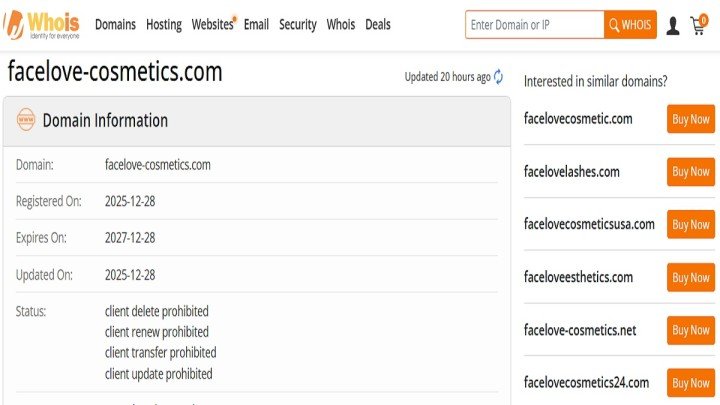
FaceLove Foundation Stick, also promoted as the Changing Foundation Stick, is being marketed as a makeup product designed especially for mature skin. The main selling point is simple: one stick that adapts to the user’s skin tone, gives a natural glow, avoids settling into fine lines, and removes the need to choose a traditional foundation shade. That kind of promise naturally attracts women who are tired of buying the wrong shade online, especially when the product page uses emotional language around confidence, aging, and simplicity. Our investigation found… this is not a case where one single detail proves the product is unsafe or fraudulent. Instead, the risk comes from a collection of signals that buyers should understand before placing an order from facelove-cosmetics com.
The official product page lists the FaceLove Changing Foundation Stick at $39, reduced from $59, and highlights free shipping, skin-tone adaptation, and a 30-day money-back guarantee. It also displays urgency messaging such as “only 7 pieces remain in stock” and a promotion ending at 11:59 PM. Those claims may be normal e-commerce marketing, but they are also common in high-pressure online beauty funnels, so we examined the site more carefully.
What the Product Claims to Do
The product is positioned as a foundation stick for mature and sensitive skin. The page says it offers even coverage, softens the appearance of fine lines, blends quickly, avoids orange or grey tones, and works for “almost all women.” It also lists skincare-style ingredients such as hyaluronic acid, niacinamide, vitamin E, squalane, and Korean Centella. These are recognizable beauty ingredients, but ingredient names alone do not prove performance. In cosmetics, the formula concentration, testing standards, manufacturing source, and shade behavior matter far more than marketing labels.
During testing, we observed… the product page is polished and emotionally persuasive, but it relies heavily on broad before-and-after style claims rather than independent lab evidence, dermatologist testing documents, or a clearly explained shade-matching mechanism. A foundation that “adapts” to skin tone is not impossible, but buyers should ask how it works. Does it use pigment capsules? Is the shade range truly universal? What undertones does it support? Does it perform equally on very fair, deep, olive, red, and golden undertones? The page gives confidence-building language, but not enough technical detail for a cautious buyer.
The Website Behind the Product
FaceLove Foundation Stick is sold through facelove-cosmetics com. The site presents itself as Facelove Cosmetics and says the brand creates beauty products for modern women, especially women who want natural radiance at every age. The website has standard shopping sections, including face, eyes, lips, bundles, contact, shipping, return policy, legal information, and privacy pages. These are positive trust indicators because completely fake stores often lack even basic policy pages.
At the same time, having policy pages does not automatically make a store low-risk. Many questionable e-commerce stores use complete-looking pages copied from templates. The real question is whether the details are clear, consistent, practical, and buyer-friendly. On facelove-cosmetics com, the legal page names Facelove Cosmetics LLC, gives the email as support [at] facelove-cosmetics com, and lists an address at 30 N Gould St, Ste R, Sheridan, WY 82801. The same legal page also states that returns are not accepted at the registered address, which is important for consumers to notice before ordering.
Why the Registered Address Matters
A Wyoming LLC address is not automatically suspicious. Many legitimate businesses use registered agents or business service addresses. Small brands, dropshipping stores, and international sellers often register in U.S. states for legal and tax reasons. But from a consumer protection viewpoint, the address becomes less useful if customers cannot return products there and cannot easily identify the real operating location, warehouse location, or fulfillment partner.
This matters because beauty product disputes usually happen after delivery. A buyer may receive the wrong item, a shade that does not work, damaged packaging, or a product that causes irritation. If the return address is only shared after approval, the buyer has less control. A transparent beauty brand normally explains where returns go, whether the product ships domestically, and how long the refund process takes after inspection. FaceLove gives some of this information in policies, but the “registered address not for returns” note means buyers should not assume the public address is where customer service problems will be solved.
Contact and Customer Support Signals
The contact page says customers can email support [at] facelove-cosmetics com or use the contact form. It also says the customer service team is available daily, with an average response time of 1–2 business days. That is not unreasonable, but for a product with a short cancellation window, the response time becomes relevant. If a customer must cancel within 12 hours, but support may respond in 1–2 business days, the buyer may have difficulty stopping an order once it is placed.
Trickymagazine researchers noticed… this type of timing mismatch is common in modern online shopping complaints. A store may technically provide cancellation rights, but the practical process can be narrow. The shopper sends an email, waits for a response, and later receives a reply saying the order has already been processed. That does not prove bad intent, but it does create buyer frustration. For cosmetic products, where shade and skin compatibility are personal, a narrow cancellation window increases risk.
Return Policy: The Most Important Section for Buyers
The return policy says products can be returned within 30 days of delivery, but they must be unused, in original packaging, and in the same condition as received. It also says customers must contact support, provide order details, explain the reason, and include images if possible. Return shipping is generally the customer’s responsibility unless the return is due to the company’s error. The policy also requires insured shipping with tracking.
The biggest issue is the hygiene restriction. The return policy states that, for hygiene reasons, opened or used products cannot be refunded. This is understandable for cosmetics, but it weakens the value of a “money-back guarantee” for a foundation product. A buyer usually has to open and test foundation to know whether it matches the skin tone. If opened products are excluded, then the guarantee may be less useful than it sounds in the sales section.
This is where consumers should slow down. A 30-day guarantee sounds comforting, but the real question is: “Can I get my money back if the foundation does not match my skin after I try it?” If the answer is unclear or depends on the product being unopened, the buyer should treat the guarantee as limited. This is not unique to FaceLove; many cosmetic brands have hygiene restrictions. Still, the difference between a genuine satisfaction guarantee and an unopened-product return policy is important.
Cancellation Window and Refund Friction
The policy says cancellations must be requested within 12 hours of placing the order. After that, the order may be processed and may no longer be cancelable. It also says digital cancellations through payment providers and doorstep refusals are not eligible for refunds.
From an investigator’s perspective, this is a risk-control clause for the seller, not a strong consumer-friendly promise. It may be legal and common, but it leaves shoppers with little time to reverse an impulse purchase. That matters because the product page uses urgency, discounting, and emotional claims. When urgency-based sales pages are paired with tight cancellation windows, consumers are more likely to buy quickly and regret slowly.
Shipping Claims and Delivery Expectations
The shipping policy says the company offers free shipping within the United States, processes orders in 1–3 business days, and estimates delivery between 2 and 7 business days depending on destination country. It also says shipment-related questions can be sent to the support email and that the team tries to respond within 6–12 hours.
These shipping details are clearer than many risky online stores. Still, buyers should keep screenshots before ordering. Shipping claims often become difficult to prove later if a website changes its policy. Save the product page, checkout page, shipping policy, and return policy on the day of purchase. If a delivery dispute happens, those screenshots can help with a payment dispute.
Sales Pressure: Normal Marketing or Warning Sign?
The product page shows a countdown-style promotion and low-stock message. Many legitimate stores use limited-time sales. The problem is not the existence of a discount. The problem is whether urgency is used to stop consumers from checking the brand properly.
Scammers and low-quality dropshipping sellers often rely on the same psychological pattern: create a beauty insecurity, offer a simple fix, add social proof, show a discount, add low stock, and push the buyer to checkout before they search reviews. A foundation stick for mature skin is a perfect product for that funnel because the pain point is personal. People who have struggled with cakey foundation, visible wrinkles, or shade mismatch may respond emotionally to claims like “made for mature skin” and “adapts perfectly.”
A trustworthy store can use emotional marketing too. The difference is evidence. Strong brands usually support their claims with clear ingredient lists, shade guidance, real customer review systems, third-party retail presence, transparent business identity, and a realistic refund process. If those are weak or incomplete, the sales pressure becomes more concerning.
Social Proof and Testimonials
The FaceLove product page includes multiple testimonials from named customers and claims that more than 50,000 women over 40 love the product. Testimonials are useful only when consumers can verify where they came from. On-page testimonials are controlled by the seller. They may be genuine, curated, imported from another market, or simply marketing copy. Without a review platform, date stamps, verified purchase labels, or independent customer photos that can be checked, they should be treated as promotional claims rather than proof.
This does not mean the testimonials are fake. It means buyers should not rely on them alone. Search for independent reviews outside the seller’s website. Look for customer videos where the product is applied in normal lighting, not just studio lighting. Check whether reviewers disclose sponsorships. Also look for negative reviews because they often reveal practical problems: delivery delays, shade mismatch, return difficulty, product texture, irritation, or customer service response.
Beauty Product Risk: Why Foundation Is Different
A foundation product carries a different type of risk than clothing or electronics. If a dress does not fit, a return is usually straightforward if the policy allows it. Foundation is more complicated because once opened, it may become non-returnable. Skin tone matching is subjective. Sensitive skin reactions are personal. Photos can be misleading because lighting changes everything.
For mature skin, the risk becomes even more specific. A product can look smooth in one influencer video but settle into lines on another person. A “universal” shade can work for some undertones and fail badly for others. A product can feel moisturizing at first but become greasy after several hours. These are not scam issues by themselves, but they are buyer-risk issues. That is why the refund terms matter more than the headline claims.
Common Warning Signs Seen in Similar Beauty Funnels
In our wider review of online beauty offers, several patterns appear again and again. A new or little-known brand uses premium emotional positioning, heavy discounts, limited stock alerts, simple miracle-style claims, and testimonials that cannot be independently verified. The checkout may add shipping insurance, bundles, or upsells. The policy pages may exist, but refunds require unused products, tracking, authorization numbers, and support approval.
FaceLove Foundation Stick shows some of these marketing patterns, especially the urgency and broad skin-adaptation claims. It also has some trust indicators, including visible policy pages, a listed company name, several payment options, and a support email. That is why a balanced verdict is necessary. We cannot call the product or website a confirmed scam based on the available evidence, but we also would not call it a low-risk purchase for everyone.
How Scammers Use Beauty Psychology
Fraudulent beauty sellers understand that people do not only buy makeup; they buy relief. Relief from looking tired. Relief from wasting money on wrong shades. Relief from aging-related frustration. A product aimed at women over 40 can be marketed with warmth and empowerment, but the same emotional angle can also be abused.
The most effective scam-style beauty pages do not look obviously fake. They look clean, modern, and friendly. They use soft colors, confident testimonials, and reassuring policy badges. The trick is not always to steal money directly. Sometimes the model is to sell a low-cost or generic product at a premium price, make returns difficult, and rely on the fact that many disappointed customers will not fight for a refund. That is why consumers should evaluate the business model, not just the website design.
Step-by-Step Verification Before Buying
Start with the product page. Screenshot the price, discount, stock message, guarantee, shipping promise, and ingredient claims. If the site later changes wording, your screenshot protects you.
Next, read the return policy word by word. Do not stop at “30-day guarantee.” Check whether opened products qualify, who pays return shipping, whether a return authorization is required, and how long refunds take.
Then check the business identity. A company name and address are positive, but verify whether the address is a real operating location, a registered agent, or a mailbox-style address. If returns are not accepted there, treat the address as legal registration information rather than customer service protection.
Search independent reviews using the product name plus words like “complaints,” “refund,” “delivery,” “skin reaction,” “shade match,” and “real review.” Ignore reviews that repeat the seller’s wording too closely.
Check social media dates. A brand with recent posts, real comments, and customer interaction is stronger than a brand with only ads. But remember: social media presence can also be built quickly through paid ads.
Finally, use a protected payment method. PayPal or a credit card is safer than debit card payments because disputes are easier if the product never arrives or the seller refuses a valid refund.

Trust Indicators We Found
There are some positive signs. The website has a legal information page, return policy, shipping policy, privacy policy, contact page, and multiple payment options. The product page gives a support email and shows secure payment options such as PayPal, American Express, Apple Pay, Google Pay, Mastercard, Visa, and Shop Pay.
The site also provides a company name and address, which is better than stores that hide everything. It lists shipping timelines and customer support expectations. These details do not guarantee customer satisfaction, but they reduce the risk compared with anonymous one-page stores.
Risk Indicators We Found
The first concern is the gap between the “money-back guarantee” language and the return policy restrictions. A foundation stick usually needs to be opened and tested, but the policy says opened or used products cannot be refunded for hygiene reasons. That can make the guarantee much less useful for real-world shade-match dissatisfaction.
The second concern is urgency-based selling. Low-stock messages and midnight promotion deadlines can push buyers into fast decisions. If the offer appears again after the deadline or if stock messages reset, that would be a stronger warning sign, though consumers should test and document this themselves.
The third concern is limited operational transparency. The site lists a legal address, but returns are not accepted there. Buyers do not see the actual return destination before starting the return process. This is not proof of wrongdoing, but it means the buyer has less information before purchase.
The fourth concern is broad product claims. “Adapts to your skin tone” and “a shade that works for almost all women” are attractive claims, but consumers need proof from diverse skin tones and independent wear tests. Marketing claims are not the same as verified performance.
Situational Examples for Buyers
A buyer with very sensitive skin should be extra careful. Even if the product says it is gentle, every person’s skin reacts differently. Before using any cosmetic product fully, test a small amount on a limited area and wait. If irritation occurs, stop using it and document the reaction with photos.
A buyer purchasing mainly because of the 30-day guarantee should read the return restrictions first. If you need to open and apply the product to know whether it works, confirm with support in writing whether dissatisfaction after testing qualifies for a refund. Do this before ordering.
A buyer who sees a “few pieces left” message should not rush. Open the page later or from another device and see whether the urgency message changes. Real inventory can change, but repeated low-stock pressure is a known sales tactic.
A buyer ordering as a gift should avoid assuming easy returns. Cosmetics are often difficult to return once opened. If the recipient dislikes the shade or texture, the buyer may not qualify for a refund.
Security and Privacy Considerations
The privacy policy says the site collects personal information during purchases, including name, shipping and billing address, email, and phone number. It also mentions marketing emails or text messages with permission and provides opt-out methods.
Consumers should use a separate email for online shopping when possible. Avoid using a debit card on unfamiliar beauty websites. Do not save card details unless you fully trust the store. After purchase, monitor your payment statement, screenshot the order confirmation, and keep all communication inside email instead of only using contact forms.
If a store sends SMS marketing, reply STOP only through the original message thread if it appears legitimate. Do not click random shortened links from messages claiming to be delivery updates. Delivery phishing scams often copy real brand names after a purchase.
Comparison With a Lower-Risk Beauty Purchase
A lower-risk beauty purchase usually has several features: a long-standing brand history, verified customer reviews across independent platforms, clear shade charts, realistic return rules, named manufacturer or distributor details, batch or ingredient transparency, and customer support that can answer specific product questions before purchase.
FaceLove has some store structure, but the buyer still needs to verify the product performance independently. If the same product or similar white color-changing foundation stick appears on marketplaces under different names, compare ingredients, packaging, and price. Sometimes the same formula is sold under many brands with different marketing stories. That does not automatically mean the product is fake, but it may reveal whether the product is unique or simply rebranded. You can read more about WildHarvest Review (2026): Is trywildharvest.com Legit or a Scam?
What To Ask Customer Support Before Ordering
Before buying, send a short email to support [at] facelove-cosmetics com and ask three practical questions. Ask whether opened products can be refunded if the shade does not match. Ask where returns are shipped from and returned to. Ask whether the foundation has a full ingredient list and whether it is suitable for your specific skin concern. The quality of the reply can tell you a lot.
A trustworthy support team should answer clearly, not with vague copy-paste lines. If they avoid the refund question, repeat the guarantee language without explaining exclusions, or pressure you to order quickly, that is a sign to wait.
What To Do If You Already Ordered
If you already placed an order and changed your mind, contact support immediately because the cancellation window is short. Save the cancellation email with timestamp. If the order ships, keep tracking records. When the package arrives, photograph the outside packaging, label, product box, and item condition before opening.
If the item is damaged, wrong, or different from what was advertised, contact support quickly and include photos. If support does not respond or refuses a reasonable request, contact your payment provider. Do not wait too long because chargeback and dispute windows are limited.
If you used the product and had a skin reaction, stop using it, take photos, keep the packaging, and consider medical advice if symptoms are serious. For refund purposes, document everything in writing.
Expert-Style Final Verdict
FaceLove Foundation Stick is not something we can responsibly label as a confirmed scam based only on the public information reviewed. The website has several normal e-commerce elements: product pages, legal information, shipping policy, contact page, privacy policy, and recognizable payment methods. Those are real trust indicators.
But this is also not a risk-free beauty purchase. The biggest concern is the combination of strong marketing claims, urgency-based sales pressure, limited cancellation time, and a return policy that appears to exclude opened or used cosmetic products. For a foundation stick, that restriction matters because the buyer usually cannot judge shade match or skin compatibility without testing it.
Our verdict: FaceLove Foundation Stick should be treated as a moderate-to-high caution purchase, especially for buyers who are relying on the money-back guarantee. If you still want to try it, use PayPal or a credit card, screenshot every policy before checkout, confirm the refund terms with support in writing, and avoid buying multiple units on the first order. A careful single-item test is safer than trusting the sales page completely.