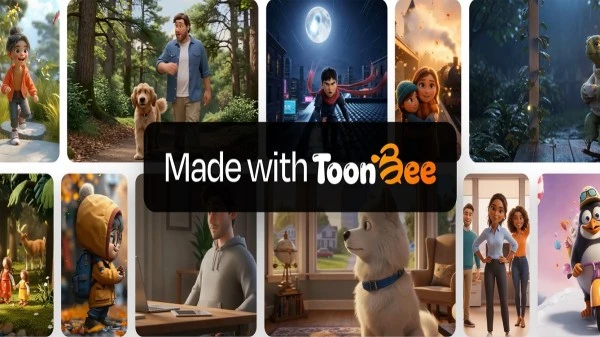
AI video tools are everywhere right now, and many of them use the same style of advertising: “one-time payment,” “lifetime access,” “no monthly fees,” “create videos fast,” and a heavy discount that makes the offer feel urgent. toonbee ai falls into that category. It presents itself as an AI-powered cartoon video generator that can help creators, marketers, educators, and small businesses turn prompts into cartoon-style videos without needing editing experience.
At first glance, toonbee ai does not look like the typical fake shopping website that lists random products, hides payment details, and disappears after collecting orders. It has an actual working product category, public social pages, official terms, a refund policy, and visible customer reviews. But that does not automatically make it risk-free. In digital software, the danger is often more subtle. The problem may not be “will I receive anything?” but “will the product work as I expected, will the lifetime deal really stay useful, and will the refund be as simple as the sales page makes it sound?”
Our investigation found… toonbee ai has both legitimate-looking signs and several caution points that buyers should understand before entering card details. The strongest concerns are not malware or a clearly fake storefront. The concerns are company transparency, refund conditions, aggressive discount language, “unlimited” wording, unclear ownership presentation, and mixed customer feedback around credits and product expectations.
Quick Verdict: Is toonbee ai Legit or Scam?
toonbee ai should not be called a confirmed scam based on the evidence currently available. It appears to be a real AI cartoon video platform offering digital access, and its official pages describe a cloud-based app, support portal, money-back guarantee, and commercial usage rights. The official website says users do not need to install anything and can access the platform from different devices because it is cloud based. It also states that there is no free trial, but users are covered by a money-back guarantee.
That said, we would rate toonbee ai as a high-caution digital purchase, especially for people buying because of the “lifetime,” “unlimited,” or “81% off” style messaging. The site’s own terms explain that “unlimited” does not mean literally infinite use and that heavy users may face soft caps, lower queue priority, cooldowns, feature restrictions, or even account termination under fair-use rules.
Our verdict: toonbee ai looks more like a real but risky AI software offer than a simple fake website. It may be useful for light users who understand AI generation limits, but buyers expecting unlimited high-volume cartoon video generation for one small payment should slow down and read the fine print carefully.
What Is toonbee ai?
toonbee ai is marketed as an AI cartoon video generator or text-to-cartoon-video platform. The idea is simple: you describe a scene or story, and the platform helps generate cartoon-style video content. According to the official terms, ToonBee is an AI-powered platform that allows users to generate custom cartoon videos, animations, and images on demand. The same terms mention access to a pre-generated content library, commercial usage rights, export formats, and customization options.
This type of tool is attractive because video creation is expensive and time-consuming. A small YouTuber, advertiser, teacher, or freelancer may see a “one-time lifetime” AI tool and think it could replace editing software, freelancers, voiceover tools, animation tools, and stock video subscriptions. That is exactly why buyers need to investigate carefully. When an offer promises too much in one package, the real value usually depends on limits that are hidden deeper in the policy pages.
During testing, we observed… the sales-style presentation puts heavy focus on speed, simplicity, discount, and risk-free buying, while the more important limitations are spread across terms, refund rules, and fair-use language. That is common in AI software marketing. The attractive part is shown upfront; the operating limits are explained later.
Company Transparency: A Key Area of Concern
One of the first things we check in any online investigation is who is behind the website. A trustworthy digital product does not always need a huge corporate office, but it should clearly explain the legal operator, support contact, refund process, and business identity.
Here, toonbee ai raises a reasonable transparency concern. The official terms state that ToonBee is “developed and created by Insta App SRL.” But the cookie policy says the site and software are “created and operated by Blaster Online LTD.” This does not automatically prove fraud. Companies may use different entities for development, operations, marketing, or payment processing. Still, for a consumer-facing paid product, this difference should be explained more clearly.
A buyer should not have to guess whether Insta App SRL, Blaster Online LTD, ToonBee, or another payment partner is responsible if something goes wrong. Who handles refunds? Who controls user data? Which legal entity owns the product? Which country’s consumer protection rules apply? These questions matter because digital software disputes often depend on the exact legal seller.
Trickymagazine researchers noticed… the company ownership details are not presented with the level of clarity we like to see from a paid tool asking for online payment. This is not enough to call toonbee ai a scam, but it is enough to place it in a “verify before buying” category.
Website Age and Reputation Signals
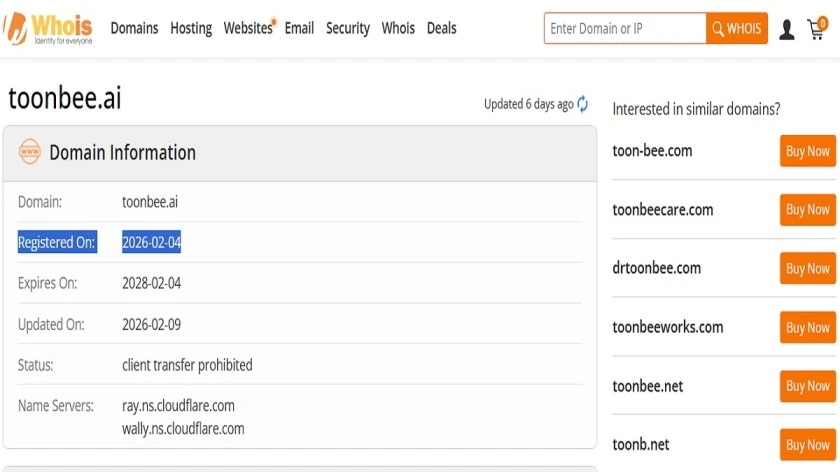
The supplied domain research shows toonbee ai was created on February 4, 2026, making it around five months old as of July 3, 2026. A young website is not automatically suspicious. Many genuine startups launch new domains every month. But when a new domain is selling lifetime access to an AI video tool, the age matters because “lifetime” is only valuable if the company survives long enough to support it.
AI video generation is expensive. Servers, models, storage, support, rendering queues, and constant updates all cost money. A one-time payment model can work if the company has a strong business plan, upsells, fair-use limits, or future pricing tiers. But buyers should understand that lifetime deals from young AI companies carry long-term uncertainty.
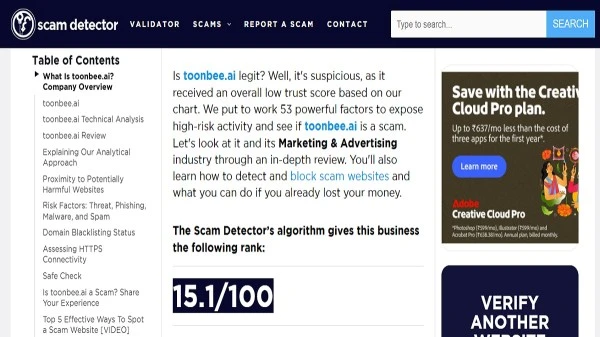
A third-party Gridinsoft report we checked described the site as having mixed positive and cautionary signals, not a confirmed scam, and noted recent registration as one reason long-term trust signals are limited. The same report listed a 63/100 trust score at the time it was checked, while your supplied dataset shows a much lower 15.1/100 score, which means trust-check platforms may be reading the risk profile differently.
When scores differ, we do not rely on one number alone. We look at the pattern. In this case, the pattern is: new domain, paid AI tool, privacy-protected registration, mixed user feedback, aggressive sales wording, and unclear business entity presentation. That combination does not prove a scam, but it does justify caution.
The “Lifetime Access” Claim Needs Careful Reading
The biggest marketing hook around toonbee ai is the lifetime-style offer. The official terms say ToonBee offers a one-time payment for lifetime access and that payments are processed through payment partners. On the surface, this sounds attractive. Pay once, avoid subscriptions, and keep using the tool.
But the same terms include a detailed fair-use policy. That policy says “unlimited” refers to normal individual use, not literally infinite, industrial-scale, automated, or commercially unusual consumption. It also says excessive use may include generation patterns that consume disproportionate compute, storage, bandwidth, queue capacity, or model resources.
This is not unusual for AI tools. The company has a practical reason to prevent abuse. But the risk for consumers is expectation mismatch. A buyer may see “unlimited” and imagine they can generate hundreds or thousands of videos for client work without limits. The terms suggest that is not how the offer should be understood.
The fair-use policy also gives ToonBee the ability to apply soft caps, rate limits, lower queue priority, daily or weekly generation ceilings, temporary cooldowns, feature restrictions, upgrade requirements, or account termination in certain cases. Again, this may be reasonable from a business side, but it weakens the simple “unlimited lifetime” impression.
Our view is simple: if you are a light creator making occasional cartoon videos, the fair-use policy may never affect you. If you are buying this for agency-level output, bulk client work, automation, stock-style content production, or heavy commercial publishing, the “unlimited” wording should not be treated as a blank cheque.
Refund Policy: Better Than Nothing, But Not Fully Risk-Free
toonbee ai advertises a 60-day money-back guarantee. That is a positive trust signal because many risky digital tools either hide refund rules or make all sales final. The official refund page says users can request a refund through the support portal, include purchase details, and receive money back to the original payment method after processing.
But the important part is eligibility. The refund page says refund eligibility is tied to credit usage. If the customer has used less than 50% of allocated credits, they are fully eligible for a refund within the 60-day window. If 50% or more of credits have been used, refunds are no longer available because the product is considered substantially delivered.
This condition is very important. A buyer may see “60-day money-back guarantee” and assume they can test the tool freely for two months. In reality, they must watch credit usage. If the interface does not make credit consumption obvious, users may unintentionally cross the refund threshold while testing.
This is one of the most common patterns in digital product disputes. The sales page sounds broad. The refund page adds conditions. The customer only learns about those conditions after becoming unhappy. That does not mean the seller is fraudulent, but it does mean the buyer must document everything.
Before buying, take screenshots of the sales page, pricing page, checkout page, refund policy, and any credit display. After buying, test slowly. Do not burn through credits in one sitting unless you are already comfortable keeping the product.
Customer Reviews: Mixed, Not Useless, Not Perfect
Trustpilot shows toonbee ai with a 3.8 rating and 79 reviews at the time of our check. The review summary includes positive comments about ease of use, creative output, support, and video generation quality. It also mentions complaints about the credit system, “unlimited” expectations, inconsistent image generation, glitches, lip-sync issues, and some refund/support dissatisfaction. Trustpilot also notes that companies have not invited customers and have not replied to negative reviews.
This mixed profile actually feels realistic. A fake product often has either no reviews, obvious fake praise, or a sudden wave of generic five-star comments. toonbee ai appears to have both happy users and unhappy users. That suggests the product may work for some buyers but disappoint others depending on expectations, prompt quality, chosen plan, add-ons, and credit usage.
The negative patterns matter more than the star rating. For AI tools, complaints usually fall into predictable categories: the demo looks better than real outputs, the base version feels limited, useful features cost extra, credits disappear faster than expected, refunds become harder after usage, and support replies feel scripted. These are not rare problems. They are common across the AI software market.
For consumers, the lesson is not “ignore all positive reviews” or “believe every complaint.” The smart approach is to read the lowest-rated reviews first and ask: would this problem bother me? If the complaint is about lip-sync quality and you need talking cartoon characters for professional client work, that is serious. If the complaint is about a learning curve and you enjoy experimenting with prompts, it may not be a dealbreaker.
Pricing and Upsells: The Real Cost May Be Higher Than the Headline
Your research notes that the checkout showed ToonBee at $67, with add-ons such as a Voice Pack at $37 and a Captions Addon at $27. The website also shows an 81% discount. The official homepage uses urgency-style language, warning that buyers may pay more later and encouraging them to act now with 81% off.
Urgency marketing is not automatically deceptive. Many real software companies use countdowns, limited-time offers, and bundle discounts. But scam-aware consumers should treat heavy discount framing as a signal to slow down, not speed up. A product that is truly useful will still be worth investigating for five extra minutes.
The presence of add-ons also changes the buying decision. If the main offer makes the tool sound complete, but voice, captions, advanced models, or other features require extra purchases, the buyer may feel misled. That does not mean the seller hid everything intentionally. It means buyers should check the full checkout path before paying.
A practical example: someone buying toonbee ai to create YouTube Shorts may need video generation, voice, captions, editing, exports, and enough credits to test multiple prompts. If voice and captions are add-ons, the original $67 price may not represent the real usable cost for that person.
Trust Indicators We Found
There are some positive signals. toonbee ai has an official website with terms, privacy policy, cookie policy, refund policy, and a support portal. The official terms describe commercial usage rights, prohibited uses, content ownership limitations, account rules, and service availability. These are better signs than a thin one-page site with no policies.
The platform also has visible social media links, including Facebook and YouTube pages. A public-facing brand presence can help users verify activity, tutorials, product updates, and customer comments. It is not proof of legitimacy, but it is useful.
The refund policy is more detailed than many questionable digital offers. It explains response time, processing time, bank processing time, access revocation after refund, and the 60-day eligibility conditions. A scam site usually avoids this level of detail or uses copied policy text with no working support route.
The product category itself also makes sense. AI cartoon video generation is a real market, and there are many genuine tools offering prompt-based video, animation, voiceover, and editing features. toonbee ai is not selling a fantasy product that cannot exist. The risk is whether the product quality, limits, and support experience match the sales promise.
Warning Signs and Caution Points
The first caution point is the mismatch between legal entity references. Terms mention Insta App SRL, while the cookie policy mentions Blaster Online LTD. This should be clarified by the company. A consumer should know exactly who is responsible for the sale and user data.
The second caution point is the young domain. A five-month-old AI tool can be legitimate, but it has not had time to build a long public history. Lifetime access from a new platform should always be evaluated carefully.
The third caution point is the “unlimited” language. The terms explain that unlimited use is limited by fair-use rules and not meant for industrial-scale or commercially unusual usage. Buyers who miss this may feel misled later.
The fourth caution point is refund eligibility tied to credit usage. A 60-day guarantee sounds simple, but the less-than-50% credit condition makes it more conditional than many users may expect.
The fifth caution point is mixed customer feedback. Trustpilot shows many positive reviews, but also a meaningful 1-star percentage and complaints around credits, glitches, and refund/support experience.
The sixth caution point is high-pressure discount language. “Act now” and large percentage discounts are designed to reduce careful thinking. That does not prove wrongdoing, but it is a pattern often seen in risky online offers.
Realistic Scam Patterns Related to AI Tools Like This
AI software scams and risky offers usually do not look like old-fashioned fake shopping sites. They often look polished. They use demo videos, social media ads, influencer-style reviews, and screenshots of impressive outputs. The buyer does receive access, but the disappointment begins later.
One pattern is “demo gap.” The public examples look cinematic, but real user outputs require better prompts, more credits, more attempts, or paid add-ons. Another pattern is “lifetime deal anxiety.” A large discount pushes users to buy quickly because they fear the price will rise. A third pattern is “feature fragmentation,” where the basic product is usable but the features customers actually expected are locked behind upsells.
A fourth pattern is “refund friction.” The refund page may look friendly, but eligibility depends on usage, time limits, support ticket categories, order numbers, or internal review. This is why buyers should never rely only on a sales-page sentence. Always read the refund policy itself.
A fifth pattern is “entity confusion.” Multiple company names, payment processors, or policy operators make it harder for users to know who to contact. This is especially important when a buyer wants a chargeback, refund, invoice, tax information, or data deletion.
toonbee ai shows some of these risk patterns, especially around urgency marketing, fair-use limitations, credit-based refunds, and ownership clarity. It also shows real trust indicators, so the correct analysis is balanced rather than extreme.
How to Verify toonbee ai Before Buying
Start with the legal pages. Open the terms, refund policy, privacy policy, and cookie policy. Check whether the same company name appears across all of them. If different names appear, save screenshots.
Next, inspect the checkout. Before entering card details, check the final price, taxes, add-ons, recurring billing language, payment processor name, and whether the page says “subscription,” “one-time,” or “lifetime.” Make sure no optional add-ons are preselected.
Then check the refund terms. Look specifically for the 60-day window, credit usage threshold, support portal process, and processing time. If a refund depends on using less than 50% of credits, decide how you will test the product without crossing that line.
After that, read negative reviews first. Search for patterns like “refund,” “credits,” “voice pack,” “caption addon,” “unlimited,” “lip sync,” “support,” and “quality.” One complaint can be personal frustration. Repeated complaints around the same issue are more meaningful.
Finally, test the support channel before buying if possible. Open the help portal and see whether there is a clear refund request category, response expectation, and knowledge base. If support is only available after purchase, that is not necessarily bad, but it does increase buyer risk. You can read more about SOLUMA Review 2026: Is TrySoluma com Legit or a Scam Website?
Security Recommendations for Buyers
Use a credit card or payment method with dispute protection. Avoid debit cards if you are unsure. Credit cards generally give buyers better options if a digital product is misrepresented or a refund is refused unfairly.
Do not use your main business password when creating an account. Use a unique password and enable any available security features. Since AI tools store prompts, generated content, and account history, do not upload private client information, sensitive business scripts, personal documents, or confidential brand material unless you understand the privacy terms.
Keep screenshots of every promise that influenced your purchase. This includes the discount, lifetime access claim, refund guarantee, feature list, checkout price, and add-ons. If there is a dispute, screenshots are stronger than memory.
Test with low-risk prompts first. Do not immediately use the platform for client deadlines. AI video tools can produce strange artifacts, timing issues, lip-sync problems, or inconsistent character results. Build a small sample project before relying on it professionally.
Watch your credit usage. If the dashboard shows credits or generation limits, check them before and after each test. If no credit meter is visible, ask support how refund eligibility is calculated before generating many videos.
Who May Find toonbee ai Useful?
toonbee ai may be useful for hobby creators, small YouTube channels, marketers testing cartoon-style ads, educators creating simple animated explainers, or freelancers who want quick concept videos. People who enjoy experimenting with prompts may get more value because AI tools often require trial and error.
It may not be the best fit for buyers expecting perfect studio-quality animation, guaranteed character consistency, flawless lip-sync, or unlimited commercial-scale output from one small lifetime payment. It may also be risky for agencies planning to resell high volumes of generated content, because the terms restrict automation, excessive use, account sharing, and bulk redistribution-style usage.
The product should be judged as an AI-assisted creative tool, not a guaranteed replacement for a professional animator, editor, voice artist, and video production team.
Final Expert Verdict: Should You Trust toonbee ai?
Based on the evidence reviewed, toonbee ai is not a confirmed scam. It appears to be a real AI cartoon video platform with official policies, a support portal, public social presence, customer reviews, and a defined refund process. That is enough to separate it from many obvious fake websites.
But it is also not a low-risk purchase. The domain is young, ownership details appear inconsistent across policy pages, the marketing uses strong urgency and discount language, the “unlimited” claim is limited by fair-use rules, and the 60-day refund policy depends on credit usage. Public reviews are mixed, with both satisfied users and complaints about credits, product quality, glitches, and support.
Our final rating: Medium to High Caution. toonbee ai may be legitimate for light creative use, but buyers should not treat the offer as truly unlimited or completely risk-free. Read the fine print, screenshot the checkout, test slowly, protect your payment method, and avoid using more than half of your credits if you may request a refund.
For consumers asking “is toonbee ai legit or scam?” the most honest answer is this: it does not currently look like a simple fake website, but it has enough warning signs that careful verification is necessary before paying. The safest buyer is the one who understands the limits before purchase, not after the refund window becomes complicated.