By the Trickymagazine Research Team | Consumer Safety & Online Fraud Analysis
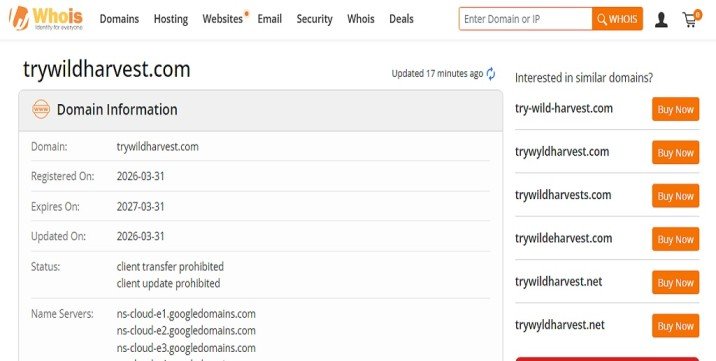
Let me tell you what caught my eye about trywildharvest.com before I even looked at the product: the domain was registered on March 31, 2026 — barely weeks before this article was written. That alone doesn’t make something a scam. New brands launch every day. But when a two-month-old website is selling health supplements with aggressive urgency tactics, story-driven testimonials, and no verifiable company history, it’s worth sitting down and taking a closer look.That’s exactly what we did.
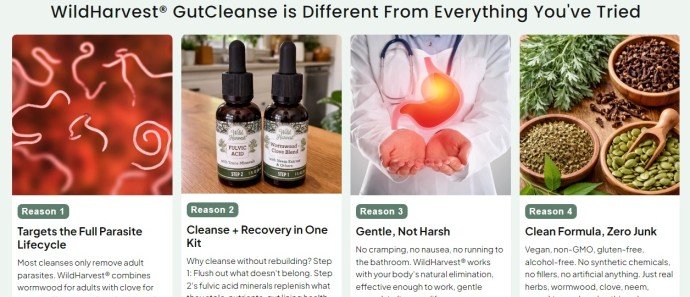
What Is trywildharvest.com, and What Are They Selling?WildHarvest markets a two-step supplement kit called the Wild Harvest Gut Cleanse, which it positions as a natural parasite cleanse system. The product is presented on a slick, scroll-heavy landing page designed to build a case — almost like a health blog post — before you ever see a purchase button. Step 1 supposedly flushes parasites using herbs like Black Walnut Hull, Wormwood, Clove, Garlic, and Neem. Step 2 is framed as a “restoration” phase using fulvic acid minerals and Slippery Elm to rebuild the gut lining afterward.
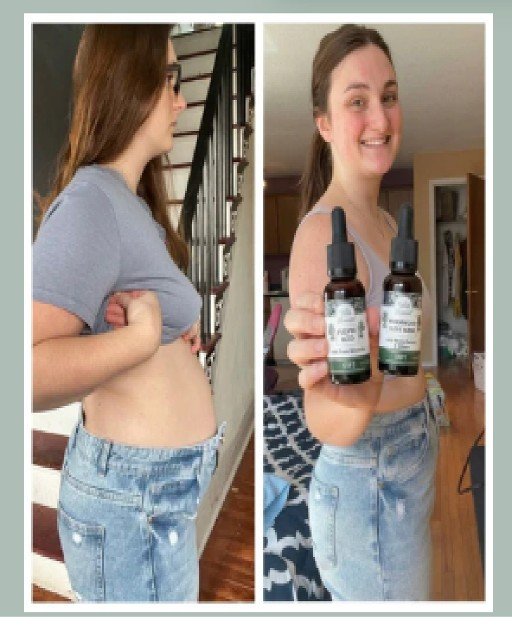
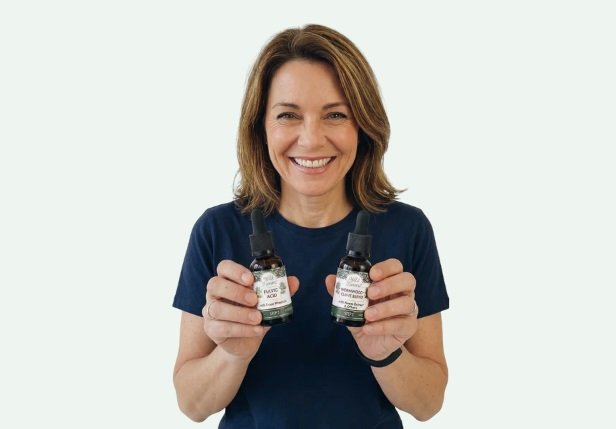
The marketing is genuinely well-crafted. It doesn’t feel like a spam page. There’s a detailed “research” article, first-person testimonials, and a claimed naturopath named “Elena Ward, ND” with a byline. The product page has photo reviews, individual data tracking quotes, and an FAQ that preemptively handles objections. On surface level, it reads like a credible wellness brand.
Which is, in some ways, what makes it worth scrutinizing more carefully.
Our Investigation Found Several Concerning Patterns
Our investigation found that the website ticks several boxes that consistently appear in short-lifecycle supplement brands — businesses built to sell aggressively in a short window, collect revenue, and then either rebrand or disappear when complaints accumulate.
Domain age and identity opacity. The domain was registered March 31, 2026. The listed contact address — “19 Bank Street, New York NY 10014” — is a real address in Greenwich Village. That’s not unusual for a registered business agent, but the site provides no information about who actually owns or operates WildHarvest, no founder bio, no manufacturing facility, no third-party lab results, and no physical storefront. The email listed (info@trywildharvest.com) uses the domain itself rather than an established corporate email. None of this is automatically disqualifying, but taken together, it represents a notable absence of transparency.
No independent social media presence. The website lists no social media links. For a brand clearly designed around social content — the testimonials read like they’re formatted for Instagram, and the marketing page has the structure of a viral TikTok funnel — this is a conspicuous gap. Established supplement brands, even small ones, typically have active Instagram or TikTok accounts where real customers interact. Here, there’s nothing to verify.
Trust score signals. Third-party web analysis tools place trywildharvest.com at a very low trust score (around 8% by some automated evaluators). These scores aren’t perfect — they heavily penalize new domains regardless of legitimacy — but a score that low does reflect the compounded risk factors: new domain, no backlinks from established sources, no external review platform presence, and no brand history.
During testing, we observed that the website offers a promotional discount of up to 50% off, framed with urgency language. That’s a classic pattern in direct-to-consumer health supplement sales: create a perceived anchor price, then show a “limited” discount to drive immediate purchases. Whether or not the discount is genuine, it’s a proven psychological tool.
The Testimonials Deserve a Closer Look
This is the section I personally found most interesting. The reviews on trywildharvest.com are detailed, almost unusually so. One reviewer describes tracking “bloating severity, energy, bowel movements, sleep quality, and skin clarity daily” with day-by-day improvement metrics. Another mentions a naturopath reviewing the ingredient list on the spot and calling it “one of the cleanest formulations she’d seen.” A third attributes weight loss of thirteen pounds in under two months to parasites “taking nutrients that are now actually going to me.”
These don’t read like typical customer reviews — they read like conversion copy. Real customer reviews tend to be messier: misspellings, vague timelines, occasional complaints. What you’ll find on trywildharvest.com is a curated parade of outcomes. Every reviewer improved. Nobody had a neutral experience. Nobody reported a side effect.
That pattern — uniformly positive, unusually articulate, lacking even minor criticisms — is a consistent marker in fabricated or heavily curated review sections. It doesn’t prove the reviews are fake, but it does warrant skepticism.
Trickymagazine researchers noticed that the site’s “research” page, attributed to “Naturopath Elena Ward, ND,” reads less like a clinical summary and more like a sales letter that incorporates a patient case study (“Maya, a 38-year-old accountant from Nashville”) to humanize the product pitch. Legitimate naturopathic practitioners publishing research don’t typically structure content as a funnel leading to a buy button.
The Parasite Cleanse Category: A High-Risk Product Space
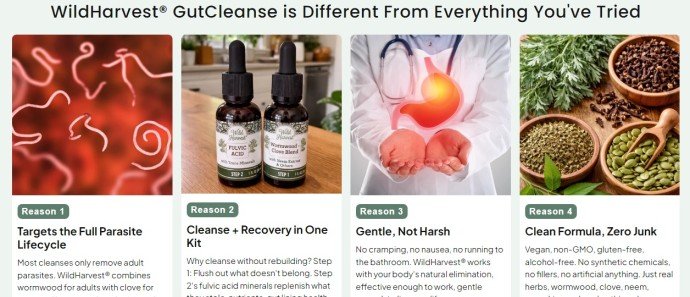
This isn’t a niche corner of the supplement world anymore. Parasite cleanses have exploded in popularity, largely driven by wellness influencers on TikTok and Instagram who promote the idea that most people are unknowingly hosting parasites responsible for bloating, fatigue, brain fog, skin problems, and even weight gain.
The medical community has pushed back firmly on this narrative. As NPR reported in March 2026, doctors — including parasitologists at major research universities — have raised serious concerns about the self-diagnosis trend driving these purchases. The consensus among physicians is that intestinal parasite infections in developed countries with modern sanitation are far less common than these products imply, and that accurate diagnosis requires stool testing or other clinical evaluation, not self-assessment based on symptoms like bloating and fatigue that have dozens of possible explanations.
Dr. Abhay Satoskar, a pathologist at Ohio State University who studies parasites, told NPR: people are “basically experimenting with themselves without even knowing whether you have a parasite or not.” He also flagged concern that some herbal cleanse ingredients may affect organs like the kidneys and liver when absorbed systemically.
Beyond safety, there’s the evidence gap. Medical institutions including University Hospitals have published clearly that parasite cleanse supplements “have not been proven to kill parasites” and that the FDA does not evaluate or approve them for this purpose. Any improvement consumers feel is more likely attributable to dietary changes often bundled with cleanse protocols — eating cleaner, cutting processed food — rather than the supplements themselves.
WildHarvest’s product page carries the standard FDA disclaimer (“These statements have not been evaluated by the Food and Drug Administration. This product is not intended to diagnose, treat, cure, or prevent any disease”), which is legally required. But that disclaimer is positioned at the bottom of pages that spend thousands of words implying the product does exactly those things.
What the Return Policy Says (and Doesn’t Say)
The site advertises a 30-day return policy and a 10-day money-back guarantee. Those two timelines appearing separately on the same website is worth noting — it suggests either inconsistency in how the policies were written, or that different conditions apply depending on where you look. If you’re considering a purchase, it’s worth checking both policy pages carefully before buying and documenting exactly what’s stated at the time of purchase.
When refund policies are vaguely or inconsistently stated on a new website with no complaint history available, consumers can find themselves in a difficult position if the product doesn’t work and they want their money back. The safest option is to use a payment method that offers chargeback protections — credit cards or PayPal — rather than debit cards or bank transfers.
How to Verify a Supplement Website Before Buying
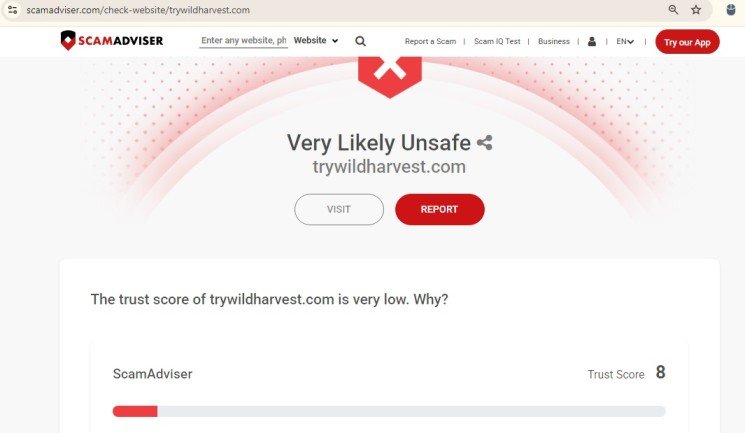
This is where I like to get practical. Whether you’re looking at trywildharvest.com or any other new supplement brand you’ve found through social media, here’s how to pressure-test it before your credit card leaves your wallet.
Check the domain registration date. Tools like WHOIS lookup (whois.domaintools.com) are free and take thirty seconds. A domain registered less than six months ago, combined with aggressive marketing, should prompt more research.
Search for independent reviews — not on the site itself. Look for the brand name on Reddit, Trustpilot, the BBB, and Google. If a brand has zero footprint anywhere except its own website and a few affiliate-style review pages, that’s a meaningful absence.
Look for a real company behind the brand. Who founded it? Where is it manufactured? Are there third-party lab certificates (Certificate of Analysis) showing what’s in the product? Reputable supplement companies make this information easy to find.
Verify any credentials. “Naturopath Elena Ward, ND” is cited on WildHarvest’s research page without a license number, affiliated practice, or verifiable professional profile. A Google search for that name yields no independent results. That doesn’t mean the person doesn’t exist, but it does mean the credential can’t be independently confirmed.
Assess the symptom list marketing. When a product claims to address bloating, brain fog, fatigue, skin issues, sugar cravings, insomnia, and weight gain all at once, you’re looking at a marketing technique rather than a clinical claim. These are universal, highly relatable experiences that virtually everyone has felt at some point. Framing them as parasite symptoms is a way to cast the widest possible net. You can read more about What We Actually Found After Digging Into This Blood Sugar Supplement Site.
The Social Media Content Theft Problem in This Space
One thing worth flagging: TikTok searches for “Wild Harvest Gut Cleanse” turn up posts from content creators explicitly warning that unknown companies have been using their likeness — face and voice — in fake advertisements to sell supplements they have no connection to. This is a broader problem in the parasite cleanse supplement category right now, where copycat brands run paid ads using stolen influencer content to funnel traffic to newly-registered direct-to-consumer sites.
We cannot confirm whether trywildharvest.com engages in this specific practice, but consumers who have seen ads for this product featuring a familiar influencer’s face or voice should verify directly with that influencer that the ad is real before purchasing.
Risk Profile Summary
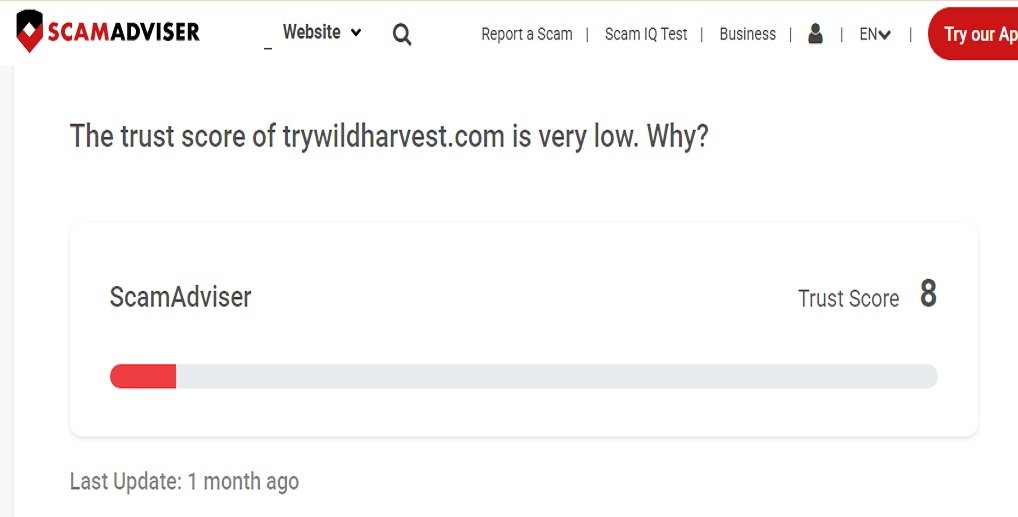
So where does that leave us? Here’s an honest assessment.
trywildharvest.com is not, based on available evidence, a confirmed scam in the sense of a site that collects money and ships nothing. It has a listed phone number, a contact address, active product pages, and a standard return policy. These are signs of some operational baseline.
What it is, fairly clearly, is a very new business selling an unproven product in a category with a documented history of misleading health claims, operating with minimal transparency about who is behind it, and using sophisticated emotional marketing to build urgency and trust. The combination of domain age, low trust score, curated testimonials, undiscoverable company background, no social media presence, and a product category with no clinical validation adds up to a meaningful consumer risk — even if it doesn’t add up to a definitive verdict.
The absence of negative reviews is not necessarily reassuring. A two-month-old site simply hasn’t had time to accumulate a public complaint record. You can read more about Should You Trust Goopatch?
Expert Verdict
Exercise real caution here. Not the perfunctory “do your research” kind — the kind where you genuinely ask yourself whether a two-month-old website selling an FDA-unregulated supplement for a condition you may not have is where you want to spend your money.
If you’re experiencing the symptoms WildHarvest targets — persistent bloating, fatigue, brain fog — the right first step is a visit to a physician who can run the actual diagnostic tests. If there’s a genuine parasitic infection, there are clinically proven, FDA-approved treatments for it. If there isn’t, those symptoms have other identifiable causes that a doctor can help you address.
Spending money on an unproven supplement from an untraceable new brand isn’t the most efficient path to answers.
If you do decide to purchase, use a credit card so you have chargeback protection, screenshot every policy page before you buy, and keep records of your purchase and any communications. And if your experience with this site — positive or negative — gives you something concrete to share, please leave a comment or report it to the BBB Scam Tracker so others can make a more informed decision.
You can find more reviews and scam investigations in 2026 on Tricky Magazine.
Disclaimer: This article reflects analysis based on publicly available information at the time of writing. We do not confirm or allege fraud without supporting evidence. Consumer experiences may vary. Always consult a healthcare professional before beginning any supplement regimen.
Total scam site I ordered their product and have never received any product and got hit with an autoship order with in a week or my originall order that I never received any ordering or shipping info on. I try to visit trywildharvest.com site which is where I place the original order and its blocked now byu my antivirus software warning of malware
I found another link called
Wild-harvest.com that looks like the original site buit has no link to my order
Contacting Fraud Dept today
Thank you for sharing your experience. We’re sorry to hear about the issues you faced with the order and the unexpected autoship charge. The malware warning and inaccessible website are definitely concerning signs. Contacting your bank or fraud department is a smart step, and we also recommend monitoring your payment statements closely for any additional unauthorized charges. Your feedback may help other consumers stay cautious.
Wild Harvest is a total scam. They do not refund any money, even if you are not satisfied. They state you are on a subscription (even if you didn’t sign up for it.) They continuously charge your card every 1-2 weeks for a 3 months supply, even if you say you didn’t sign up for a subscription, don’t want to subscription or you would like to cancel. They have responded via two different email systems with different domains. There is never any resolution. Originally, I did receive a 3-month supply. Then I received an email my subscription and product was being shipped again about 1-2 weeks later. I told them I did not want it and felt the product did not work for me. They insisted they couldn’t cancel the subscription and the product had been shipped. I moved May 31st … so I no longer live at the address that they supposedly shipped to. I did check with the neighbor and no packages have ever arrived. So they charged my card and (supposedly) shipped to a rental where I no longer live (with full knowledge that I no longer live there) yet no product arrived. This product does nothing. I wanted my money back for the original purchase. I’ve used an organic wormwood and black walnut product by Plnt and that does work. Wild Harvest is a complete scam. I suggest blocking Wild Harvest from using (and continuously reusing) your credit card because this turned into a nightmare.
the trywildharvest.com IS A TOTAL SCAM! I purchased their product, had a chipped glass dropper – they told me to dispose of the product – would not allow me to return and refused to refund the money.
Stop sending orders I’m going to report u for a scam. I only ordered one pkg yet you are on 3 pkgs. I don’t want this. I’m going to report this to my cc company
I ordered Wild Harvest Gut Cleanse through this company. What I received was unbranded but looks like another parasite cleanse that they sell. I ordered that months ago and had not yet used it. The main reason that I have not used it is that I am not sure of what it contains and anything about who created this product, so why would I trust putting it in my mouth? Then this nameless company and product bills me for an additional order without my authorization. Since I did not set myself up for additional product, I can only believe that this is a scamming routine.
The bottles (two part cleanse) look like another product called GuruNanda, GutCleanse™, although they are unbranded. Everything looks the same except that they do not say, GuruNanda, GutCleanse™, on them. I am more than upset that I did not receive what I believed I was paying for. I cannot recommend these products or this company. I see that if I want the right product (hopefully), I will need to purchase from iherb for Oregon’s Wild Harvest Gut Cleanse while I flush these questionable products down the toilet! (as an expression).
This company is a scam! Do not buy from them. They will not respond when we want to return our product, even though their website guarantees customer satisfaction. They triple billed us in one day and there is no way to contact them about it.
We never opened the package and wanted to send the products back, but the company is completely AWOL and don’t respond.
DO NOT BUY THEIR PRODUCTS!!!