When a suspicious seller, supposed government official, online investment adviser, tech-support agent, or new internet acquaintance suddenly asks for payment in Bitcoin, USDT, Ethereum, or another cryptocurrency, the payment method itself deserves attention.
That does not mean cryptocurrency is inherently fraudulent. Millions of legitimate transactions involve digital assets, and businesses, investors, developers, and ordinary consumers use cryptocurrency for lawful reasons. The problem appears when someone deliberately steers a victim toward crypto because the payment structure gives the recipient advantages that a credit-card transaction normally would not.
I checked current guidance from the Federal Trade Commission, FBI, Consumer Financial Protection Bureau, and recent U.S. cryptocurrency-fraud investigations while looking into why scammers prefer crypto payments. One theme appears repeatedly: scammers tend to favor methods that move money quickly, reduce the victim’s ability to reverse the transaction, and make the payment feel unfamiliar enough that normal fraud instincts may not kick in until the transfer is complete.
The scale of the problem is no longer small. The FBI said its 2025 Internet Crime Report recorded 181,565 complaints involving cryptocurrency with reported losses exceeding $11 billion. Investment fraud remained one of the largest drivers of those losses.
Those numbers do not prove that cryptocurrency itself causes fraud. They show something more useful for consumers: cryptocurrency has become a very attractive payment rail for people running certain kinds of scams.
Why Scammers Prefer Crypto Payments in the First Place
The simplest explanation is payment finality.
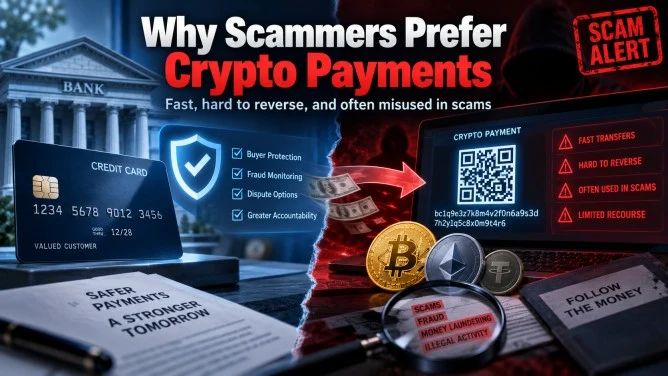
If someone steals your credit-card information or charges you for merchandise that never arrives, the card ecosystem gives you mechanisms for disputing the transaction. There is a bank, payment processor, merchant account, and established dispute process between you and the seller.
Cryptocurrency works differently. The FTC explains that cryptocurrency payments generally do not come with the same protections associated with credit and debit cards, and transfers typically cannot simply be reversed after they have been completed. Getting the money back may depend on the recipient voluntarily returning it, an exchange freezing funds, or law enforcement successfully intervening.
For an honest transaction, that characteristic can simply be part of how the technology works.
For a scammer, it can be extremely useful.
A fraudster does not want a victim calling a card company thirty minutes later and successfully reversing the payment. The scammer wants the financial decision to become difficult to undo as soon as possible.
That is the first major reason crypto appears so frequently in modern fraud.
Crypto Removes the Familiar Chargeback Safety Net
Imagine two suspicious online sellers.
The first accepts Visa. You place a $600 order, receive nothing, contact the merchant, document the dispute, and eventually speak with your credit-card issuer.
The second seller tells you that its “special wholesale price” is available only when you send USDT directly to a wallet address.
Both sellers may disappear after receiving payment. The difference is what happens next.
With the card payment, multiple financial intermediaries remain involved. With the direct cryptocurrency transfer, the recipient may already control the digital assets once the blockchain confirms the transaction.
This distinction matters more than the fact that one payment is “digital” and another uses a card.
The FTC highlighted the issue again in July 2026, saying reported scam losses exceeded $4 billion in the previous year when victims paid through bank transfers and cryptocurrency. The agency warned that scammers commonly push victims toward payment methods that make recovering money difficult.
That is why I would treat an unexplained insistence on cryptocurrency differently from a website merely offering crypto alongside credit cards, PayPal, or other established methods.
Choice matters.
When a legitimate seller gives consumers several normal payment methods and optionally accepts cryptocurrency, the situation requires ordinary due diligence.
When someone says, “Crypto only,” particularly after contacting you unexpectedly, the risk calculation changes substantially.
Speed Works in the Scammer’s Favor
Fraud depends heavily on timing.
The longer a victim thinks, the more opportunities there are to call a family member, Google the company, contact a bank, check a government agency’s real phone number, or recognize inconsistencies in the story.
Scammers therefore manufacture urgency.
Your computer has supposedly been compromised.
Your bank account is allegedly being attacked.
A package is supposedly being held.
A government fine allegedly has to be paid immediately.
An investment window supposedly closes in twenty minutes.
A romantic interest suddenly has an emergency.
The story changes. The objective does not.
The scammer wants the victim to act before independently verifying the claim.
Cryptocurrency fits that behavioral strategy because funds can often be transferred rapidly without waiting for the slower processes consumers normally associate with bank checks, card disputes, or traditional payment arrangements.
The FTC lists pressure to act immediately and demands for payment through cryptocurrency, wire transfers, payment apps, or gift cards among classic scam warning signs. The CFPB gives similar guidance.
From an investigative perspective, the urgency and the payment method should be evaluated together. Either factor alone may have an innocent explanation. When both appear simultaneously, I start asking much harder questions.
A Wallet Address Does Not Look Like a Person
There is another psychological advantage that does not receive as much attention.
A conventional bank payment normally includes recognizable information: a merchant name, bank account holder, business descriptor, payment-service account, or some other human-readable identity.
Cryptocurrency transactions can instead revolve around a long wallet address.
To an experienced investigator, blockchain analyst, or exchange, that address can be meaningful.
To the average consumer, it looks like random characters.
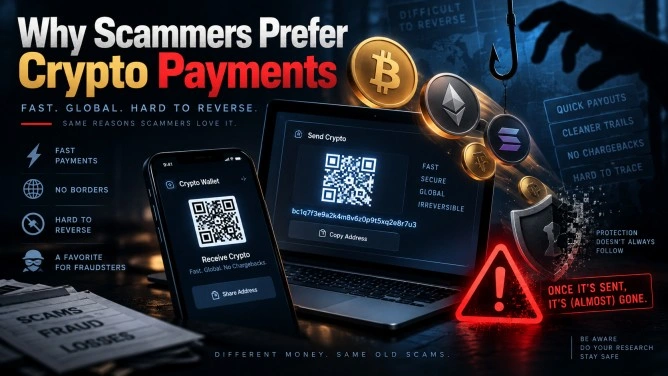
During testing, we observed… that the use of a wallet QR code can make the process feel even more detached. Instead of manually checking a long destination address, the consumer simply scans an image and authorizes the transaction. That convenience is valuable in legitimate cryptocurrency use, but in a scam it can remove another psychological reminder that real money is about to leave the victim’s control.
This is especially noticeable in cryptocurrency ATM scams.
The FTC has documented cases where impersonators remain on the phone while directing victims to withdraw cash, visit a Bitcoin ATM, deposit the cash, and scan a QR code supplied by the scammer. The QR code sends the purchased cryptocurrency to the scammer’s wallet. FTC data previously showed more than $65 million in reported Bitcoin ATM scam losses during just the first half of 2024, with a reported median loss of $10,000.
The QR code makes a technically unfamiliar process surprisingly easy to complete.
That is exactly why it can be dangerous when combined with manipulation.
The Myth That Cryptocurrency Is Completely Anonymous
One point needs correcting because it appears constantly in discussions about crypto fraud.
Cryptocurrency does not automatically make a scammer invisible.
Many blockchain transactions are recorded publicly. Depending on the network, researchers and investigators may be able to see addresses, transaction amounts, movement between wallets, and subsequent transfers. The FTC specifically warns consumers that cryptocurrency transactions are not as anonymous as people sometimes assume.
Recent law-enforcement cases demonstrate the same thing.
In June 2025, the U.S. Department of Justice filed a civil forfeiture action involving more than $225 million in cryptocurrency allegedly connected with investment-fraud laundering. Investigators said blockchain analysis and other techniques were used to connect cryptocurrency addresses with fraudulent activity. In July 2026, authorities announced additional seizures exceeding $25 million in cryptocurrency tied to international fraud investigations.
So saying that scammers choose crypto because it is “untraceable” is too simplistic.
A more accurate explanation is that cryptocurrency can create operational distance between the fraudster and the original victim while making consumer-initiated reversals difficult. Criminal networks may attempt to complicate tracing after receiving funds, but blockchain investigators, exchanges, stablecoin issuers, and law enforcement can sometimes identify, freeze, or seize assets.
Recovery is possible in some cases.
It is simply far from guaranteed.
The Scam Often Begins Long Before Crypto Is Mentioned
Our investigation found… that cryptocurrency frequently appears near the payment stage of a scam rather than at the beginning.
That distinction matters.
A sophisticated scammer does not necessarily message a stranger and say, “Send Bitcoin.”
They first create a reason the victim should trust them.
The FBI describes cryptocurrency investment fraud as a confidence-based process. Victims may initially meet scammers through social media, dating platforms, unexpected text messages, investment groups, advertisements, fake job opportunities, or messaging services such as WhatsApp and Telegram. The relationship develops first. Cryptocurrency enters the conversation later.
This is why judging a scam solely by how professional its website looks can be misleading.
The website may be only one part of the operation.
The real product being manufactured is trust.
Once the target believes the person behind the screen, converting dollars into cryptocurrency can be presented as nothing more than a technical step.
The Fake Investment Platform Pattern
One of the clearest examples involves fraudulent investment platforms.
A person receives a message from someone who appears friendly, knowledgeable, attractive, successful, or professionally connected. Communication continues for days or weeks.
Eventually, investing comes up.
The scammer may tell the victim to open an account at a legitimate cryptocurrency exchange. This detail can lower suspicion because the victim recognizes the exchange.
The victim purchases Bitcoin, Ether, USDT, USDC, or another asset.
Then comes the important part: the cryptocurrency is transferred away from the legitimate exchange and into a wallet or investment platform selected by the scammer.
The fake platform displays profits.
The numbers look impressive.
Sometimes the victim may even be permitted to withdraw a small amount.
That withdrawal is not necessarily evidence that the platform is genuine. The FBI has specifically documented scammers allowing early withdrawals because doing so strengthens trust and encourages much larger deposits later.
Eventually, the victim tries to withdraw a meaningful amount.
Suddenly there is a tax.
Then a verification fee.
Then an account-unlocking fee.
Then an anti-money-laundering deposit.
Each payment supposedly releases the previous money.
It does not.
At this stage, the displayed account balance may be nothing more than numbers controlled by whoever operates the fraudulent website.
The actual cryptocurrency may have been gone since the first transfer.
Relationship Scams Are Particularly Effective
Romance and friendship scams demonstrate why focusing only on technical security misses half the problem.
Strong passwords cannot protect someone who voluntarily authorizes a transaction because they trust the recipient.
Neither can antivirus software.
The SEC warned in 2025 about relationship investment scams in which scammers establish friendships or romantic connections before persuading targets to invest through fraudulent opportunities. The FBI describes similar schemes as confidence-enabled cryptocurrency investment fraud.
The psychological progression is often gradual.
At first, the conversation has nothing to do with money.
Then the person mentions their success trading.
Later, they casually show screenshots.
Eventually, they offer to “teach” the victim.
By the time cryptocurrency is introduced, refusing the investment can feel like distrusting a friend rather than declining a financial transaction.
That emotional framing is deliberate.
The fraud succeeds because the scammer moves the victim from rational verification toward relationship-based decision-making.
Fake Jobs Use Crypto for the Same Reason
Another pattern has grown around remote work.
The supposed employer offers easy online tasks: rating products, optimizing listings, completing orders, clicking through assignments, or helping a business generate activity.
A dashboard displays earnings.
At some point, the worker must deposit their own money to unlock additional tasks or complete a supposedly profitable order.
Crypto becomes the funding mechanism.
The FBI warns that cryptocurrency job scams frequently allow victims to withdraw small earnings early before requiring increasingly large deposits. Eventually, the victim faces a major payment demand and cannot retrieve the money already deposited.
A legitimate employer pays the employee.
When a “job” repeatedly requires the worker to send cryptocurrency to unlock wages or commissions, the arrangement deserves immediate scrutiny.
Recovery Scammers Know Crypto Victims Are Desperate
The fraud may continue even after the original scam ends.
A victim posts online asking whether anyone can recover stolen Bitcoin.
Someone responds.
They claim to be a blockchain investigator, hacker, lawyer, recovery specialist, government agent, or cybersecurity company.
Good news: they have supposedly located the wallet.
Bad news: the victim must first pay a recovery fee.
Usually in cryptocurrency.
This is sometimes called a recovery scam.
The psychology is particularly unpleasant because the second scam exploits someone who has already suffered a financial loss.
The FTC warns that fraudsters may demand upfront “processing,” “administrative,” or recovery fees, while the FBI advises cryptocurrency-investment victims not to pay people claiming they can recover lost funds.
If someone guarantees they can recover stolen cryptocurrency but requires crypto before beginning, I would not treat that promise as evidence of recovery capability.
I would treat it as another transaction requiring independent verification.
Why Stablecoins Can Appear in Scam Payments
Many people associate cryptocurrency scams exclusively with Bitcoin.
That is outdated.
Stablecoins such as USDT and USDC can also appear in fraud cases. Their value is designed to remain relatively stable compared with highly volatile cryptocurrencies, which can make them convenient for legitimate transfers as well as attractive to scammers who do not want payment value changing dramatically during the transaction process.
The FBI specifically lists Bitcoin, Ether, Tether, and USDC among cryptocurrencies victims may be instructed to purchase in investment-fraud schemes.
Consumers therefore should not assume that a payment is safer simply because the requested asset is supposedly backed by dollars or designed to track the U.S. dollar.
The issue is not whether the token’s market value is stable.
The issue is who controls the destination wallet and why you are being asked to send money there.
The Behavioral Pattern Is More Important Than the Coin
Themakerdepot researchers noticed… that the strongest warning signal is often not a particular cryptocurrency but the sequence surrounding the payment request.
Publicly documented cases tend to contain combinations of trust, urgency, secrecy, unusual instructions, controlled communication, and payment finality.
A scammer may insist you remain on the phone.
They may discourage you from speaking with bank staff.
They may tell you to lie if an exchange asks why you are buying cryptocurrency.
They may ask you not to tell family members.
They may say the opportunity disappears if you wait.
They may claim your money needs to be moved to a “safe wallet.”
They may even portray normal fraud warnings from your bank or exchange as evidence that the institution is trying to prevent you from making money.
The FBI says isolation and artificial urgency are common tactics in cryptocurrency investment fraud, and Operation Level Up found that 77% of the victims contacted by the FBI as of December 2025 did not realize they were being scammed.
That statistic says something important about fraud psychology.
Victims are not necessarily ignoring an obvious crime.
Often they are operating inside a carefully constructed explanation in which every warning has already been accounted for by the scammer.
Warning Signs That Deserve Immediate Attention
No single clue proves fraud, but several signals appearing together substantially change the risk.
- Someone who contacted you unexpectedly demands cryptocurrency rather than merely offering it as one optional payment method. They create urgency, insist that you remain on the phone, send a wallet address or QR code, ask you to visit a cryptocurrency ATM, discourage independent verification, promise guaranteed returns, require additional payments to release existing funds, tell you to keep the transaction secret, or ask you to move money into a so-called secure wallet. The risk increases further when the same person controls the investment website, provides the payment instructions, explains how to buy the crypto, and decides whether you are allowed to withdraw it.
The FTC is particularly clear about demands involving government impersonation: legitimate government agencies do not require people to buy cryptocurrency and send it to a wallet to resolve a legal problem or protect money. You can read more about How Fake Receipts and Payment Alerts Trick Sellers.
How I Would Verify a Crypto Payment Request
Step 1: Stop Communicating Through the Channel They Chose
If the caller claims to represent your bank, do not verify the story by calling a number they provided.
If the message supposedly came from an exchange, do not use the link inside the message.
Open the institution’s official website yourself or use the phone number printed on your card or statement.
This simple separation breaks one of the scammer’s biggest advantages: controlling both the problem and the supposed solution.
Step 2: Ask Why Cryptocurrency Is Necessary
This question is surprisingly effective.
Why does the seller refuse credit cards?
Why can the “government investigator” accept Bitcoin but not an official government payment portal?
Why does an employer need money from an employee?
Why does an investment adviser require payment to a personal wallet?
Why must a withdrawal fee be sent to a different cryptocurrency address?
A legitimate explanation should survive ordinary scrutiny.
A scam explanation usually becomes more complicated as you question it.
Step 3: Research the Person and Organization Separately
Search the name plus terms such as “scam,” “complaint,” “fraud,” and “review.”
Check the domain independently.
Look at when it was registered.
Check whether the claimed company name, address, licensing information, executives, and regulatory details can be verified through independent sources.
Do not rely on testimonials appearing on the same website asking for your money.
A polished interface is evidence of web-design capability, not evidence of financial legitimacy.
Step 4: Verify the Investment Through the Appropriate Regulator
If someone is offering investments, determine what entity is actually making the offer and what registration or licensing requirements apply.
Do not accept a screenshot of a certificate as verification.
Go directly to the regulator.
Fake investment platforms frequently borrow the names, branding, or registration information of legitimate businesses.
Step 5: Treat Withdrawal Problems as Evidence, Not a Temporary Glitch
This is one of the most important rules in the entire article.
Suppose you deposited $5,000 and the website now claims the account is worth $13,000.
You request a withdrawal.
Customer service says you need to pay $2,600 in “tax.”
Do not assume the $13,000 exists simply because a dashboard displays it.
Paying another $2,600 may turn a $5,000 loss into a $7,600 loss.
An account balance shown on a website controlled by the recipient is not independent proof that the funds exist.
Crypto Versus Credit Cards: Why Scammers Often Prefer the Former
The difference is not that credit cards are fraud-proof.
They clearly are not.
Card fraud happens every day.
The difference is the consumer-protection architecture surrounding the payment.
Credit-card issuers maintain fraud-detection systems and dispute processes. Merchants usually operate through identifiable payment processors and acquiring institutions. Suspicious transactions may be blocked before completion.
Direct cryptocurrency transfers can remove several of those layers.
That makes personal verification more important.
The FTC specifically recommends paying by credit card when possible because credit cards provide stronger dispute options than payment methods commonly favored by scammers.
For an unfamiliar online merchant, I would therefore consider “credit card accepted” a more consumer-friendly payment characteristic than “send USDT directly to this wallet.”
It does not prove that the seller is legitimate.
It simply means the customer may retain more options if the transaction goes wrong. You can read more about Fake Crypto Casino or Real? (Spoiler: Run)
What to Do If You Already Sent Cryptocurrency
Speed still matters after the payment.
Do not keep paying because someone promises the next transfer will unlock the previous one.
Stop communicating long enough to document what happened.
Save wallet addresses, transaction hashes, QR codes, screenshots, emails, phone numbers, usernames, website addresses, chat histories, payment receipts, and exchange records.
Contact the cryptocurrency exchange or ATM operator used for the transaction immediately and tell them the transfer was connected to suspected fraud. Ask whether the transaction can be stopped, flagged, frozen, or otherwise investigated.
The FTC advises victims to contact the cryptocurrency company they used and request assistance even though crypto payments are typically difficult to reverse. The FBI asks victims to provide transaction dates, amounts, wallet addresses, account details, communication information, and other records when filing an IC3 complaint.
In the United States, reports can be submitted to the FTC through ReportFraud.ftc.gov and to the FBI through IC3.gov. The CFPB also recommends reporting scams to relevant federal, state, and local authorities.
Do not assume reporting is pointless merely because the blockchain transaction is complete.
Recent DOJ investigations show that investigators sometimes trace funds and obtain freezes or seizures. In one 2025 Ohio case, investigators traced stolen cryptocurrency and Tether later froze assets at an identified address before federal seizure proceedings followed.
Recovery cannot be promised, but rapid reporting gives investigators more information to work with.
Legitimate Crypto Payments Do Exist
Balanced scam research requires making this distinction.
A business accepting cryptocurrency is not automatically suspicious.
A freelancer might accept USDC from international clients.
A retailer may offer Bitcoin alongside cards.
A technology company may pay contractors using digital assets.
Two experienced crypto users may intentionally transact wallet-to-wallet.
None of those scenarios automatically indicates fraud.
What concerns me is coercion.
A legitimate merchant generally does not need to frighten you into paying immediately.
A normal business should be able to explain who it is, what you are purchasing, what refund terms apply, and why a particular payment method is being offered.
A legitimate investment should not require a stranger from WhatsApp to control every step.
A genuine employer should not need repeated deposits from the employee.
A real government agency should not instruct you to convert your savings into cryptocurrency and send it to a QR code.
Context separates ordinary cryptocurrency use from a high-risk payment demand.
Trust Indicators I Would Look for Before Paying
I place more weight on verifiable business identity than on website design.
A trustworthy transaction should have a clear legal business name, independently verifiable contact information, transparent pricing, understandable refund or return terms where applicable, and a payment structure that matches the type of business.
For an established retailer, I would also look for ordinary payment alternatives.
For an investment platform, regulatory status matters far more than testimonials.
For a person offering investment advice, identity and authorization need independent verification.
For any business, domain history can provide useful context, although domain age alone proves neither legitimacy nor fraud.
Social media followers, five-star testimonials, celebrity photos, screenshots of profits, countdown timers, SSL certificates, and professionally designed dashboards should never be treated as decisive trust signals.
All of those things can be reproduced.
The Security Lesson Is Bigger Than Cryptocurrency
After examining these cases, I do not think the most useful consumer lesson is “never use crypto.”
That is too broad.
The better lesson is to pay attention when another person tries to control how you move money.
Scammers regularly prefer payment methods that reduce friction for them while reducing recovery options for the victim. Cryptocurrency happens to offer characteristics that fit that goal particularly well in certain fraud scenarios.
That is why the payment request itself can become evidence.
If a stranger first creates fear, then insists you buy Bitcoin, that sequence matters.
If an online friend first establishes trust, then teaches you how to transfer USDT into an investment platform they selected, that sequence matters.
If a website refuses normal payment methods and offers a large discount only for direct cryptocurrency transfers, that deserves investigation.
If someone tells you that cryptocurrency is necessary because banks cannot be trusted, that claim deserves independent verification before money moves.
The point is not to fear technology.
It is to recognize when technology is being used to remove the protections and pauses that might otherwise stop a fraudulent payment.
Final Verdict: Why Crypto Appeals to Scammers
So, why do scammers prefer crypto payments?
The strongest explanation is not complete anonymity, and it is not because every cryptocurrency transaction is inherently dangerous.
Scammers prefer cryptocurrency in many schemes because transfers can be fast, difficult for consumers to reverse, accessible across borders, and easy to initiate with little more than a wallet address or QR code. The unfamiliarity of the process can also give a scammer more control over the victim, especially when the fraudster stays on the phone or provides step-by-step instructions.
At the same time, cryptocurrency leaves records that investigators can sometimes trace. Recent law-enforcement seizures make clear that blockchain transactions are not automatically invisible.
The real danger appears when payment technology is combined with human manipulation.
Urgency.
Trust.
Fear.
Secrecy.
Guaranteed profits.
A supposedly temporary fee.
An unfamiliar wallet.
A QR code.
A promise that everything will be fixed once one final payment is made.
That combination should make any consumer stop before sending money.
If somebody unexpectedly demands cryptocurrency to solve a problem, protect your savings, release investment profits, secure a job, pay a government agency, or recover money previously lost to fraud, verify the story independently before doing anything.
Once the crypto leaves your wallet, discovering the truth five minutes later may be five minutes too late.