UPI has made everyday payments remarkably convenient in India. A shop bill, rent payment, online order, or transfer to a friend can often be completed in seconds. That convenience is one reason fraudsters are interested in UPI as well, but there is an important distinction that tends to get lost in alarming social-media posts: many UPI scams do not involve someone technically breaking into the UPI network. They involve convincing the account holder to approve something they did not fully understand.
I spent time looking at the payment flow, the warnings published by payment authorities, and the patterns that repeatedly appear in reported fraud attempts. What stands out is how ordinary many of these tricks look. A QR code may look perfectly normal. A collect request may appear inside a genuine UPI app. A person claiming to send a refund may know your name and transaction amount. The technology on the screen can be authentic while the story behind the transaction is completely false.
That distinction matters because protecting yourself from scam UPI payment tricks requires more than checking whether you are using a genuine payment app. You need to understand what the transaction is actually asking you to authorize.
NPCI describes UPI as an instant bank-to-bank payment system and states that the UPI PIN is used to authorize bank transactions. NPCI also advises users not to share their UPI PIN, while RBI’s public awareness material warns that receiving money does not require entering a PIN or scanning a QR code sent by someone claiming to pay you.
Why UPI Scams Often Feel Surprisingly Convincing
The best UPI scams usually do not begin with an obviously suspicious message saying, “Send me money.” They begin with a believable reason for interacting with your payment app.
Maybe somebody wants to buy the second-hand phone you listed online. Perhaps a caller says a refund is waiting. Someone claiming to represent a bank tells you your KYC has expired. A supposed customer-care executive offers to reverse a failed transaction. A stranger sends a small amount first to establish trust. In another variation, a merchant’s QR code has allegedly been replaced with somebody else’s payment QR.
The technical details vary, but the behavioral strategy is remarkably consistent. The scammer creates a situation in which opening the UPI app feels like the logical next step. Once you are inside an app you already trust, your suspicion naturally falls.
Our investigation found… the most dangerous moment often occurs after the victim has already accepted the scammer’s explanation. By the time the UPI screen appears, the victim is no longer asking, “Is this person genuine?” They are simply trying to complete the instructions correctly.
That is why looking only for fake apps and fake websites does not provide enough protection. A fraudster may send you a transaction request that appears inside a genuine UPI application. The app can be real, the bank can be real, and the UPI infrastructure can be functioning correctly. The manipulation may exist entirely outside the payment system.
The QR Code Trick: “Scan This to Receive Your Money”
This remains one of the simplest UPI manipulations because many consumers think of QR codes as neutral payment tools. They are not inherently dangerous, but the direction of the payment matters.
Imagine you advertise a used table for ₹6,000. A buyer contacts you and agrees unusually quickly. Rather than asking for your UPI ID, the buyer says he is sending you a “payment QR.” He asks you to scan it and enter your UPI PIN to receive ₹6,000.
That explanation should immediately stop the transaction.
NPCI’s fraud-awareness guidance specifically warns about QR codes and fake cashback schemes, explaining that scanning a QR code and entering a UPI PIN is associated with making a payment rather than receiving one. RBI similarly advises users that receiving money does not require scanning an unknown QR code or entering a PIN or OTP.
There is a simple mental rule I recommend: if someone claims to be paying you, but the process ends with you authorizing a payment using your UPI PIN, examine the screen again before doing anything.
Do not rely on the caller’s explanation of what the screen means. Read the transaction details yourself.
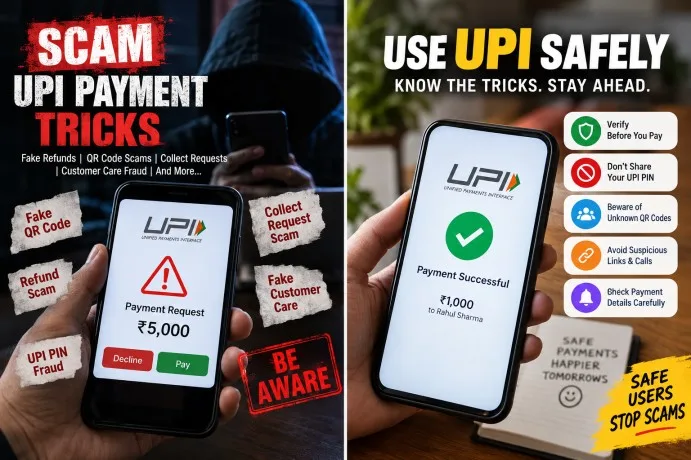
Collect Requests Can Be Legitimate – and That Is Why They Can Be Abused
UPI supports legitimate request-money or collect functions. For example, BHIM allows users to request money through a UPI address, and its transaction section can display pending collect requests.
That legitimate feature creates an opportunity for social engineering.
A fraudster may tell you, “I have credited ₹3,000 to your account. Just approve the request.” What actually arrived may be a request for you to pay ₹3,000.
The distinction can feel embarrassingly obvious when written on a page, but real scams do not happen in quiet laboratory conditions. They happen while somebody is talking continuously on the phone, creating urgency, offering instructions and telling the victim exactly which button to press.
Themakerdepot researchers noticed… that scam narratives frequently redefine familiar payment words. “Approve” gets described as “accept the refund.” “Pay” becomes “verify.” A collect request becomes “receive money.” The language is deliberately chosen to make an outgoing transaction sound like an incoming one.
If an unexpected collect request appears, reject it unless you independently know why it was sent and recognize the requester. BHIM even provides the ability to block or mark users sending illicit collect requests as spam.
Fake Refund and Cashback Payments
A fake refund scam usually begins with good news.
“You are eligible for a ₹1,499 refund.”
“We accidentally charged you twice.”
“You won a cashback reward.”
“We need to return your cancelled order payment.”
That positive framing matters psychologically. People tend to approach unexpected money differently from unexpected bills. Instead of asking why somebody wants money from them, they begin thinking about how to collect what they believe they are owed.
The scammer may then send a link, QR code or payment request and instruct the victim to enter a UPI PIN “to verify the account.” NPCI specifically lists fake cashback links among fraud patterns consumers should watch for.
A legitimate refund normally does not require you to authorize an unrelated outgoing UPI payment to the person supposedly refunding you. If a merchant says a refund has been initiated, verify the refund from the merchant’s official order history, original customer-support channel and your actual bank or UPI transaction history.
Do not verify the claim through a phone number supplied in the suspicious message itself. That simply sends you back into the scammer’s environment.
The Fake UPI Payment Screenshot
This scam usually targets sellers rather than buyers.
The fraudster purchases something in person or through a marketplace, apparently completes the UPI payment, and immediately shows the seller a payment-success screen or sends a screenshot.
The seller sees a familiar payment-app interface, transaction amount and a large success symbol. The product is handed over. Later, the seller discovers that no money arrived.
Screenshots are weak evidence because an image can be edited, recreated, reused from an earlier transaction or presented in a way that hides the relevant details. A seller should verify incoming payment through their own bank account, payment application or genuine merchant notification.
A buyer’s screen tells you what the buyer is showing you. Your own account tells you whether you were actually credited.
This difference becomes particularly important in busy stores, delivery handovers, fuel stations and peer-to-peer sales where employees may instinctively react to the familiar payment-completed sound or green tick.
The “I Sent You Money by Mistake” Trick
This situation deserves slightly more nuance because genuine mistaken transfers do occur.
Someone may contact you saying, “I accidentally sent ₹5,000 to your number. Please return it immediately.”
A small credit may even be visible in your account.
Do not automatically assume the person is a scammer, but do not immediately send money to whatever UPI ID they provide either.
First check your own bank transaction history rather than a screenshot supplied by the caller. Confirm the actual amount, transaction reference and sender details available to you. If the situation is unclear, contact your bank through its official channel and explain that somebody is claiming an erroneous transfer.
The safest response is verification, not confrontation.
A genuine sender should understand why you want the transaction properly confirmed. A person who becomes aggressive, demands payment to a different UPI account, insists you act within minutes or asks you to follow unusual instructions creates additional risk indicators.
Fake Customer Care Is Particularly Effective
Customer-service impersonation works because victims are often already dealing with a real problem.
Perhaps a UPI payment is pending. A refund has not arrived. A food-delivery charge looks incorrect. Someone searches online for customer support and calls the first number they find. Unfortunately, search results, social-media comments and unofficial listings can sometimes expose consumers to impersonators.
NPCI’s fraud-awareness material specifically identifies risks connected with internet searches, social-media grievances and unknown applications. RBI has separately warned about fraud involving people being tricked into opening suspicious links or downloading applications that can expose sensitive information.
The fake support executive may sound professional because the victim supplies most of the information during the conversation.
“What is the transaction amount?”
“₹8,450.”
“When did you make it?”
“About an hour ago.”
“Which bank?”
“HDFC.”
A few minutes later, the scammer seems to know the transaction amount, approximate time and bank — because the victim just told them.
This is one reason perceived knowledge should not be treated as proof of identity.
Screen-Sharing and Remote-Access Scams
Another risky pattern begins when someone claiming to offer technical or payment support asks the consumer to install an unfamiliar app.
The reason may sound harmless: “I need to check why your UPI is not working.”
At that point the situation has moved far beyond ordinary customer support. Remote-access and screen-sharing software can expose information displayed on the phone or allow an attacker to guide the victim through sensitive actions while observing the process.
RBI has previously highlighted fraud involving spurious applications capable of accessing critical information on users’ devices.
A genuine bank employee should not need your UPI PIN. NPCI explicitly says bank customer support will not ask for it.
If somebody claiming to represent a bank or payment service asks you to disclose your PIN, share an OTP, install a remote-control application or transfer money into a “safe account,” end the interaction and contact the institution through the number published in its genuine app, statement or official website.
QR Sticker Replacement at Physical Shops
Not every UPI risk occurs online.
Consider a small store where the owner’s printed UPI QR code is displayed near the counter. If somebody places another QR sticker over the genuine one, customers could potentially direct payments to a different account.
The customer’s phone may still display a perfectly normal UPI payment screen.
This type of situation highlights an important principle: a working QR code is not automatically the correct QR code.
When paying a merchant, check the beneficiary name shown by your UPI app before authorizing the transaction. If the name is completely unrelated to the store or person you expect to pay, ask the merchant before proceeding.
Merchant names are not always identical to storefront names because businesses can operate under different legal entities or proprietorships, so a mismatch does not automatically prove fraud. It is simply a reason to verify.
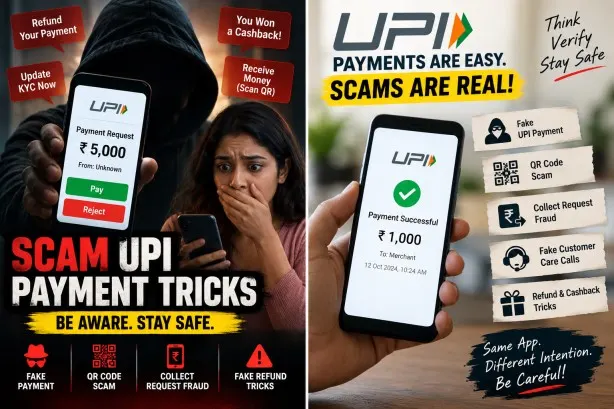
UPI Mandates and Autopay Need a Different Kind of Attention
UPI is no longer limited to simple one-time transfers. It can also support mandates and recurring payments. NPCI explains that UPI AutoPay can be used for recurring obligations such as utility bills, subscriptions, insurance and certain investments.
This matters for scam awareness because consumers should not treat every authorization screen as if it were an ordinary one-time payment.
Before approving a mandate, check who will receive the payment, the maximum amount, frequency and relevant validity information displayed in the app.
A ₹1 verification story deserves particular attention if the screen is actually authorizing something broader than a one-time ₹1 payment.
The correct question is not simply “How much is being charged right now?” It is “What am I giving permission for?”
A Genuine UPI Screen Does Not Make a Stranger Genuine
This is probably the most useful comparison to remember.
| What you see | What it actually proves |
|---|---|
| Genuine UPI app | You are using a real payment application |
| Valid QR code | The code contains payment information |
| UPI ID resolves successfully | A payment address exists |
| Beneficiary name appears | The payment system has resolved recipient information |
| Collect request arrives | Someone has requested money |
| “Success” screenshot from another person | Very little until you independently verify the credit |
| Money visible in your own bank transaction history | Much stronger evidence that funds reached your account |
None of the first five items independently proves that the person talking to you is a genuine buyer, bank representative, seller or customer-care agent.
The transaction layer and the identity layer are separate.
How Scammers Manipulate Otherwise Careful People
Fraud discussions sometimes reduce victims to being “careless.” I do not find that explanation particularly useful.
Good social engineering is designed to temporarily change how a person evaluates risk.
Urgency is one technique. “Your account will be blocked in ten minutes.”
Authority is another. “I am calling from the bank.”
Greed or reward can be used more subtly. “You have received a cashback.”
Fear may be stronger still. “An unauthorized transaction is happening right now.”
Scammers also use commitment. They first ask you to perform harmless actions: open the app, check your balance, confirm your name or read a transaction number. Once you have complied with four small instructions, the fifth instruction — entering a PIN — may not feel like a major change.
During testing, we observed… in a controlled review of the transaction steps documented by NPCI that the final authorization stage is the point consumers should deliberately slow down. The surrounding conversation may be confusing, but the payment screen itself is where the user can re-check who is being paid, how much is involved and what type of authorization is being requested.
That pause is surprisingly powerful.
Step-by-Step Verification Before Approving an Unexpected UPI Transaction
When a payment situation feels unusual, I recommend using the following sequence rather than trying to decide whether the caller “sounds genuine.”
- Stop listening to the caller for a moment and read the UPI screen yourself. Identify whether the app says Pay, Request, Mandate, Autopay or another transaction type. Never let somebody on the phone interpret the payment screen for you.
- Check the direction of money. Ask one simple question: am I supposed to receive money or send money? If you are supposedly receiving money but the screen asks you to authorize a debit, investigate the discrepancy.
- Verify the beneficiary. Look at the displayed recipient or merchant name and UPI ID. A mismatch is not automatic proof of fraud, but it deserves confirmation before payment.
- Check the exact amount. Scammers sometimes rely on hurried reading. ₹9,900 and ₹990 are visually similar when someone is talking rapidly and pressuring you to act.
- Do not enter a UPI PIN merely because someone says it is needed to receive a payment. RBI’s consumer guidance states that entering a PIN or OTP is not required to receive money.
- Verify independently. If the person claims to represent a bank, marketplace or merchant, end the call and contact the organization using its genuine app, official website or number already known to you. Do not use the contact details supplied in the suspicious message.
- Check your own account instead of accepting screenshots as payment evidence. For incoming payments, verify the transaction through your bank or payment app.
- If anything still feels inconsistent, cancel the transaction. A legitimate buyer or business can usually repeat a payment after the confusion has been resolved. Recovering money from an authorized fraudulent payment can be much harder.
Warning Signs I Would Take Seriously
No individual warning sign proves that someone is committing fraud, but combinations matter.
A stranger asking you to scan a QR code in order to receive money is a strong reason to stop. So is a supposed bank employee requesting your PIN, an unexpected collect request paired with a phone call, pressure to install remote-access software, a demand to return money to a different UPI ID, or instructions not to disconnect the call while completing payment steps.
I also pay attention to emotional pressure. Statements such as “Do this in two minutes,” “Don’t tell anyone until the refund is completed,” or “The transaction will fail if you disconnect” are not technical explanations. They are attempts to reduce the time available for independent verification.
Another warning sign is unnecessary complexity. Receiving ₹2,000 should not normally require paying ₹1 first, scanning several codes, installing software, changing security settings and reading OTPs aloud.
When a simple financial action suddenly becomes complicated, ask who benefits from that complexity. You can read more about What the Security Indicator Really Tells You.
Not Every UPI Problem Is Fraud
Balanced scam awareness also means avoiding false alarms.
Payments can fail. Transactions can remain pending. Merchant names can differ from storefront names. A genuine friend can send a collect request. A legitimate subscription can use a mandate. Somebody can genuinely transfer money to the wrong account.
Calling every unusual payment event a scam makes scam education less credible.
The better approach is evidence-based verification.
Look for inconsistencies between what the person says and what the UPI app shows. Verify money through your own account. Check identities independently. Preserve transaction references. Contact your bank through an official channel when something cannot be explained.
That method works whether the situation turns out to be fraud, a genuine error or a normal payment issue. You can read more about How the Scam Works and How to Verify a Payment.
What to Do Immediately If Money Has Already Gone
Speed matters after suspected financial cyber fraud.
First contact your bank or payment provider through its official fraud-reporting channel and report the transaction. Preserve the transaction ID, amount, time, UPI ID, phone numbers, chat messages and screenshots instead of deleting them in frustration.
For cyber financial fraud in India, the National Cyber Crime Reporting Portal directs victims to report immediately through the cybercrime helpline 1930 or through the national cybercrime reporting system.
Do not spend the first hour arguing with the scammer or trying to frighten them into returning the money. Save the evidence and report the transaction.
RBI’s customer-protection framework also makes prompt notification important in cases involving unauthorized electronic banking transactions. The exact liability can depend on circumstances, including whether there was customer negligence and how quickly the bank was informed, so consumers should report an unauthorized transaction as soon as they discover it rather than assuming the money is permanently lost.
If you have already disclosed sensitive credentials, change relevant credentials and speak with your bank about protecting the affected account.
What If the Bank Does Not Resolve the Complaint?
Reporting cybercrime and disputing a banking-service issue are related but different processes.
The first step should generally be raising the issue with your bank or regulated payment provider and keeping the complaint reference.
As of July 1, 2026, RBI’s Integrated Ombudsman Scheme 2026 provides a cost-free alternate grievance-redress mechanism for eligible complaints involving deficiencies in service by regulated entities. RBI states that complaints can be lodged through its Complaint Management System after the applicable complaint requirements have been met.
This should not be confused with calling 1930 after a suspected financial cyber fraud. When money has just been lost to suspected fraud, immediate fraud reporting should be prioritized.
Trust Indicators That Actually Matter
People sometimes focus on weak signals when deciding whether a payment request is safe.
A professional WhatsApp profile photo is weak evidence. So is a company logo, a caller ID name, a polished message, fluent English, knowledge of your first name or a screenshot showing a payment-company interface.
Stronger trust comes from independent verification.
Can you reach the organization through contact details obtained independently? Does the transaction appear in your own bank account? Does the beneficiary shown by the payment app match the person or merchant you intend to pay? Does the transaction type make sense for what you are trying to accomplish?
Good fraud prevention usually comes down to reducing the number of assumptions you make.
Security Habits That Reduce UPI Risk
The most effective security habits are surprisingly ordinary.
Keep your payment app and phone operating system updated. Use a screen lock that other people cannot easily guess. Avoid sharing your phone unlocked with strangers. Never disclose a UPI PIN. Treat unsolicited links and QR codes carefully. Review unexpected mandates and collect requests rather than approving them reflexively.
It is also useful to turn transaction notifications into an active security tool rather than background noise. When a payment alert appears, read it.
If you run a shop, train employees to verify successful payments from the merchant side instead of depending entirely on a customer’s screen. If possible, regularly check that the physical QR displayed at the counter has not been replaced or covered.
Families should discuss these scams too. Fraudsters do not only target people unfamiliar with smartphones. They target anyone who can be rushed, distracted or convinced that an unusual process is normal.
Expert Verdict: The Main Risk Is Misleading Authorization
After examining the common scam UPI payment tricks, I do not think the useful takeaway is that UPI itself should be feared. UPI is a legitimate payment infrastructure with authentication and security controls. The recurring consumer risk is that criminals can use deception around that infrastructure to convince a person to authorize something they did not intend.
The difference is important.
A QR code can be genuine while the story used to persuade you to scan it is false. A collect request can be technically valid while the person sending it is dishonest. A real payment app can display a genuine authorization screen during a fraudulent conversation.
That is why the best defense is not memorizing every scam script. Fraud scripts change quickly. The payment logic changes much less.
If you are receiving money, ask why you are being told to authorize an outgoing payment. If you are paying somebody, verify the recipient and amount. If a stranger claims to represent an institution, independently contact that institution. If somebody tells you that your UPI PIN is needed so they can send you money, stop and reassess the transaction.
Most importantly, do not let another person’s urgency become your urgency.
UPI has made payments fast. Your verification does not have to be.