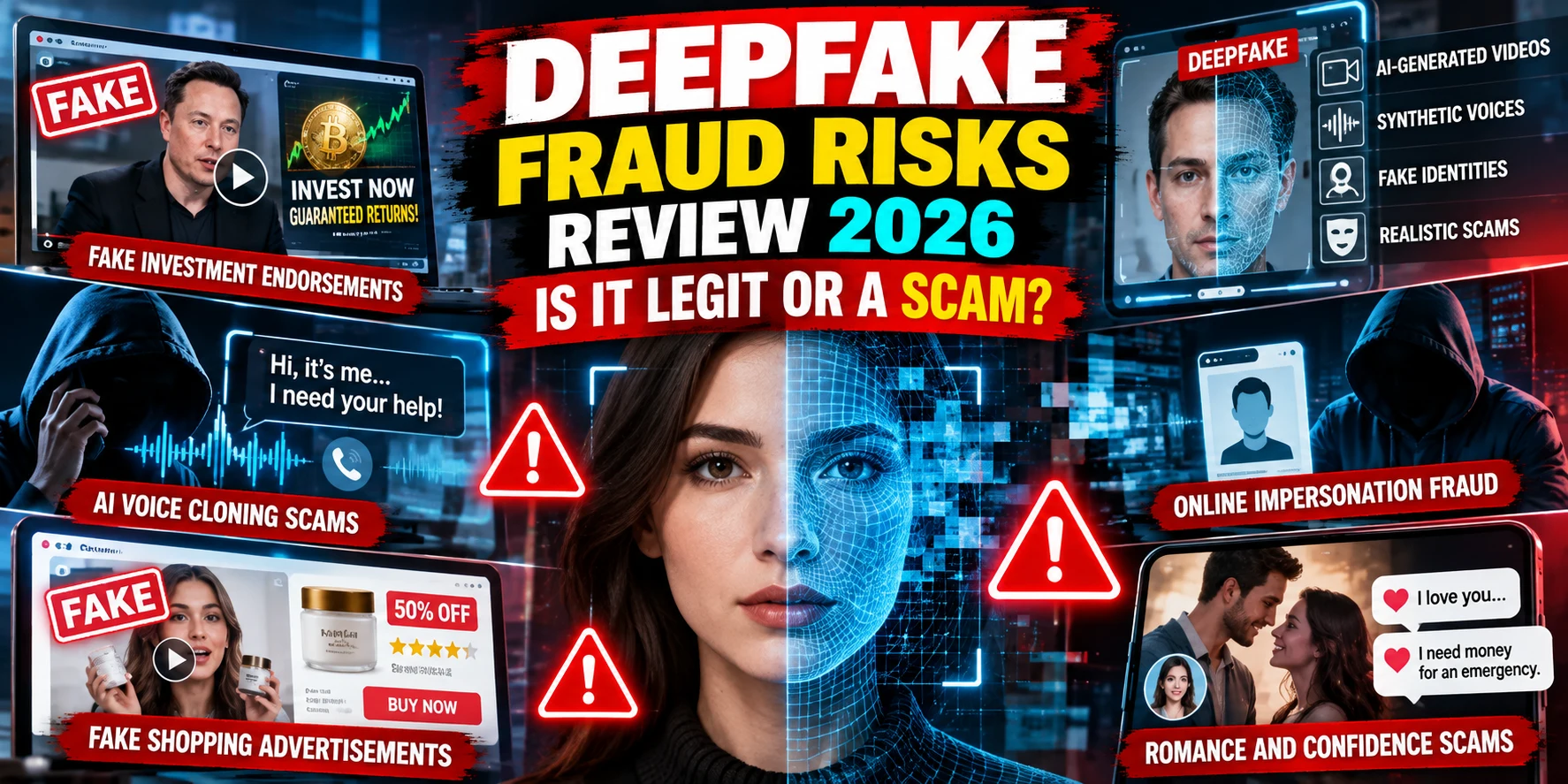
Verdict: Deepfake technology is not inherently a scam, but its use in impersonation, financial fraud, fake online shopping advertisements, and identity deception presents a serious consumer-safety risk in 2026. Artificial intelligence can now generate convincing images, voices, and videos that make fraudulent messages appear to come from trusted people or legitimate businesses. The FBI has identified AI-related complaints among the costly forms of internet-enabled crime, while the Commodity Futures Trading Commission (CFTC) has warned that criminals use AI-generated media and fraudulent websites to deceive consumers. Our assessment is that deepfake-enabled fraud deserves a high-risk rating, particularly when a supposed identity is used to pressure someone into sending money, sharing sensitive information, or trusting an investment opportunity.
This Deepfake Fraud Risks Review 2026 examines how these schemes work, the warning signs consumers should recognize, and the evidence needed to distinguish legitimate uses of AI from deceptive activity. It also explains why familiar faces, realistic voices, professional-looking websites, and apparently authentic video calls are no longer sufficient proof of identity.
Research and update date: October 14, 2026.
Quick Verdict: Deepfake Fraud Risks in 2026
| Review Factor | Findings |
|---|---|
| Subject | Deepfake fraud risks |
| Review year | 2026 |
| Category | AI-enabled impersonation and digital deception |
| Overall risk level | High |
| Editorial risk rating | 4.5/5 for potential consumer harm |
| Is deepfake technology itself a scam? | No. It has legitimate uses as well as potential for abuse |
| Main concerns | Impersonation, fraudulent investment offers, fake advertisements, identity misuse, and social engineering |
| Common techniques | Synthetic images, cloned voices, manipulated videos, and fabricated identities |
| WHOIS and domain age | Not applicable to the category as a whole |
| Trustpilot rating | No single rating applies to deepfake fraud |
| ScamAdviser score | No single score applies to this category |
| Product pricing and shipping | Not applicable to the category as a whole |
| Customer reviews | Must be assessed for each specific service or business |
| Recommended action | Independently verify identity and claims before transferring money or sharing sensitive information |
Important distinction: This article investigates a category of fraud rather than one particular website. There is no single domain, company owner, product catalog, shipping policy, or customer service department to evaluate. Individual websites, advertisements, and services must be assessed separately.
1. What Is Deepfake Fraud?
A deepfake is synthetic or manipulated media created or modified using artificial intelligence. It can make a person appear to say something they never said, show someone performing an action that never occurred, or imitate a person’s voice.
Deepfake technology has legitimate applications in entertainment, education, accessibility, creative production, and other fields. The presence of AI-generated content does not automatically mean that someone is committing fraud.
The problem arises when manipulated media is used to deceive people about identity, evidence, authority, or intent.
For example, a fraudulent advertisement might feature a convincing imitation of a public figure endorsing a financial opportunity. A scammer might use a synthetic voice resembling a family member to request emergency assistance. A fake video meeting could make an apparent business executive seem to authorize a financial transaction.
In each case, the deception depends on the victim believing that the person shown or heard is genuine.
Why the risk matters in 2026
Traditional scams often contain clues such as unusual wording, inconsistent branding, or suspicious contact details. AI-generated media can make some of these clues less obvious.
A fabricated video may look professional. A cloned voice may sound familiar. A fraudulent advertisement may use realistic images and polished language.
These improvements can make deception more persuasive, but they do not make every deepfake convincing or impossible to detect.
Our assessment: Deepfake fraud is a significant risk because it can undermine the visual and audio cues people have traditionally used to judge whether someone is genuine.
2. Deepfake Investment Scams
Investment fraud is one of the most financially damaging areas in which deepfake technology can be used.
A fraudulent promotion may feature an apparently recognizable businessperson, financial expert, celebrity, or public figure discussing an investment opportunity. The video might claim that a particular product has exceptional returns or that an exclusive investment program is available for a limited time.
The individual shown may have no connection to the offer.
How the deception works
A deepfake investment scheme may follow a sequence like this:
- A person sees a polished video promoting an investment.
- The video appears to feature someone who seems credible or familiar.
- The viewer is directed to an unfamiliar website or private contact.
- The supposed adviser promises unusually attractive returns.
- The victim is encouraged to transfer money or provide financial information.
- The operator may display fabricated account balances or supposed profits to encourage further deposits.
Some fraudulent platforms use convincing dashboards to show that an investment is growing. A displayed balance is not proof that the money exists or can be withdrawn.
Warning signs
Be particularly cautious when a promotion includes:
- Guaranteed profits or claims that an investment cannot lose money.
- A famous person’s apparent endorsement without independent confirmation.
- Pressure to deposit funds immediately.
- An unfamiliar platform that cannot be independently verified.
- Requests to transfer money to personal accounts or cryptocurrency wallets.
- Additional payments demanded before a supposed withdrawal can be processed.
- Testimonials that exist only on the promoter’s own website.
A video endorsement is not a substitute for checking the investment itself.
Verdict: Treat investment offers promoted through unfamiliar deepfake videos as unverified until the business, product, and claims have been independently investigated.
3. Voice-Cloning and Family Emergency Scams
Voice-cloning technology can imitate aspects of a person’s voice. In a fraudulent scenario, a scammer may use a synthetic voice to make a phone call sound as though it comes from a relative, friend, colleague, or other trusted person.
The caller might claim to be in trouble and ask for urgent financial help.
The apparent familiarity of the voice can make the request feel genuine, especially when the caller creates a sense of urgency.
What makes these scams persuasive?
People naturally use voice, tone, and speaking style to recognize familiar individuals. A convincing imitation may exploit those instincts.
The caller may also mention information that appears to confirm the identity. Some details could have come from public social media posts, compromised accounts, or information shared elsewhere.
A familiar voice, however, does not prove that the speaker is the person they claim to be.
How to respond safely
If someone unexpectedly requests money because of an emergency, pause before acting.
Contact the person through a separate, previously known phone number or messaging account. If appropriate, ask a question that an impersonator would not easily answer from public information. You can also verify the situation with another trusted family member.
Do not rely solely on a voice message or video call when the request involves a significant financial transfer.
For younger people, an unexpected emergency request involving money should be discussed with a trusted adult before any payment is made.
Verdict: A familiar voice should be treated as one piece of information, not conclusive proof of identity.
4. Deepfake Shopping Advertisements and Fake Online Stores
Deepfake fraud is also relevant to ecommerce because a fabricated endorsement can make an unfamiliar store or product appear trustworthy.
A fraudulent advertisement might show an apparent celebrity, doctor, business owner, or influencer recommending a product. The person may appear to discuss personal experience with the item even though the endorsement was never made. Social Engineering Scams Review
The advertised product could be genuine, misleadingly described, or entirely different from what the advertisement suggests. The use of a deepfake alone does not establish which of these is true.
How an advertisement can mislead shoppers
Consider an unfamiliar website selling electronics, beauty products, home accessories, or health-related products.
Its advertisement might feature a convincing video of a recognizable person praising the product. The video may link directly to a polished checkout page with a large discount and a countdown timer.
A shopper could interpret the apparent endorsement as evidence that the store has been vetted.
But several separate claims need to be verified:
- Is the person actually endorsing the product?
- Does the seller have a verifiable business identity?
- Are the product specifications accurate?
- Is the advertised price realistic?
- Are the shipping and refund policies clear?
- Do independent customers report receiving what they ordered?
A convincing video does not answer these questions.
Ecommerce warning signs
Look for inconsistencies between the advertisement and the website. The business name may differ across pages, the product description may change between listings, or the supposed endorsement may not appear on the person’s verified channels.
Other warning signs include unclear contact information, copied branding, contradictory policies, and payment methods that provide limited protection.
None of these factors alone proves fraud, but several together justify caution.
For a practical store-verification framework, see USPS Phishing Scam
Verdict: Never treat a celebrity-style endorsement or realistic product video as sufficient evidence that an unfamiliar online store is legitimate.
5. Business Impersonation and Fake Executive Videos
Deepfake fraud can target businesses as well as individual consumers.
A scammer may imitate a company executive, supplier, accountant, or other employee to make a request appear authorized. The message may arrive through email, a video meeting, or a messaging platform.
For example, an employee could receive a request that appears to come from a senior manager asking for an urgent payment or a change to supplier bank details.
The request might be accompanied by a convincing voice or video.
Why normal approval procedures matter
A realistic video should not replace a company’s normal financial controls.
Businesses can reduce risk by requiring independent confirmation of unusual payment requests, changes to bank details, and urgent transfers. A second authorized person can verify a request through a previously established contact method.
A familiar face on a screen is not proof that the request originated from the person being imitated.
Warning signs
Be suspicious of requests that combine several of the following:
- Unusual urgency or secrecy.
- A sudden change in payment instructions.
- Requests to bypass established approval procedures.
- New bank details supplied through an unexpected message.
- A refusal to confirm the request through an established channel.
- Instructions to keep the transaction confidential from other staff.
Verdict: Financial requests should be verified through established procedures, even when they appear to come from a familiar executive.
6. Fake Customer Support and Identity Verification
Some fraudulent operations use fabricated images, synthetic voices, or manipulated video to impersonate customer support representatives.
A supposed representative may claim that an account is compromised, a payment has failed, or a refund requires immediate attention.
The person may then request a password, verification code, remote access to a device, or an additional payment.
The deepfake can make the conversation appear more credible, but the underlying goal remains familiar: gaining access to money, information, or an account.
How to distinguish legitimate support from impersonation
If a support representative contacts you unexpectedly, do not automatically trust the identity displayed on screen. Online Typing Job Scams Review
Visit the company’s official website independently or open its established application. Use the contact details provided there rather than a telephone number or link supplied by the unexpected caller.
A genuine support representative should not need you to reveal your password or disclose a one-time security code to them.
Be particularly cautious when someone says that you must install remote-access software to resolve an issue that you did not report.
Verdict: A realistic face or voice does not establish that someone is an authorized representative of a business.
7. Deepfake Romance and Confidence Fraud
Romance and confidence scams rely on trust developed through online communication.
A scammer may use a fabricated profile image, manipulated video, or synthetic voice to appear more credible. The person might gradually establish a relationship before introducing a financial emergency or an investment opportunity.
The victim may believe that video calls or personal images prove the other person’s identity.
Unfortunately, synthetic media can make that assumption unreliable.
Warning signs
Be cautious when an online contact:
- Repeatedly requests money or financial assistance.
- Encourages secrecy about the relationship.
- Introduces an investment opportunity after building trust.
- Requests cryptocurrency or another difficult-to-reverse payment.
- Avoids reasonable independent verification.
- Claims that a payment is needed to release funds or resolve a supposed emergency.
A genuine relationship should not require someone to surrender financial control or make rushed payments.
Verdict: Do not send money to an online contact solely because their photographs, voice messages, or video calls appear convincing.
8. Fake Evidence, Fabricated Testimonials, and Reputation Manipulation
Deepfake media can also be used to manufacture apparent evidence.
A fraudulent seller might present a fabricated testimonial showing a customer praising a product. A misleading advertisement might show an apparent expert discussing a product’s benefits. A fake interview could make an individual appear to endorse a business.
These techniques can create the impression of independent validation when the content is actually controlled by the promoter.
What should shoppers check?
First, look for the same endorsement on the person’s established, independently verified channels.
Second, examine whether the testimonial provides specific details that can be checked. A generic statement about extraordinary results carries little evidentiary weight.
Third, search for independent information about the business and product rather than relying entirely on content supplied by the seller.
Be careful not to assume that every unfamiliar testimonial is fake. Without supporting evidence, it is more accurate to say that the endorsement could not be independently verified.
Verdict: Treat promotional videos as advertising unless independent evidence establishes the authenticity of the endorsement and supports the claims being made.
9. What Do Official Reports Say About AI-Enabled Fraud?
Official reporting helps establish that AI-assisted deception is a genuine concern, but statistics must be interpreted carefully.
The FBI’s 2025 Internet Crime Report, released in April 2026, recorded more than one million complaints to its Internet Crime Complaint Center and nearly $21 billion in reported losses associated with cyber-enabled crime and other internet-related offenses. The report identifies artificial intelligence-related complaints among the costly forms of internet-enabled crime. However, the overall loss figure covers many types of crime and must not be presented as a total for deepfake fraud alone.
The CFTC has separately warned that generative AI makes it easier for criminals to create convincing fake images, voices, videos, social media profiles, and malicious websites designed to resemble legitimate financial platforms.
These findings support three conclusions:
- AI can be used to make fraudulent content more convincing.
- Deepfake-enabled deception is relevant to financial and identity-related fraud.
- Aggregate cybercrime statistics cannot establish the losses caused exclusively by deepfakes.
Research limitation: This article does not claim to have identified every deepfake incident in 2026 or calculated a complete worldwide loss total. We could not independently verify a single comprehensive figure that isolates all deepfake-related fraud across countries and industries.
10. WHOIS, Trustpilot, ScamAdviser, and Website Reputation Checks
Because this is a category review rather than an investigation of a single website, domain and reputation checks must be performed on a case-by-case basis.
| Check | What it can establish | Important limitation |
|---|---|---|
| WHOIS | Domain registration details, registrar, expiry, and sometimes registrant information | Does not prove the operator is honest |
| Domain age | How long a domain has been registered | A new domain is not automatically fraudulent |
| Trustpilot | Public customer feedback about a specific business | Ratings may be incomplete or unrepresentative |
| ScamAdviser | Automated and third-party website risk indicators | A score is not a definitive fraud finding |
| Gridinsoft | Website reputation and security-related indicators | Results should be considered alongside other evidence |
| SSL certificate | Whether a connection uses HTTPS and has a certificate | Does not establish the business’s legitimacy |
| Company information | The operator’s stated identity and business details | Published claims may require independent verification |
| Social media | Public communication and potential official channels | Accounts can be impersonated or manipulated |
| Customer complaints | Reported experiences and potential recurring patterns | Individual allegations may remain unverified |
What looks normal?
AI-generated media can be used legitimately in advertising, entertainment, education, and business communications. A website that uses AI-generated imagery is not automatically suspicious.
Likewise, a company may use automated support, synthetic narration, or digital avatars without intending to deceive customers.
What deserves caution?
A deepfake becomes more concerning when it is used to misrepresent a person’s identity, create a false endorsement, pressure someone into transferring money, or manufacture evidence for an investment or product claim.
What could not be verified?
For the category as a whole, we could not independently verify one domain registration date, one company owner, one Trustpilot score, one ScamAdviser rating, or one customer support record. These details depend on the specific website or service being investigated.
Our conclusion: Reputation tools can help assess an individual website, but the central question in a deepfake investigation is whether the identity and claims being presented can be independently corroborated.
11. Website Security, Payments, Refunds, and Customer Support
Deepfake fraud often directs consumers toward a separate website or payment process. The media used to attract the victim and the destination website should therefore be evaluated separately.
Website security
Check whether the website uses HTTPS, but remember that encrypted connections do not establish the honesty of the operator.
A fraudulent website can use a valid certificate, professional branding, and a polished checkout page.
Payment safety
Be especially cautious when an unfamiliar seller or supposed investment adviser requests cryptocurrency, gift cards, wire transfers, or other payment methods that may be difficult to reverse.
Where appropriate, use a payment method that offers dispute protections. Review the transaction details before confirming payment. Where appropriate, use a payment method that offers dispute protections. Review the transaction details before confirming payment.
Shipping, returns, and refunds
For an individual ecommerce store, read the shipping terms, return window, refund conditions, and any restrictions before purchasing. Facebook Ad Scam Stores Review
If the advertisement promises a product guarantee but the website provides contradictory terms, seek clarification before paying.
For investment platforms or financial services, conventional product-return policies may not apply. The relevant concerns include withdrawal conditions, account restrictions, fees, and the legal identity of the operator.
Customer support
Do not trust a support representative solely because their voice or face appears authentic.
Contact the company through a channel found independently. Avoid sharing passwords, one-time codes, or unnecessary personal information with someone who contacted you unexpectedly.
Verdict: Evaluate the website, payment request, and identity claim separately. A convincing deepfake does not make the destination service legitimate.
12. Pros and Cons of Deepfake Technology
The technology itself has legitimate applications, so it is important to distinguish its potential benefits from the risks associated with deceptive use.
| Potential benefits | Potential risks |
|---|---|
| Creative production and visual effects | Impersonation of real people |
| Educational demonstrations | Fake endorsements |
| Accessibility and synthetic narration | Voice-cloning scams |
| Translation and media localization | Fabricated evidence |
| Digital avatars for communication | Misleading customer testimonials |
| Legitimate simulation and training | Fraudulent investment promotions |
| Automated content production | Greater difficulty assessing authenticity |
The benefits depend on responsible use and appropriate disclosure. The risks increase when synthetic content is used to mislead people about identity or encourage harmful financial decisions.
13. Red Flags: When Should You Suspect Deepfake Fraud?
No single visual or audio clue can reliably identify every deepfake. Some manipulated content is easy to recognize, while some convincing examples may not contain obvious technical errors.
Instead of relying on visual inspection alone, look at the circumstances surrounding the content.
High-risk warning signs
- A familiar person unexpectedly requests money.
- A supposed celebrity promotes an unfamiliar investment.
- A video urges viewers to deposit funds immediately.
- A business representative requests an unusual payment.
- An unfamiliar website promises guaranteed returns.
- A supposed support agent asks for passwords or verification codes.
- A seller uses a dramatic endorsement that cannot be independently confirmed.
- The person discourages you from verifying the request with anyone else.
- The payment must be made quickly or through an irreversible method.
The strongest warning sign is often not how the video looks. It is the behavior being requested.
Practical rule: If the request would be suspicious without the video, the video should not make it trustworthy.
14. How to Protect Yourself From Deepfake Fraud
A few habits can reduce the risk of being deceived.
Verify through a separate channel
If someone claims to be a relative, call them using a number you already know. If a business representative requests payment, contact the business through an independently located official channel.
Do not rely on the contact information supplied in the suspicious message.
Establish a family verification plan
Families can agree on a simple way to verify unexpected emergency requests. This might involve contacting another family member or asking a question that cannot easily be answered using public information.
The purpose is not to rely on a secret phrase alone, but to create a second check before money changes hands.
Investigate product endorsements
If a video features a public figure promoting a product, look for confirmation from that person’s established channels and independent reporting.
Even if the endorsement is genuine, verify the seller and product separately.
Slow down financial decisions
Urgency is a common feature of scams. Take time to research an investment, inspect a website’s policies, and confirm payment instructions.
Do not send money merely because a video appears authentic.
Protect sensitive information
Do not share passwords, verification codes, identity documents, or financial information with an unexpected contact. If an account may have been compromised, secure it through the service’s official channels.
Preserve evidence
If you encounter suspected fraud, keep relevant messages, screenshots, transaction records, and contact details. These may help when reporting the incident to a bank, platform, or appropriate authority.
15. What Should You Do If You Have Been Targeted?
If you believe you have transferred money or shared sensitive information in response to a deepfake scam, act promptly.
If money was sent:
- Contact your bank or payment provider as soon as possible.
- Explain that the transaction may be connected to fraud.
- Ask whether the payment can be stopped, disputed, or recalled.
- Preserve receipts, messages, and transaction details.
- Report the incident to the relevant consumer-protection or law-enforcement authority.
If account information was shared:
- Change affected passwords through the official service.
- Secure your email account and enable multifactor authentication where available.
- Contact the relevant financial institution if payment details may be exposed.
- Review account activity for transactions or changes you do not recognize.
If an impersonator used your image or identity:
- Save the relevant content and record where it appeared.
- Report the impersonation to the platform.
- Contact affected businesses or people through verified channels if necessary.
Be wary of anyone who promises to recover your money for an upfront fee. Fraud victims are sometimes targeted again by people claiming to be recovery specialists.
Recovery depends on the circumstances and is not guaranteed.
16. Final Verdict: Are Deepfake Fraud Risks Legit or a Scam?
Final verdict: Deepfake fraud is a genuine and significant consumer-safety concern in 2026, but deepfake technology itself is not inherently fraudulent.
Official agencies have warned that AI-generated images, voices, videos, and fabricated identities can be used in deceptive financial promotions, impersonation, and other forms of fraud. The available evidence supports treating these schemes seriously, especially when they involve urgent payment requests, unverifiable endorsements, or promises of guaranteed returns.
However, the evidence does not support labeling every AI-generated image, video, or business communication a scam. Legitimate organizations use synthetic media for many purposes, and individual allegations require appropriate verification.
Our final assessment
| Category | Assessment |
|---|---|
| Potential financial harm | High |
| Impersonation risk | High |
| Fake endorsement risk | High |
| Risk from unfamiliar investment offers | High |
| Reliability of visual or audio identity alone | Insufficient |
| Legitimacy of deepfake technology itself | Not inherently fraudulent |
| Recommended response to suspicious requests | Stop and independently verify |
The most important lesson is that realistic media is not the same as reliable evidence.
A familiar voice does not prove that a relative made a call. A convincing executive video does not authorize a payment. A celebrity-style advertisement does not establish that a product or website is trustworthy.
Our recommendation: Verify the person, investigate the claim, and assess the destination website before sending money or sharing sensitive information. When the request is urgent, unusual, or difficult to reverse, pause rather than relying on what you see or hear.
Frequently Asked Questions
1. What is deepfake fraud?
Deepfake fraud occurs when synthetic or manipulated images, audio, or video are used to deceive people about identity, evidence, or intent. It may involve fake endorsements, cloned voices, fabricated business representatives, or fraudulent investment promotions.
2. Are deepfakes always scams?
No. Deepfakes have legitimate uses in entertainment, education, accessibility, and creative production. The concern is deceptive use, especially when synthetic media is used to impersonate someone or obtain money or sensitive information.
3. Can a deepfake video look real?
Yes. Some AI-generated videos can appear convincing, although their quality varies. Visual realism alone cannot establish authenticity, so important claims should be verified through independent sources.
4. How do deepfake investment scams work?
A fraudulent promotion may use an apparently recognizable person to endorse an investment or financial platform. Victims may then be directed to an unfamiliar website and pressured to deposit money based on claims that have not been independently verified.
5. Can someone clone a person’s voice for a scam?
AI tools can imitate aspects of a person’s voice, and criminals may use this capability in impersonation attempts. If a familiar voice unexpectedly requests money, verify the situation through another trusted communication channel.
6. Are deepfake shopping advertisements trustworthy?
Not automatically. A realistic video or apparent celebrity endorsement does not prove that the seller is legitimate or that the product matches the advertisement. Verify the business, product claims, and refund policy independently.
7. Can WHOIS or ScamAdviser detect a deepfake scam?
These tools may help assess a specific website’s domain history or reputation, but they do not reliably establish whether a video or voice recording is authentic. Website checks should be combined with independent identity verification and examination of the underlying claims.
8. What should I do if a deepfake scammer asks for money?
Do not send money until you have independently verified the request. Contact the supposed person or organization through a trusted channel, and speak with a trusted adult if you are unsure how to assess the situation.
9. What if I have already paid a suspected deepfake scammer?
Contact your bank or payment provider promptly and explain what happened. Preserve messages and transaction records, secure any affected accounts, and report the incident to the appropriate authority. A refund or recovery is not guaranteed.
10. How can I protect myself from deepfake fraud in 2026?
Verify identities independently, investigate unfamiliar businesses, avoid rushed financial decisions, and never rely solely on a video or voice recording to authorize a payment. Treat guaranteed returns, requests for secrecy, and unusual payment instructions as serious warning signs.
SEO Details
SEO Title: Deepfake Fraud Risks Review 2026 – Warning Signs and Safety Tips
Meta Description: Explore deepfake fraud risks in 2026, including voice cloning, fake endorsements, investment scams, and impersonation. Learn warning signs and ways to protect yourself.
Suggested URL Slug: deepfake-fraud-risks-review-2026
Primary Keyword: Deepfake fraud risks review
Secondary Keywords:
- Deepfake fraud risks 2026
- Deepfake scams
- Deepfake fraud warning signs
- AI voice cloning scams
- Deepfake investment scams
- Fake celebrity endorsement scams
- AI impersonation fraud
- How to identify deepfake fraud
- Deepfake shopping advertisements
- Protect yourself from deepfake scams
Featured Image Alt Text: Deepfake fraud risks in 2026 illustrating AI-generated faces, voice-cloning scams, fake investment endorsements, online impersonation, and warnings about fraudulent advertisements.
Editorial Note: This article examines deepfake fraud as a category rather than reviewing one particular website. Official reports and consumer-protection advisories support the general risk assessment, but they do not establish that every synthetic image, video, or AI-powered service is fraudulent. Individual websites, endorsements, and allegations should be assessed using independently verifiable evidence.