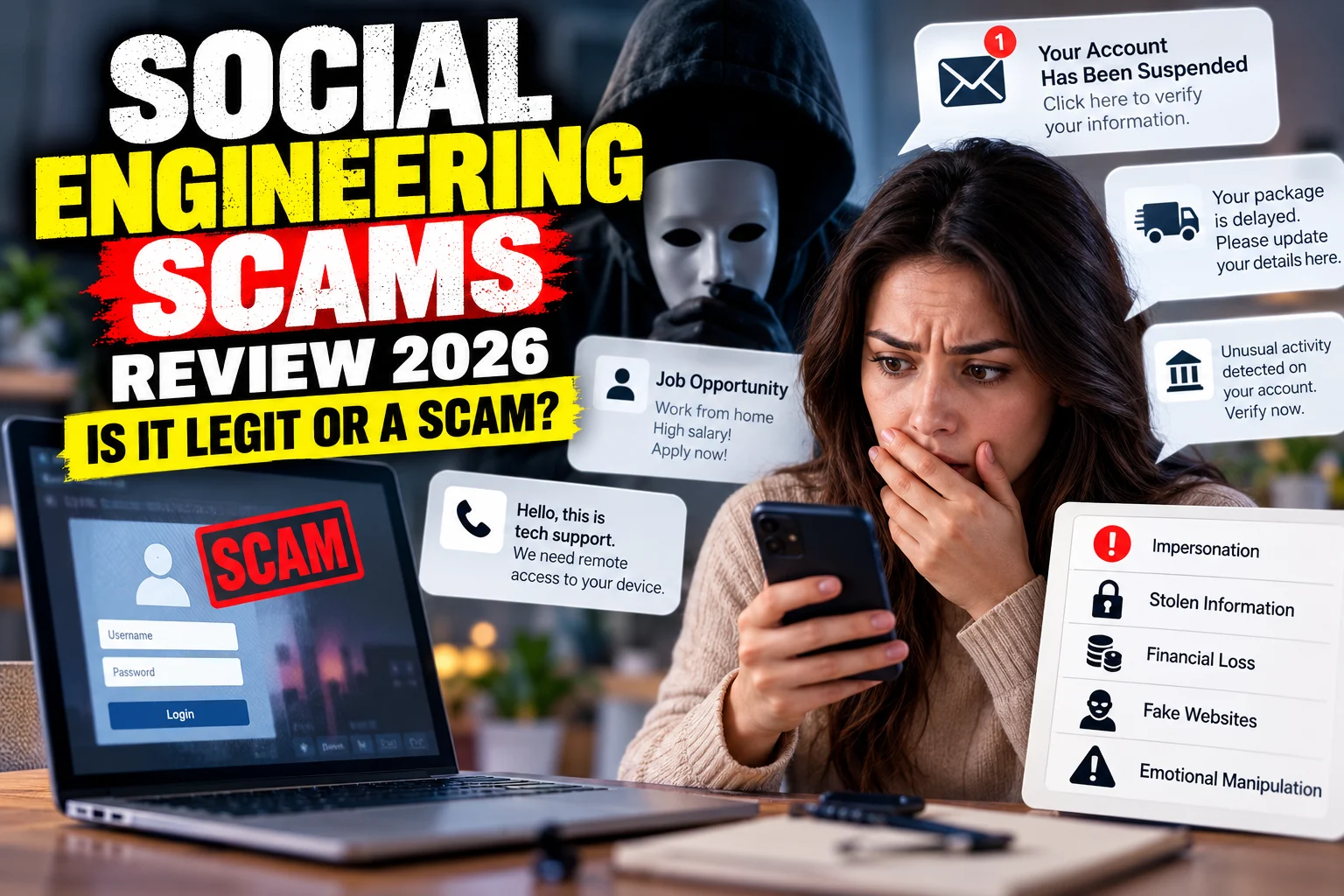
Verdict: Social engineering scams are a documented form of fraud, and the risk to consumers is significant. Unlike scams that depend entirely on malicious software or fake websites, social engineering relies on manipulating people into trusting the wrong person, sharing sensitive information, or making decisions they would otherwise question. Criminals may impersonate banks, delivery companies, employers, technical support agents, government officials, or even people their targets know personally. Our assessment is that social engineering is a high-risk fraud category, although any individual message, website, or interaction must be evaluated on its own evidence.
This investigation examines how these scams work, the warning signs consumers should recognize, and the practical steps that can help prevent financial loss and personal information exposure. It also explains why familiar branding, professional communication, and convincing stories are not reliable proof that a person or organization is genuine.
Research updated: October 9, 2026.
Quick Risk Summary
| Investigation area | Findings |
|---|---|
| Topic reviewed | Social engineering scams |
| Website or domain | Not applicable to the general fraud category |
| Type of activity | Manipulation, impersonation, deception, and information theft |
| Common channels | Email, text messages, phone calls, social media, messaging applications, and websites |
| WHOIS information | Relevant only when investigating a specific domain |
| Trustpilot rating | Not applicable to the category as a whole |
| ScamAdviser and Gridinsoft | Assess individual websites or domains, not social engineering as a general category |
| Main targets | Personal information, account credentials, money, and access to digital accounts |
| Common warning signs | Urgency, secrecy, unexpected requests, impersonation, and unusual payment demands |
| Overall risk assessment | High |
| Is every unexpected message fraudulent? | No; individual communications require verification |
| Recommended approach | Verify identities independently and never let pressure replace judgment |
What Are Social Engineering Scams?
Social engineering is a method of manipulating someone into taking an action that benefits the person attempting the deception.
Instead of relying exclusively on technical vulnerabilities, the scammer tries to influence the target’s decisions. The approach may involve fear, authority, curiosity, sympathy, excitement, or the promise of an attractive opportunity.
For example, someone might receive a message claiming that their bank account requires urgent attention. The sender may use the bank’s logo, copy its usual writing style, and include a link to a page that resembles the real service.
The message is designed to make the recipient act before checking whether the request is genuine.
Other approaches involve impersonating a family member, pretending to offer customer support, sending a fake delivery notification, or claiming that an online account has been compromised.
The FBI identifies phishing and spoofing as important components of fraud. These techniques can be used to obtain sensitive information, persuade people to visit deceptive websites, or convince them to transfer money.
The important distinction is that social engineering describes a method of deception, not one specific website or company. A responsible review therefore examines the fraud category and its documented characteristics rather than assigning a single domain rating to it.
How We Investigated Social Engineering Scams
Our assessment focused on recognized fraud patterns and the practical risks they create for consumers.
We considered the following questions:
- How do scammers establish trust with an unfamiliar person?
- What types of organizations are commonly impersonated?
- How can deceptive messages lead to financial loss or information exposure?
- What evidence can help distinguish a legitimate request from a suspicious one?
- Which website and business checks are useful when an interaction involves an unfamiliar online store?
- What should someone do after sharing information or sending money?
- Which precautions reduce the likelihood of becoming a target?
We also distinguished established fraud techniques from assumptions about individual incidents.
For example, an urgent message from an unfamiliar number may be suspicious, but that alone does not prove who sent it. A website with hidden ownership may warrant additional scrutiny, but privacy protection does not establish fraudulent intent. Similarly, a person who claims to work for a bank may be genuine, but their identity should be verified before sensitive information is shared.
These distinctions matter because effective consumer protection requires careful verification rather than automatic trust or automatic suspicion.
How Social Engineering Scams Work
Most social engineering scams follow a recognizable pattern, even when the story changes.
1. The Scammer Establishes Contact
The interaction may begin through a phone call, email, text message, social media account, online advertisement, or message sent through a familiar platform.
Sometimes the recipient has never interacted with the sender. In other cases, the message appears within an existing conversation or comes from an account that has been impersonated or compromised.
2. The Scammer Creates a Convincing Story
The sender claims there is a problem, opportunity, or urgent task requiring attention.
Common themes include:
- A suspicious payment that needs verification.
- A parcel that supposedly cannot be delivered.
- A job offer requiring immediate action.
- A relative who claims to need urgent assistance.
- A technical problem that supposedly threatens an account.
- An unexpected prize or refund.
- A warning that personal information has been exposed.
The story is designed to make the requested action seem reasonable.
3. The Scammer Applies Pressure
The sender may insist that the recipient act immediately, keep the conversation secret, or avoid contacting other people.
Pressure reduces the time available to check details. A person who feels frightened or excited may be more likely to accept an explanation without independently verifying it.
4. The Scammer Requests Something Valuable
The request may involve money, account credentials, personal details, verification codes, or access to a device.
In some cases, the immediate request seems harmless. The person may be asked to confirm an email address or complete a basic form. That information can then be used in further attempts to gain trust or access accounts.
5. The Scammer Exploits the Information or Trust
The consequences vary. A victim may experience an unauthorized transaction, account takeover, identity misuse, or further deceptive contact.
Not every attempt succeeds, and not every suspicious message results in financial loss. The risk arises when the recipient acts on a deceptive request without confirming its legitimacy.
Common Types of Social Engineering Scams
Phishing Emails
Phishing emails imitate organizations or people the recipient may trust.
A message might claim that a payment has failed, an account needs verification, or a security problem requires immediate attention. It may include a link to a deceptive website or an attachment that should not be opened.
Warning signs include unexpected requests for sensitive information, unfamiliar sender addresses, mismatched website names, and pressure to act immediately.
A professional design does not prove authenticity. Scammers can copy logos and imitate the appearance of legitimate organizations. (Refund Scams Explained: How Fake Refunds and Recovery Schemes Really Work)
Text Message Scams
Text messages can impersonate delivery companies, financial institutions, online retailers, or public agencies.
Some claim that a parcel requires an additional payment. Others warn of suspicious activity or ask the recipient to confirm account details.
A message may include a link that leads to a page requesting personal or payment information.
If you receive an unexpected message about an account or delivery, check it through the organization’s established website or application. Do not assume that a message is genuine because it contains a familiar brand name.
Phone Impersonation Scams
In these scams, a caller pretends to represent a bank, government agency, technical support provider, or another organization.
The caller may sound professional and know some details about the person they are contacting. That information may have been obtained from public sources, previous interactions, or exposed data.
A caller might claim that money is at risk and insist that the recipient follow instructions immediately.
Be especially cautious when someone asks for passwords, security codes, or an unexpected payment. End the conversation and contact the organization through a trusted channel if you need to check the claim.
Fake Customer Support
Some scammers pose as representatives offering to resolve a technical problem, process a refund, or recover access to an account.
They may claim that a device is infected, a payment has failed, or an account requires urgent attention.
The interaction becomes particularly concerning when the supposed representative requests remote access to a device, asks for payment before explaining the service, or requests sensitive information through an unverified channel.
A legitimate support process should be verifiable. An unexpected caller should not be allowed to take control of a device simply because they claim to be helping.
Social Media Impersonation
Social media provides opportunities for scammers to imitate real people, businesses, and public figures.
An account may use a familiar photograph or a similar username. A message might appear to come from a friend, a company representative, or someone offering assistance.
The account’s appearance is not enough to establish identity.
If a friend unexpectedly asks for money or sensitive information, verify the request through another established method. If a business account offers an unusual deal, check the company’s official channels before acting.
The Federal Trade Commission reported in April 2026 that nearly 30% of people who reported losing money to a scam said it began on social media in 2025. Reported losses associated with these scams reached $2.1 billion. These figures concern reported social-media scams broadly, not social engineering alone, but they demonstrate why unfamiliar online interactions deserve careful scrutiny. The FTC’s findings are available in its report on social-media scam losses.
Business Email Compromise
Business email compromise involves deceptive messages that manipulate employees or organizations into disclosing information or transferring money.
A message may appear to come from a manager, supplier, colleague, or business partner. The sender might request an urgent payment, announce a change in bank details, or ask for confidential documents.
The request can be especially convincing when it refers to an existing business relationship.
Organizations should independently verify unexpected payment instructions and changes to account details. A familiar email thread is not sufficient proof that the latest message is genuine.
Fake Job and Recruitment Messages
Some employment scams begin with an unexpected message offering an attractive remote position.
The sender may claim that the job requires little experience and offers unusually favorable conditions. After establishing trust, the scammer may request personal information, upfront payments, or money for supposed equipment and training.
A legitimate employer may need identifying information at an appropriate stage of hiring, but applicants should verify the organization and the vacancy before sharing sensitive details.
Be wary of pressure to pay money simply to obtain a job.
WHOIS and Domain Investigation: What Applies Here?
Because social engineering scams are a category of fraudulent behavior rather than one website, there is no single domain registration record to investigate.
WHOIS information becomes relevant when a particular website, such as a suspicious online store or an imitation login page, is involved.
The following table explains what domain information can contribute to an investigation.
| Domain factor | Why it matters | What it cannot prove |
|---|---|---|
| Registration date | Shows when the domain was registered | A new domain is not automatically fraudulent |
| Registrar | Identifies the domain’s registration provider | A reputable registrar does not guarantee an honest website |
| Expiration date | Provides information about the registration period | A normal expiration date does not prove legitimacy |
| Privacy protection | Indicates whether public registration details are concealed | Privacy protection is not proof of fraud |
| Historical records | May reveal changes in ownership or domain use | Historical information may be incomplete |
| Hosting information | Helps identify the technical infrastructure supporting a website | Hosting location does not independently identify the scammer |
When investigating a suspicious website, compare its domain information with the claims made by the business.
For example, a website claiming a long operating history while using a recently registered domain may deserve further investigation. But there could be a legitimate explanation, such as a new domain for an existing company.
The domain should be assessed alongside the website’s contact information, policies, independent reputation, and the specific behavior that raised concern.
Website Security and Reputation Checks
A website’s technical security can provide useful information, but no single indicator establishes that an organization is trustworthy.
Is HTTPS Enough?
No. HTTPS helps encrypt information transmitted between a browser and a website.
It does not prove that the website operator is honest, that a retailer will deliver an order, or that the organization will handle submitted information responsibly.
A deceptive website can also have a valid security certificate.
When assessing an unfamiliar site, consider its domain name, business identity, contact details, privacy policy, and the nature of any information request.
What About ScamAdviser and Gridinsoft?
ScamAdviser and Gridinsoft provide assessments of individual websites or domains. Depending on the service and available evidence, these assessments may consider technical characteristics, reputation signals, or other information.
They do not provide one universal rating for social engineering scams as a category.
A warning from a reputation service can justify additional investigation, but an automated score is not definitive proof of fraud. A favorable score also does not guarantee that a website is safe.
Does Trustpilot Help?
Trustpilot hosts reviews of individual businesses. Customer feedback may help identify recurring concerns about delivery, customer service, billing, or other experiences.
However, reviews should be evaluated carefully. A review does not automatically establish that every detail of an account is accurate, and a lack of reviews does not prove that a business is fraudulent.
For a specific website, consider the number and timing of reviews, the range of experiences, and whether the business responds to complaints.
What Looks Normal, What Deserves Caution, and What Could Not Be Verified?
| Observation | Assessment | Explanation |
|---|---|---|
| An organization asks for a delivery address during checkout | Usually normal | The information may be needed to deliver a physical order |
| A bank sends an account notification | Possible legitimate activity | Verify the notification independently if it is unexpected |
| A website uses HTTPS | Positive technical signal | It does not establish the operator’s honesty |
| A domain was recently registered | Requires context | New businesses can be legitimate |
| A caller demands immediate payment to protect money | Strong warning sign | The request may be designed to prevent independent verification |
| A message requests a password or security code | Strong warning sign | The request may enable unauthorized account access |
| A business has no relevant Trustpilot profile | Inconclusive | It may be new, small, or not actively reviewed |
| A reputation service gives a low score | Requires further investigation | Automated systems can produce false positives |
| A person reports an unauthorized transaction | Requires case-specific assessment | The transaction and circumstances need to be investigated |
| A supposed official asks for secrecy and an unusual payment | Strong warning sign | Legitimate processes should be independently verifiable |
No specific website or incident was provided for this review. Therefore, we could not independently verify a particular domain’s registration details, customer complaints, payment methods, business registration, or refund history.
Those details should be checked individually whenever a specific business is under investigation.
Red Flags That Deserve Attention
Several warning signs are particularly relevant when someone contacts you unexpectedly.
Urgency: The sender insists that you act immediately and discourages you from checking the request.
Secrecy: The person asks you not to discuss the matter with family, colleagues, your bank, or other trusted contacts.
Unverified identity: The person claims to represent a familiar organization but cannot be confirmed through an independent channel.
Unexpected requests for sensitive information: The sender asks for passwords, verification codes, or personal details without a clear and verifiable reason.
Unusual payment demands: The person insists on a payment method or transaction process that does not fit the stated purpose.
Suspicious links: The message directs you to an unfamiliar website or a domain that does not match the organization being impersonated.
Pressure to install software: Someone claiming to offer technical assistance asks for remote access to your device without a verified reason.
Conflicting information: The sender’s identity, contact details, or explanation changes when you ask questions.
One warning sign does not always prove fraud. Several appearing together, especially alongside pressure to act quickly, should prompt you to stop and verify the request independently.
Positive Signs That Help Establish Trust
When evaluating an unexpected request, look for evidence that can be independently confirmed.
Positive indicators include:
- A business identity that matches reliable public information.
- Contact details that can be verified independently.
- A website address consistent with the organization’s established channels.
- A clear explanation of why information is required.
- A payment process appropriate to the transaction.
- Privacy and account-security information that is easy to locate.
- No pressure to disclose sensitive information immediately.
- A way to confirm unusual requests with another representative or established contact.
These features can increase confidence, but they are not guarantees. A criminal may imitate a legitimate business or compromise a genuine account.
The strongest protection is independent verification rather than relying on how professional a message looks.
Pros and Cons of Common Protection Measures
| Protection measure | Advantages | Limitations |
|---|---|---|
| Independent identity verification | Helps establish whether the person or business is genuine | Takes extra time |
| Unique passwords | Limits the damage from a compromised password | Requires secure password management |
| Multifactor authentication | Adds a layer of protection against unauthorized access | Does not prevent every form of deception |
| Checking a domain | Helps identify misleading or inconsistent website addresses | A familiar-looking domain is not proof of legitimacy |
| Reviewing independent feedback | Can reveal recurring customer concerns | Reviews may be incomplete or unrepresentative |
| Limiting public personal information | Reduces information available for targeted impersonation | Some information may already be public |
| Contacting a financial institution promptly | Helps begin an investigation into suspicious transactions | Recovery is not guaranteed |
| Saving messages and transaction records | Preserves evidence for reports or disputes | Does not itself reverse a transaction |
No single precaution can eliminate every risk. Combining independent verification, secure account practices, and prompt reporting offers a more reliable approach.
What to Do If You Suspect a Social Engineering Scam
The appropriate response depends on what happened.
If You Received a Suspicious Message
Do not follow its instructions until you have checked the request independently.
Avoid clicking unexpected links or opening suspicious attachments. If the message claims to come from a business, use its established website or application to find the appropriate contact method.
You do not need to respond to an unsolicited message to prove that it is fraudulent.
If You Shared a Password
Change the password through the official service. If you reused it elsewhere, update those accounts as well.
Enable multifactor authentication where available and review account activity for unfamiliar access.
If the affected account is your email account, secure it promptly because email may be used to reset passwords for other services.
If You Shared Payment Information
Contact your bank or payment provider through an independently verified channel.
Explain what happened, review recent transactions, and ask whether additional account protection or a card replacement is appropriate.
Report transactions you do not recognize as soon as possible.
If You Sent Money
Contact your bank, card issuer, or payment provider immediately. Explain that the transaction may involve fraud and ask whether it can be stopped, disputed, or investigated.
Keep copies of messages, payment confirmations, and other relevant records.
Do not assume that a person who promises to recover the money is legitimate. People who have already lost money can be targeted again by someone claiming to be a recovery specialist.
If Someone Claims to Be an Official Investigator
Verify the person’s identity independently before sharing information or acting on instructions.
Be particularly cautious if the person asks you to pay a fee to recover money, transfer funds to protect an account, or disclose sensitive information through an unfamiliar channel.
Legitimate reporting processes should be verifiable through official sources.
What Consumers Should Consider Before Trusting an Online Request
Before sharing information or making a payment, pause and consider five questions:
- Who is contacting me? Can I confirm the person’s identity independently?
- Why is the information needed? Does the request make sense for the stated purpose?
- Why must I act now? Is there a genuine reason for urgency, or am I being pressured?
- Can I verify the claim elsewhere? Is there an established website, telephone number, or account I can use?
- What happens if I wait? Would a short delay allow me to check the facts without creating a genuine problem?
A trustworthy organization should generally allow you to verify unusual requests through established channels.
If the sender insists that you must act before checking, that is a reason to slow down rather than comply.
Is Social Engineering a Scam or a Legitimate Practice?
Social engineering is a broad term, and not every attempt to influence someone is fraudulent. Legitimate organizations use communication, persuasion, and identity verification in ordinary business operations.
Social engineering scams, by contrast, involve deceptive manipulation intended to obtain information, money, access, or another benefit without proper authorization.
The evidence reviewed supports treating these scams as a serious consumer-safety concern. Phishing, impersonation, and deceptive requests are documented techniques used in financial and account-related fraud.
There is no single domain, Trustpilot rating, ScamAdviser score, or refund policy that can represent the entire category. Those details become relevant when investigating a particular website or incident.
Our assessment is that consumers should be especially cautious when an unexpected contact combines an unverified identity with urgency, secrecy, or requests for sensitive information.
That conclusion does not mean every unusual message is fraudulent. It means that the cost of verifying a request is often much smaller than the potential cost of trusting a deceptive one.
Final Verdict: Social Engineering Scams Review 2026
Overall risk level: High.
Social engineering scams exploit trust and pressure people into actions they might not take if they had time to verify the facts. They can involve phishing messages, impersonation, fake support services, misleading job offers, or deceptive requests for payment and personal information.
The evidence supports treating the fraud category as a serious risk, but an individual message or website should be assessed using its own facts. Domain age, website design, customer reviews, and automated security ratings can provide context, but none should replace independent verification.
Before sharing sensitive information, confirm who is contacting you, use established contact channels, and be cautious when someone demands secrecy or immediate action. If you suspect that you have already been targeted, secure affected accounts and contact the relevant financial institution or service provider promptly.
For more guidance, see tricky magazine ‘s Why Scammers Prefer Crypto Payments: The Real Reasons Behind the Growing Fraud Risk
Our final recommendation: Treat unexpected requests for money, credentials, or sensitive personal information with caution. Verify the request independently before acting, and do not let pressure replace judgment.
Frequently Asked Questions
What are social engineering scams?
Social engineering scams use deception and manipulation to persuade people to disclose information, transfer money, or provide access to accounts or devices. Common examples include phishing messages, impersonation calls, and fake customer-support interactions.
Are social engineering scams a real threat in 2026?
Yes. Government agencies continue to document phishing, impersonation, and related fraud schemes. The exact risk depends on the situation, but unexpected requests for sensitive information deserve careful verification.
How can I recognize a social engineering scam?
Warning signs include urgency, secrecy, an unverified identity, unexpected requests for passwords or security codes, and unusual payment demands. Check the claim through an established channel before acting.
Can a legitimate-looking website still be part of a scam?
Yes. A deceptive website can copy the appearance of a real business and may even use HTTPS. Verify the domain, business identity, contact information, and purpose of any information request.
What should I do if I shared personal information with a suspected scammer?
Secure affected accounts, change exposed passwords, and contact your financial institution if payment information may be involved. Preserve relevant messages and transaction records, and report suspected fraud through the appropriate official channels.
Can customer reviews or security scores prove that a website is safe?
No. Reviews and automated scores can provide useful context, but neither guarantees legitimacy. Consider them alongside independently verified business information, website details, and the specific circumstances of the interaction.
SEO Metadata
SEO Title:
Social Engineering Scams Review 2026: Warning Signs & Safety
Meta Description:
Social engineering scams use impersonation and manipulation to steal money or information. Learn the warning signs and how to protect yourself in 2026.
URL Slug:social-engineering-scams-review
Primary Keyword:
Social engineering scams review
Secondary Keywords:
- Social engineering scams
- Social engineering scam warning signs
- Social engineering fraud
- Phishing and impersonation scams
- Online social engineering risks
- How to recognize social engineering scams
- Social engineering scam prevention
- Is social engineering a scam
Featured Image Alt Text:
Social engineering scam warning showing a suspicious message, an impersonation attempt, exposed personal information, and online fraud prevention alerts.