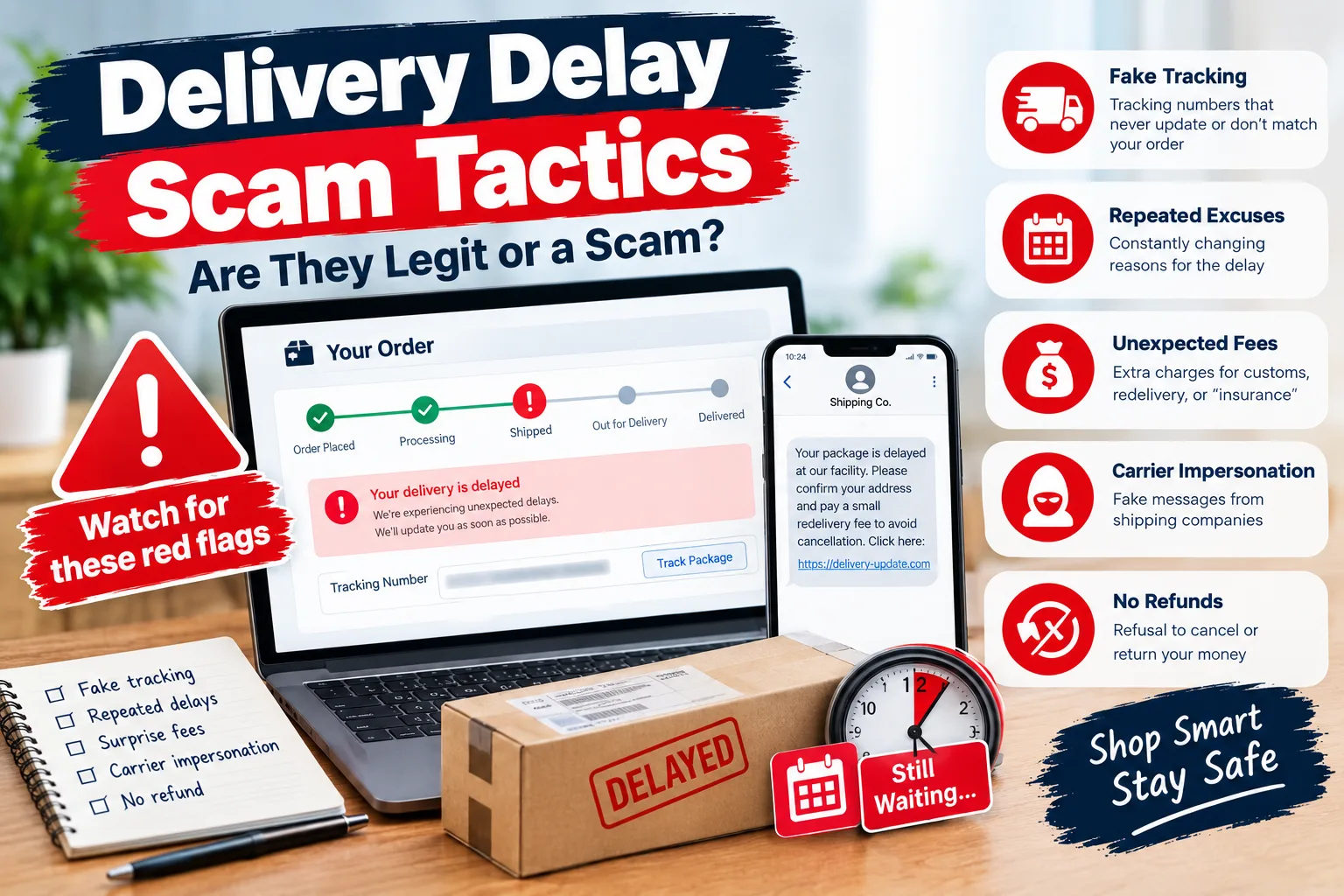
Verdict: Delivery delay scams are a documented form of online fraud, but not every delayed order is a scam. The warning sign is usually the pattern around the delay: a seller gives vague excuses, repeatedly moves the expected delivery date, provides unusable or misleading tracking information, asks for additional shipping or customs payments, or stops communicating when the buyer requests a refund. The Federal Trade Commission says online sellers generally must ship within the promised timeframe, or within 30 days when no timeframe was provided, and a seller that cannot meet the deadline must give the buyer the option to accept a delay or cancel for a full refund.
This review examines delivery delay scam tactics as a scam category rather than a single ecommerce website. Because there is no one domain to investigate, WHOIS, Trustpilot, ScamAdviser, and Gridinsoft cannot produce a universal score for “delivery delay scams.” Instead, those checks become useful when investigating the particular store behind a delayed order.
Research/update date: October 6, 2026
Quick Risk Summary
| Check | Finding |
|---|---|
| Topic | Delivery delay scam tactics |
| Scam category | Documented online-shopping and delivery fraud |
| Universal WHOIS check | Not applicable |
| Universal Trustpilot score | Not applicable |
| Universal ScamAdviser score | Not applicable |
| Universal Gridinsoft score | Not applicable |
| Main tactic | Using repeated or misleading delivery problems to delay refunds or extract more money |
| Common warning signs | Vague delays, fake tracking, extra fees, unreachable support, constantly changing delivery dates |
| Strongest protection | Verify tracking independently and keep all order records |
| Payment safety | Credit cards generally provide stronger dispute protections |
| Overall assessment | High caution when multiple delay-related red flags appear |
What Are Delivery Delay Scam Tactics?
A delivery delay becomes suspicious when it is used as part of a broader deception rather than being a genuine logistics problem.
Legitimate retailers can experience warehouse backlogs, carrier disruptions, customs delays, inventory shortages, weather problems, or incorrect addresses. A delayed parcel by itself does not establish fraud.
A scam can look different. The seller may take payment first and then repeatedly tell the customer that the order is “almost shipped,” “stuck at customs,” “held at the warehouse,” or “delayed by the carrier.” Instead of resolving the problem, the seller may use each explanation to buy more time.
In some cases, the delay is combined with a second demand: an unexpected “redelivery fee,” “insurance fee,” “customs payment,” “warehouse release fee,” or other charge.
BBB specifically warns about false claims that packages are being held at airports, warehouses, or distribution centers until the victim pays a fee.
That distinction matters. A real delivery delay can happen. A fake delivery problem can be deliberately manufactured to prevent a customer from demanding a refund.
How the Delivery Delay Scam Usually Works
The basic pattern can be surprisingly simple.
A consumer finds an unfamiliar online store, places an order, and receives an order confirmation. The website may look polished and may even provide an estimated delivery date.
Then nothing happens.
The customer contacts support and receives an explanation such as:
- The warehouse is unusually busy.
- The parcel is waiting for customs clearance.
- The courier has a backlog.
- The package was held because of weather.
- The shipping company lost the first tracking number.
- The order has been transferred to another carrier.
- The package is being inspected.
- The seller needs another few days to process it.
One delay might be legitimate. The problem is what happens next.
If the seller keeps extending the delivery date without providing meaningful evidence, refuses cancellation, stops answering questions, or asks for additional payments, the situation becomes considerably more concerning.
The FTC has previously warned about online sellers who used supposed shipping delays as an excuse after taking customers’ money and then failed to deliver the merchandise.
Delivery Delay vs. Delivery Delay Scam
This is one of the most important distinctions for shoppers.
A normal delivery delay may involve:
- A real tracking number
- A recognizable carrier
- A specific shipment date
- A genuine tracking history
- A reasonable explanation
- Consistent communication
- A revised delivery estimate
- A functioning refund or cancellation process
A suspicious delay may involve:
- Tracking that never updates
- Tracking that does not match the order
- Repeated excuses
- Contradictory explanations
- No evidence that the package was actually shipped
- Requests for additional money
- Pressure to wait indefinitely
- Refusal to provide a refund
- Support that suddenly disappears
The difference is not simply how long the parcel takes.
A parcel can legitimately take weeks to arrive. A much shorter delay can also be suspicious if the seller cannot prove that the order was shipped.
Why Scammers Use Delivery Delays
A delivery excuse gives a fraudulent seller something valuable: time.
Immediately after payment, a buyer may be willing to wait because the order appears to be processing.
A few days later, the seller can blame a shipping problem.
Another week passes and a new explanation appears.
By then, the buyer may be less certain about whether the problem is the store, the courier, customs, or the buyer’s own address.
That uncertainty can work in the scammer’s favor.
The seller may also hope that the customer forgets about the order, misses a payment-dispute deadline, or becomes tired of pursuing the refund.
This is why keeping records is important. The FTC recommends retaining copies of the product description, price, receipt, and communications with the seller, including messages about shipping delays.
Fake Tracking and Misleading Shipping Updates
A tracking number can make an unfamiliar store look more legitimate than it actually is.
But having a tracking number does not automatically prove that the seller shipped the correct product.
The tracking information should make sense in context.
For example, consider an order placed with a retailer on October 1. The seller claims it shipped on October 2, but the tracking number remains inactive for many days. The seller then says the carrier has the parcel even though the carrier’s own system does not show meaningful movement.
That deserves investigation.
Another warning sign is tracking that appears to show a delivery but does not correspond with the buyer’s address, shipment, or order details.
BBB identifies stolen tracking numbers and incorrect-item schemes as a form of online shopping delivery fraud.
For a broader guide to checking suspicious online stores, see our Chargeback Scams Explained: How They Work, Warning Signs, and How to Protect Yourself
Fake Carrier Messages Are a Related Scam
Not every delivery delay scam comes directly from the retailer.
Sometimes the scammer impersonates a shipping company.
A consumer might receive a text saying:
“Your package is delayed.”
The message then claims that the customer must:
- Confirm an address
- Pay a small redelivery charge
- Update delivery preferences
- Pay unpaid postage
- Schedule another delivery
- Verify identity
- Confirm a credit card
The message contains a link.
That link may lead to a fake carrier website designed to collect personal or financial information.
The FTC has specifically warned about fake USPS delivery messages and similar impersonation attempts. Its advice is to verify delivery information through the retailer or carrier independently rather than clicking the link in the unexpected message.
BBB similarly warns that fake shipping alerts can ask consumers to click links that steal personal information or money.
WHOIS Investigation: What Can and Cannot Be Checked
Because delivery delay scam tactics describe a category rather than one website, there is no single WHOIS record to examine.
However, WHOIS can be extremely useful when investigating the individual store responsible for a delayed order.
Check:
- Domain creation date
- Registrar
- Expiration date
- Ownership visibility
- Domain age
- Nameservers
- Historical changes where available
A very new domain is not automatically fraudulent. Many genuine businesses launch new websites.
Likewise, privacy-protected WHOIS information is common and does not prove wrongdoing.
But a recently registered domain combined with anonymous ownership, aggressive discounts, poor independent reputation, copied website material, vague company information, and repeated delivery problems deserves substantially more caution.
Website Platform and SSL
The technology used by a store is not proof of legitimacy.
A scammer can build a website using a mainstream ecommerce platform. A legitimate business can also use the same platform.
SSL is similar.
A website with HTTPS encrypts information between the browser and the server, but HTTPS does not establish that the seller is trustworthy. The FTC explicitly warns that scammers can also use encrypted websites.
When investigating a delayed-order website, treat technical security as only one part of the assessment.
The bigger questions are:
Who operates the store?
Where is the business located?
Can its contact information be independently verified?
Does the company have a credible history?
Does its shipping policy match what customers were promised?
Trustpilot, ScamAdviser and Gridinsoft
These services can be useful when researching a particular store, but none can universally determine whether a delivery delay is fraudulent.
Trustpilot
Look for:
- A genuine profile matching the exact domain
- A meaningful history of reviews
- Recent customer feedback
- Repeated complaints about delivery
- Reports of refunds being denied
- Patterns rather than isolated comments
Be careful with a newly created review profile or a handful of unusually enthusiastic reviews.
At the same time, the absence of a Trustpilot profile does not prove that a store is fraudulent. A small or new business may simply have little review history.
ScamAdviser
ScamAdviser can provide automated risk indicators for a specific domain, including domain age, ownership information, traffic and technical characteristics.
A low score is a reason to investigate further, not by itself proof of fraud.
Gridinsoft
Gridinsoft can provide another automated perspective on a domain’s technical and reputation signals.
Again, it should be treated as supporting evidence rather than a final verdict.
If multiple independent indicators point in the same direction, however, the overall risk becomes harder to dismiss.
What Looks Normal
Some delivery situations that initially look suspicious may have perfectly reasonable explanations.
Normal signs include:
- The order has a real carrier tracking number.
- Tracking shows movement.
- The seller provides a specific revised delivery date.
- The delay is consistent with the carrier’s own information.
- The business responds to questions.
- The seller provides a reasonable cancellation/refund process.
- No unexpected payment is requested.
- The company’s published shipping policy explains possible delays.
A legitimate retailer should be able to explain what happened without continuously changing its story.
What Deserves Caution
Certain combinations should make shoppers slow down.
1. Repeated unexplained delays
One delay is normal.
Three or four vague explanations are different.
2. The delivery date keeps moving
If the promised date changes every few days, ask why the seller cannot provide a definite estimate.
3. Tracking never becomes meaningful
A label being created is not the same as the package moving through a carrier network.
4. New fees appear after purchase
Be particularly careful when a seller suddenly demands money for “insurance,” “release,” “customs,” “warehouse,” or “redelivery.”
5. Refund requests are discouraged
A seller that repeatedly tells customers to “wait just a few more days” without resolving the underlying problem deserves scrutiny.
6. Customer service stops responding
A genuine logistics problem can happen. Disappearing customer service is much harder to explain.
7. The store has weak business transparency
No clear company identity, no verifiable address, no useful contact information and no independent reputation can increase the risk.
What We Could Not Verify
Because this article examines a scam tactic rather than one website, we could not independently verify:
- A universal domain age
- A universal WHOIS record
- A universal Trustpilot score
- A universal ScamAdviser score
- A universal Gridinsoft rating
- A specific company’s shipping policy
- A specific company’s return policy
- A specific customer’s refund experience
- A particular tracking number
- A particular merchant’s business registration
Those details must be investigated on a store-by-store basis.
That distinction prevents a common mistake: assuming that every late shipment represents fraud.
Shipping, Returns and Refunds
Shipping policies should be checked before purchasing, not after a problem develops.
The FTC states that sellers generally must ship within the timeframe advertised. If no timeframe is provided, the seller generally has 30 days to ship. When a seller cannot meet the promised deadline, the buyer must be given the choice to agree to the delay or cancel for a full refund.
This makes an indefinite “please wait” response particularly concerning.
A legitimate delay should not eliminate the customer’s options.
Before buying, check:
- Processing time
- Estimated transit time
- Maximum delivery window
- International shipping conditions
- Customs responsibilities
- Cancellation rules
- Refund procedure
- Return shipping costs
- Conditions for delayed or lost orders
For more warning signs involving questionable ecommerce stores, see our Fake Payment Confirmation Scams: How Fake Receipts and Payment Alerts Trick Sellers
Payment Safety
Payment method matters when an order does not arrive.
The FTC recommends paying by credit card when possible because buyers can dispute charges for merchandise that was never received or was not as described.
Be especially cautious if an unfamiliar seller insists on payment methods that make recovery difficult.
Warning signs include requests for:
- Cryptocurrency
- Gift cards
- Wire transfers
- Unusual payment arrangements
- Direct transfers to personal accounts
A payment processor’s presence does not automatically make a store legitimate, but a credit card can provide stronger dispute options than many irreversible payment methods.
Customer Service Test
Before buying from an unfamiliar store, consider testing customer support.
Ask a simple question about:
- Shipping time
- Product availability
- Returns
- Delivery locations
- Refunds
Then evaluate the response.
A useful answer should be specific and consistent with the published policy.
A generic response such as “your order is being processed” does not tell you much.
If there is no response before payment, that is a stronger warning than a response arriving a day later.
Red Flags to Watch For
| Red Flag | Why It Matters |
|---|---|
| Repeated unexplained delays | May indicate the seller cannot fulfill orders |
| Tracking never updates | Shipment may not have been properly dispatched |
| Unexpected delivery fees | Common feature of delivery-related scams |
| Fake carrier messages | Can lead to phishing or payment theft |
| Constantly changing explanations | Suggests poor transparency |
| Refund refused after missed delivery | Major consumer-protection concern |
| Customer support disappears | Makes resolution difficult |
| Very new website | Limited track record |
| Hidden business identity | Harder to hold seller accountable |
| Extreme discounts | Can be used to attract impulse purchases |
| Pressure to pay quickly | Reduces time for research |
Positive Signs
Not every delayed order is dangerous. Positive indicators include:
- A verifiable company identity
- A genuine physical business presence
- Consistent contact information
- A detailed shipping policy
- Real carrier tracking
- A reasonable explanation for the delay
- Responsive customer support
- Clear cancellation terms
- A transparent refund procedure
- Established independent customer feedback
- Credit-card payment availability
No single positive sign proves legitimacy, but several together can reduce uncertainty.
How to Investigate a Delayed Order Safely
If your order is late, do not immediately assume the seller is a scam.
Start with the order confirmation.
Check the promised shipping date and delivery window.
Then access the carrier’s official website independently. Do not rely solely on a tracking link contained in an unexpected text or email.
Compare the carrier information with the seller’s explanation.
If the seller says the package is at customs but the carrier has no corresponding record, ask for clarification.
If the seller says it has not shipped, but previously supplied a tracking number claiming it was already dispatched, save the conflicting messages.
Documentation can become important if you later need to dispute the payment.
What to Do If the Seller Keeps Delaying
If a promised delivery date has passed, contact the seller in writing.
Ask for:
- Confirmation that the order was shipped.
- The carrier name.
- The tracking number.
- The current shipping status.
- A definite revised delivery date.
- Your cancellation and refund options.
Avoid lengthy arguments.
Keep the communication factual and save copies of everything.
If the seller refuses to resolve the matter, consider contacting the payment provider or card issuer promptly about the dispute process.
The FTC states that when an order does not arrive and the seller will not refund the money, consumers can dispute the charge.
Buyer Safety Tips
Before purchasing
Research the store’s domain, company identity, independent reviews and policies.
During checkout
Save the product page, price, delivery promise and confirmation email.
After ordering
Monitor the order through the retailer’s account and the carrier’s official tracking system.
If a delay occurs
Compare the seller’s explanation with the carrier’s actual information.
If an unexpected message arrives
Do not click its tracking link. Open the retailer or carrier website independently.
If additional money is requested
Stop and investigate before paying.
A legitimate shipping problem does not automatically mean you must pay an unexpected fee.
Pros and Cons of the Delivery Delay Scam Category
Pros for legitimate shoppers
- Many genuine delays have simple explanations.
- Carrier tracking can help verify shipment progress.
- Credit-card disputes can provide additional protection.
- Written policies can clarify delivery expectations.
- Independent research can reveal established complaints.
Cons and risks
- Delays can give dishonest sellers extra time.
- Fake tracking can create a false impression of shipment.
- Carrier impersonation can lead to phishing.
- Extra “shipping” fees can become another payment trap.
- Repeated delays can make refund recovery harder.
- New stores may have little independent reputation.
Is Delivery Delay Scam Tactics Legit or a Scam?
The tactic is real and documented.
That does not mean every delayed shipment is fraudulent.
The strongest evidence of a delivery-delay scam usually comes from a combination of behaviors: payment is taken, the order does not arrive, explanations repeatedly change, tracking cannot be independently confirmed, unexpected fees appear, and the seller avoids providing a refund.
The FTC’s consumer guidance makes the underlying standard clear: sellers are expected to meet their stated shipping timeframe or provide the appropriate option when they cannot.
So the right question is not simply, “Is my package late?”
It is:
Can the seller demonstrate that the order was genuinely shipped, explain the delay consistently, and provide the refund or cancellation option when required?
If the answer is repeatedly no, the risk rises sharply.
Final Verdict
Delivery delay scam tactics are a legitimate and documented online-shopping fraud concern.
A late package alone is not evidence of a scam. Shipping networks experience real disruptions, and international orders can take substantially longer than expected.
The concern begins when the delay becomes a mechanism for avoiding accountability.
Repeated excuses, unusable tracking, surprise fees, fake carrier messages, disappearing customer support and refusal to provide an appropriate refund are much stronger warning signs than delivery time alone.
Consumers should investigate the individual store rather than applying a universal scam score to every delayed order. WHOIS, Trustpilot, ScamAdviser, Gridinsoft, company records and customer feedback can all contribute to that investigation, but none should be treated as conclusive on its own.
Overall assessment: High caution when multiple delivery-delay warning signs appear.
FAQ
Are delivery delays always a sign of a scam?
No. Genuine warehouse, carrier, customs and weather delays happen regularly. A delay becomes more concerning when the seller provides inconsistent explanations, cannot demonstrate shipment, demands additional money or refuses to resolve the order.
How long can an online seller take to ship an order?
The seller generally must ship within the timeframe it advertised. If no shipping timeframe was provided, the FTC says the seller generally has 30 days to ship.
Can a scammer use a real tracking number?
Yes. A tracking number by itself does not prove that the correct merchandise was shipped to the correct buyer. BBB warns about tracking-code scams involving stolen tracking information and incorrect items.
Should I pay a redelivery fee for a delayed package?
Do not automatically pay. Verify the alleged fee independently through the retailer or carrier’s official website. Unexpected requests for payment are a known feature of delivery scams.
What should I do if a delivery text asks me to click a link?
Do not use the link in the message. Instead, open the retailer’s account or the carrier’s official website independently and check the shipment there.
Can I get a refund if my order never arrives?
Potentially, yes. The specific process depends on the seller and payment method, but the FTC says that if an online seller does not ship as required and does not resolve the matter, consumers may have refund and dispute rights.
Is a new ecommerce domain automatically a scam?
No. A newly registered domain is only one risk indicator. It becomes more significant when combined with hidden ownership, weak independent reputation, poor business transparency and suspicious order behavior.
What is the safest way to pay an unfamiliar online store?
A credit card generally provides stronger dispute protections for undelivered or incorrect merchandise than many irreversible payment methods.
What is the biggest warning sign in a delivery-delay situation?
There is rarely one universal sign. A combination of repeated unexplained delays, unverifiable tracking, unexpected fees, inconsistent explanations and refusal to refund is considerably more concerning than a simple late delivery.
SEO Information
SEO Title: Delivery Delay Scam Tactics Review 2026: Are They Legit or a Scam?
Meta Description: Learn how delivery delay scams work, including fake tracking, repeated shipping excuses, surprise fees and carrier impersonation. See the warning signs.
URL Slug: delivery-delay-scam-tactics
Primary Keyword: Delivery delay scam tactics
Secondary Keywords:
- delivery delay scam
- delivery delay scams
- delivery delay scam tactics
- fake shipping delay scam
- online shopping delivery scam
- delayed order scam
- fake delivery tracking scam
- shipping delay fraud
- package delay scam
- fake carrier delivery scam
- delivery scam warning signs
- online order never arrived
- fake shipping excuses
- delivery refund scam
- is a delivery delay a scam
Featured Image Alt Text: Delivery delay scam tactics showing fake tracking, shipping excuses, surprise fees and online shopping fraud warnings
Research/Update Date: October 6, 2026
Source references
The primary consumer-protection sources used for this investigation were the Federal Trade Commission’s online shopping guidance and Better Business Bureau’s delivery scam guidance.