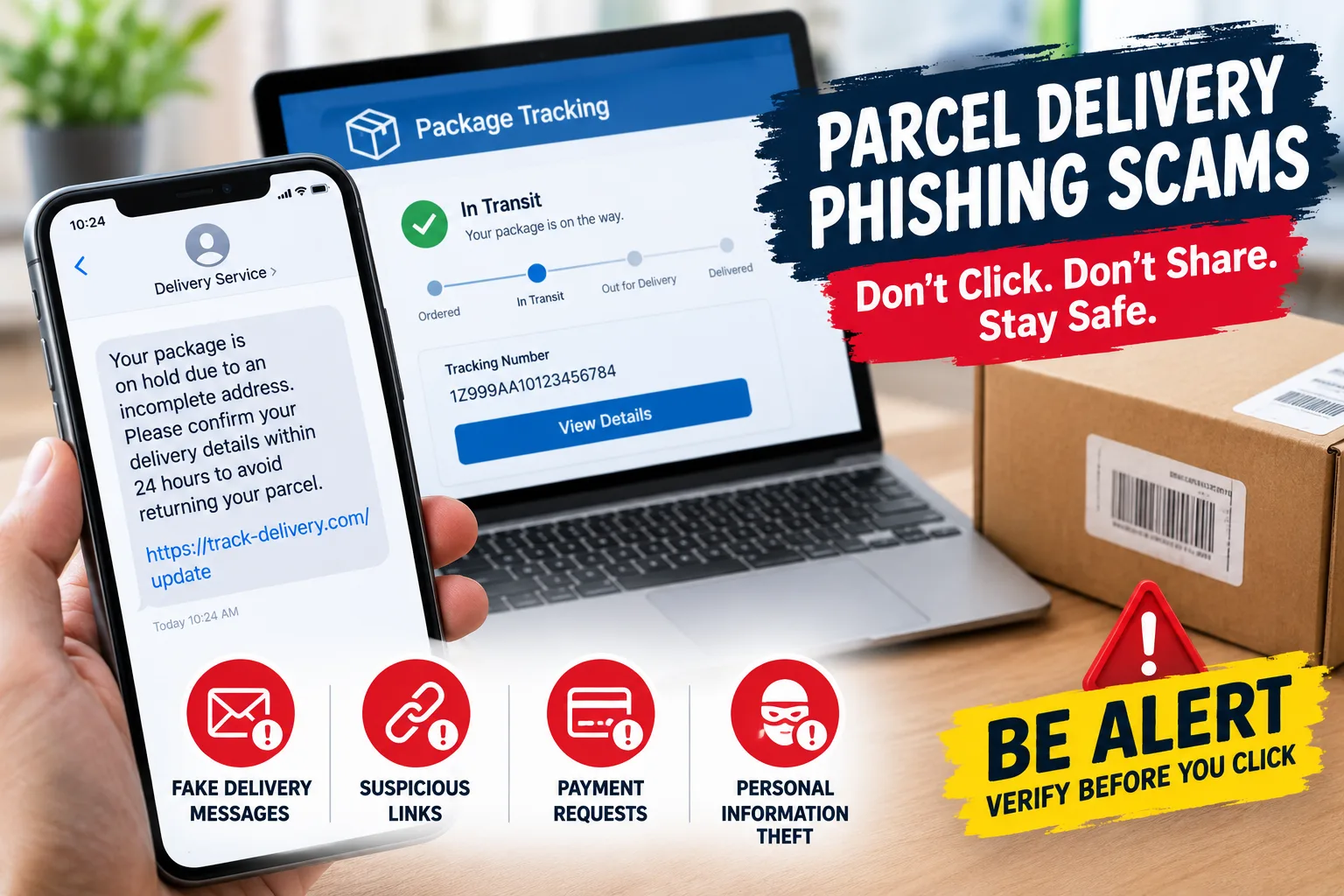
As of October 3, 2026, parcel delivery phishing scams are a documented form of fraud, not a legitimate delivery service or a single website. The evidence from the FTC, U.S. Postal Inspection Service, BBB and major carriers shows that scammers commonly impersonate USPS, UPS, FedEx and other delivery companies through texts, emails, fake tracking pages and phone calls. The goal is usually to make the recipient click a link, provide personal or financial information, or pay a small fee for a supposed delivery problem.
Because “Parcel Delivery Phishing Scams” is a scam category rather than a specific ecommerce domain, there is no single WHOIS record, Trustpilot profile or company registration to investigate. Instead, this review examines the documented scam pattern, the websites and messages commonly used in it, and the evidence consumers can use to distinguish a genuine delivery notification from a phishing attempt.
Bottom line: the scam pattern is well documented. An unexpected parcel message asking you to click a link, correct an address, reschedule delivery or pay a small fee should be treated as suspicious until independently verified.
Research/update date: October 3, 2026
Quick Risk Check
| Check | Finding |
|---|---|
| Topic investigated | Parcel delivery phishing scams |
| Specific website/domain | Not applicable |
| Legitimate company behind the topic | No — this is a scam category |
| Documented scam activity | Yes |
| Common impersonated companies | USPS, UPS, FedEx and other delivery services |
| Common channels | SMS, email, fake websites and phone calls |
| Typical requests | Address confirmation, redelivery, delivery fees, tracking updates |
| Main risk | Theft of payment and personal information |
| Malware risk | Possible when malicious links or attachments are involved |
| Independent evidence | FTC, USPS Inspection Service, BBB and carrier warnings |
| Overall assessment | Documented phishing scam pattern — high caution |
What Are Parcel Delivery Phishing Scams?
Parcel delivery phishing scams are messages designed to look like legitimate communications from a shipping company.
A typical message claims that something has gone wrong with a package. The recipient may be told that:
- the address is incomplete
- delivery was attempted
- a package is waiting at a warehouse
- a small redelivery fee is required
- postage has not been paid
- delivery preferences need to be updated
- a signature is required
- the package will be returned unless the recipient acts quickly
The message then provides a link.
That link is the important part.
Instead of taking the recipient to the real carrier’s website, it can lead to a convincing imitation designed to collect names, addresses, passwords, card details or other sensitive information. The FTC has specifically warned about fake USPS, FedEx and DHL delivery messages that direct consumers to look-alike websites.
The U.S. Postal Inspection Service describes unsolicited USPS delivery texts containing unfamiliar links as smishing, a form of phishing conducted through text messages.
How the Scam Usually Works
The scam is effective because the story sounds ordinary.
Millions of people receive parcels every day. A message saying “your package could not be delivered” does not immediately sound unusual, particularly when the recipient has recently purchased something online.
Step 1: The scammer sends a delivery message
The victim receives a text or email appearing to come from a recognizable delivery company.
The message may include:
- a tracking number
- a carrier logo
- a delivery date
- the recipient’s name
- a warning about a failed delivery
- a link to “fix” the problem
Some messages use professional-looking formatting and language.
BBB has documented delivery scams involving fake notices about incomplete addresses, missed deliveries, rescheduling and supposed package holds.
Step 2: The message creates urgency
Scammers do not want recipients to stop and investigate.
The message may say that the package will be returned, held or cancelled unless the recipient responds within a short period.
This pressure is deliberate.
UPS’s own fraud guidance warns consumers to slow down when a message creates urgency or demands immediate action.
Step 3: The recipient clicks the link
The link may appear to contain the name of a genuine delivery company.
That does not mean the destination is legitimate.
A fraudulent website can copy logos, colors, layouts and tracking forms from a real carrier.
Step 4: The fake website requests information
The page may ask for an address, phone number, password or payment-card information.
In some variations, the scammer initially asks for only a small amount, such as a supposed redelivery fee.
The real objective may be the payment information entered during that process.
The FTC says these fake delivery links can lead to look-alike websites that collect personal or financial information.
Common Parcel Delivery Phishing Tactics
Not every scam message looks exactly the same.
Fake incomplete-address notices
The recipient is told that the delivery company cannot complete delivery because the address is incomplete.
The message asks the recipient to confirm or update the address through a link.
BBB has documented this exact pattern in consumer reports involving supposed USPS and UPS notifications.
Fake redelivery fees
A message claims that a package requires a small payment before delivery.
The amount may be intentionally low because a small charge can make the request seem more believable.
The FTC has warned about delivery texts that request payment for supposed redelivery or unpaid postage.
Fake missed-delivery messages
The scammer claims that a driver attempted delivery but could not reach the recipient.
The recipient is told to schedule another delivery.
Fake tracking links
The message includes a tracking number and a link that appears to lead to the carrier.
A tracking number alone does not establish that the message is genuine. The safest approach is to independently open the carrier’s official website rather than using the message’s link.
Fake package-hold warnings
The recipient is told that a parcel is being held at a warehouse or distribution center.
The message may demand payment or additional information to release it.
Fake phone calls
Not all parcel phishing happens through text.
A scammer may call and claim to represent a courier. BBB has reported cases in which callers asked recipients to confirm personal details or payment information after claiming there was a delivery problem.
WHOIS Investigation
A normal website investigation would examine the domain’s registration date, registrar, expiration date and ownership information.
That does not apply to this topic because Parcel Delivery Phishing Scams is not a single website or registered business.
There are, however, important domain-related warning signs within individual scams.
A fake delivery message can send the recipient to a newly registered domain that has little connection to the company being impersonated. The domain may use words resembling a legitimate carrier while adding extra terms, unusual spelling or unrelated domain extensions.
A familiar logo is not proof of ownership.
Likewise, an HTTPS connection is not proof that the website belongs to a real shipping company. HTTPS encrypts the connection but does not establish that the person operating the site is trustworthy.
If you receive a suspicious delivery message, typing the carrier’s known official website into your browser yourself is safer than following the supplied link.
Website and Security Check
The websites used in parcel phishing scams often imitate legitimate carrier pages.
They may contain:
- tracking forms
- delivery status screens
- company logos
- customer-service links
- address forms
- payment pages
- security icons
A convincing design should not be treated as evidence of authenticity.
The FTC specifically warns that scammers create look-alike sites to collect personal and financial information.
What looks normal
A legitimate carrier website will generally allow you to verify tracking information through its own official domain.
For example, if a message claims to concern a USPS package, you can independently visit the official USPS website rather than clicking the message.
What deserves caution
Be particularly careful when:
- the domain does not match the carrier
- the message contains a shortened or unusual URL
- the page asks for card details to solve a minor delivery issue
- the message arrived without you requesting tracking notifications
- the page asks for information the carrier should already have
- the message pressures you to act immediately
Trustpilot and Customer Reviews
There is no legitimate Trustpilot profile for “Parcel Delivery Phishing Scams” because this is not a specific company.
That distinction matters.
Searching for reviews of the exact message, phone number, sender address or suspicious domain can sometimes reveal consumer reports, but those reports should be treated as individual accounts rather than independently verified proof.
BBB Scam Tracker contains numerous consumer reports involving package-delivery phishing. For example, reports in 2026 include suspicious package messages and other phishing activity connected with supposed delivery services.
We could not independently verify the underlying circumstances of every consumer report, so individual Scam Tracker submissions should not automatically be treated as established facts.
The broader scam pattern, however, is independently documented by government agencies and delivery companies.
ScamAdviser, Gridinsoft and Other Reputation Checks
ScamAdviser and Gridinsoft can sometimes be useful when investigating a particular suspicious domain.
They cannot provide one universal score for parcel delivery phishing scams because scammers may create many different domains and abandon them quickly.
That creates an important limitation.
A suspicious delivery message might use a domain that has not yet accumulated enough data for a reputation service to flag it. Conversely, a domain can have a valid SSL certificate while still being used for phishing.
For that reason, the behavior of the message matters more than any single automated website score.
Shipping and Delivery Verification
One of the easiest ways to check a parcel message is to bypass it.
If you recently bought something online:
- Open the store or marketplace where you placed the order.
- Sign in through your normal route.
- Locate the order.
- Check the tracking information shown there.
- If necessary, open the carrier’s official website separately.
- Enter the tracking number yourself.
The FTC recommends checking the order through the retailer and contacting the shipping company directly rather than using information contained in an unexpected delivery message.
This approach removes the scammer’s link from the verification process.
Returns and Refunds
Returns and refunds are generally relevant to the underlying purchase, not the phishing message itself.
If a fraudulent delivery message caused you to make a payment, the appropriate next step depends on how you paid and what information was disclosed.
If you entered card information, contact the card issuer or financial institution through its official contact information.
If you gave away a password, change it through the real service’s website rather than through a link supplied in the message.
If you entered sensitive personal information, monitor accounts for suspicious activity and consider the appropriate identity-theft protections.
Do not continue communicating with the sender simply because they claim they can “refund” a delivery charge.
Payment Safety
A small payment request is one of the most common warning signs in parcel phishing.
A message may request:
- a redelivery charge
- unpaid postage
- address-verification fees
- customs or processing fees
- a small delivery surcharge
Some legitimate shipments can involve duties, taxes or other charges, so the existence of a fee does not automatically prove fraud.
The key question is how the fee is being requested.
UPS advises customers to verify fees through its legitimate tracking and account systems rather than trusting unexpected requests.
If a message provides a payment link, do not assume the link is genuine simply because the message contains the correct carrier name.
Customer Service Verification
If you are unsure whether a delivery message is real, contact the carrier independently.
Do not use:
- the phone number contained in the suspicious message
- the email address supplied by the sender
- the link supplied in the message
Instead, find the carrier’s customer-service information through its official website or your existing account.
The same principle applies to the retailer that sold the product.
Positive Signs vs Red Flags
What looks normal
Some characteristics can appear in legitimate delivery communications:
- You actually placed an order.
- The retailer’s order page shows the same shipment.
- The tracking number appears in your retailer account.
- The carrier’s official website recognizes the tracking number.
- You previously opted into delivery notifications.
- The message does not demand unusual personal or financial information.
Even these signs should be checked independently when money or sensitive information is requested.
Red flags
The following combination deserves particular caution:
- unexpected package notification
- unfamiliar sender
- urgent language
- unfamiliar web domain
- request to click a link
- request to “confirm” personal information
- request for card details
- small redelivery fee
- threat that the parcel will be returned
- tracking number that does not appear in your actual order history
The U.S. Postal Inspection Service says USPS tracking texts are customer-initiated and that unsolicited USPS tracking messages containing links should not be clicked.
Pros and Cons of the Scam Pattern
This section is about identifying the tactic, rather than evaluating a legitimate business.
Warning signs
- Impersonates familiar delivery brands
- Uses realistic package stories
- Exploits the normal expectation of online orders
- Often creates urgency
- Can lead to fake payment pages
- Can collect personal information
- May expose victims to malware or fraudulent websites
What can make a message appear convincing
- Correct-looking carrier branding
- Tracking numbers
- Delivery dates
- Recipient names
- Familiar shipping language
- Professional-looking websites
These details can be copied or fabricated, so they should not be treated as independent proof.
How to Check a Parcel Message Safely
The safest method is to separate verification from the message itself.
If you receive an unexpected delivery notification, do not click the link immediately.
Instead, check your recent orders.
If you are expecting a parcel, open the retailer’s website or app independently. Find the order and compare the tracking information.
Then, if necessary, go directly to the shipping carrier’s official website.
This is also a useful reason to keep order confirmations and tracking details until the delivery has been completed.
For more general advice on checking unfamiliar online stores before purchasing, see Scam UPI Payment Tricks: How Fraudsters Manipulate Digital Payments and How to Stay Safe
If you are researching an unfamiliar shopping website connected to the message, Fake PayPal Payment Screenshots: How the Scam Works and How to Verify a Payment can also help you assess the seller separately.
What to Do If You Already Clicked
Clicking a suspicious link does not automatically mean your information has been stolen, but you should take the situation seriously.
If you entered payment information, contact your financial institution using a trusted number or official website.
If you entered a password, change it through the real service and avoid reusing that password elsewhere.
If you downloaded an unexpected file or installed something, consider getting help from a trusted adult or qualified technical support person before continuing to use the affected device for sensitive accounts.
The Postal Inspection Service advises people who interacted with a suspicious USPS smishing URL to notify their financial institution and report the message.
You can also report unwanted scam texts by forwarding them to 7726 (SPAM) where that reporting service is available. The FTC and USPS provide reporting guidance for phishing and smishing.
Buyer Safety Tips
Before responding to any parcel-related message:
- Check whether you actually ordered something.
- Do not trust the link simply because the carrier name looks familiar.
- Open the retailer’s website independently.
- Enter tracking numbers manually on the carrier’s official site.
- Be suspicious of unexpected payment requests.
- Never provide passwords or sensitive personal information through an unsolicited delivery link.
- Ignore pressure to act immediately.
- Check the sender address and domain carefully.
- Do not assume HTTPS means the website is legitimate.
- Keep order confirmations and tracking information.
- Report suspicious texts and emails instead of engaging with the sender.
Is Parcel Delivery Phishing Legit or a Scam?
There is strong independent evidence that parcel delivery phishing is a real and established scam category.
The FTC has repeatedly warned about fake delivery notifications designed to send consumers to fraudulent websites. The U.S. Postal Inspection Service specifically identifies unsolicited USPS tracking texts with unfamiliar links as smishing. BBB has documented multiple variations involving fake delivery problems, address verification, rescheduling and delivery fees. Major carriers such as UPS also publish warnings about fraudulent delivery communications.
That does not mean every delivery text or email is fraudulent.
Legitimate carriers do send delivery notifications in some circumstances, particularly when customers have opted into them. The important distinction is whether the message can be independently verified through the retailer, carrier account or official carrier website.
An unexpected link asking for payment or sensitive information deserves particular caution.
Final Verdict
Parcel delivery phishing scams are a documented online fraud pattern and should be treated as high risk.
There is no single domain to rate, because scammers can rotate through different websites, phone numbers and sender identities. The strongest evidence comes from the recurring tactics themselves: fake delivery problems, urgent messages, suspicious links, look-alike carrier websites and requests for personal or payment information.
The most reliable defense is simple: do not use the link in an unexpected parcel message to verify the delivery.
Instead, check the order through the retailer where you purchased it and access the carrier independently. If the supposed delivery problem cannot be confirmed through those trusted channels, do not provide information or payment.
The evidence does not support treating every parcel notification as fraudulent. It does support treating unexpected delivery messages that demand action through an unfamiliar link as suspicious until independently verified.
FAQ
Is a parcel delivery text always a scam?
No. Legitimate delivery companies can send notifications, particularly when a customer has requested or opted into them. The problem is that scammers can imitate these messages. Verify the delivery independently before clicking links or providing information.
How do I know if a package tracking message is fake?
Check whether the shipment appears in your retailer account and whether the tracking number works when entered manually on the carrier’s official website. Be especially cautious if the message asks you to click an unfamiliar link, pay a small fee or provide personal information.
Can a fake parcel message steal my card information?
Yes. The FTC warns that fraudulent delivery links can lead to look-alike websites designed to collect payment and other personal information.
What if the message uses my real name and address?
That does not prove it is genuine. Scammers can obtain or already possess personal information from various sources. Verify the shipment through your retailer and carrier independently.
Should I pay a redelivery fee from a text message?
Do not pay through an unexpected link simply because the message claims a delivery fee is required. Check the shipment directly with the carrier using its official website or account.
What is parcel delivery smishing?
Smishing is phishing conducted through SMS or text messages. The U.S. Postal Inspection Service uses the term for deceptive delivery-related text messages designed to obtain personal or financial information.
What should I do after clicking a suspicious delivery link?
Stop interacting with the site. If you entered payment or sensitive information, contact the relevant financial institution or service through trusted contact information. Change compromised passwords through the real service and report the suspicious message.
Can a tracking number prove a delivery message is legitimate?
No. A tracking number or delivery status can make a message look convincing, but you should still verify it through the retailer’s account or the carrier’s independently accessed website.
Are fake USPS delivery texts real scams?
Yes. The U.S. Postal Inspection Service specifically warns about unsolicited USPS tracking texts containing unfamiliar links and identifies this activity as smishing.
Should I click a delivery link if I am actually expecting a package?
It is safer to avoid the message link. Open the retailer or carrier website independently and check the tracking information there.
SEO Information
SEO Title:
Parcel Delivery Phishing Scams Review 2026 – Is This Scam Legit or a Scam?
Meta Description:
Parcel delivery phishing scams use fake tracking texts, emails and delivery links to steal money or personal information. Learn the warning signs and stay safe.
URL Slug:parcel-delivery-phishing-scams-review
Primary Keyword:
Parcel Delivery Phishing Scams review
Secondary Keywords:
parcel delivery phishing scams; parcel delivery phishing scam; parcel delivery scam; package delivery phishing; delivery phishing scam; fake parcel delivery text; package delivery text scam; fake delivery message; parcel tracking phishing; delivery smishing scam; package phishing scam; is parcel delivery phishing a scam; fake USPS delivery text; fake package tracking scam
Featured Image Alt Text:
Parcel delivery phishing scam warning showing a fake package tracking message, suspicious delivery link and online shopping fraud risks
Research/Update Date:
October 3, 2026