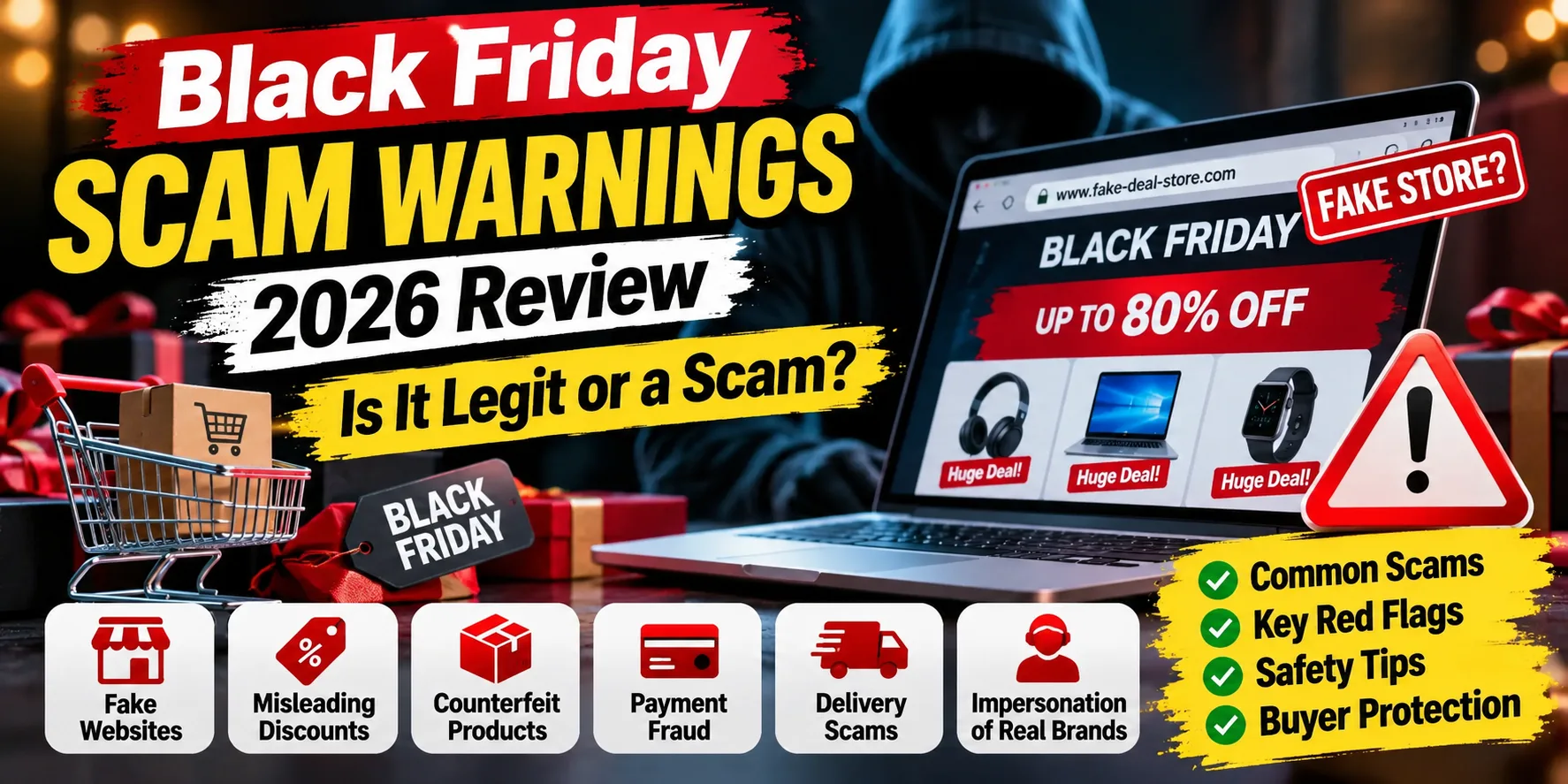
Black Friday sales are not inherently fraudulent, and many established retailers offer genuine discounts during the shopping period. However, Black Friday is also an opportunity for scammers to exploit shoppers with fake online stores, counterfeit products, misleading discounts, impersonation websites, and fraudulent delivery messages. Current consumer-protection reporting shows that shopping scams promoted through social media remain a significant concern. Our assessment is that shoppers can buy safely during Black Friday, but unfamiliar sellers and unusually attractive offers deserve careful scrutiny before any payment is made.
This investigation looks at the most relevant Black Friday scam warnings for 2026, the evidence behind current concerns, and the practical checks consumers can use to distinguish legitimate promotions from suspicious offers.
Black Friday Scam Warnings 2026: Quick Summary
| Category | Findings |
|---|---|
| Topic | Black Friday shopping scams |
| Shopping event | November 27, 2026 |
| Website under investigation | Not applicable; this is a general consumer-safety topic |
| WHOIS/domain age | Not applicable to the topic as a whole |
| Trustpilot rating | No single rating applies |
| ScamAdviser rating | No single rating applies |
| Main risk | Fake stores, impersonation websites, misleading advertisements, and payment fraud |
| Relevant evidence | FTC and FBI consumer-protection reporting |
| Overall assessment | Genuine Black Friday sales are legitimate, but fraudulent offers and impersonation schemes are a real risk |
What Are Black Friday Shopping Scams?
Black Friday shopping scams are fraudulent or deceptive activities that use the popularity of the annual sales event to attract customers.
Scammers take advantage of the expectation that prices will fall sharply. They may advertise expensive products at unusually low prices, imitate recognizable retailers, or create a convincing storefront that appears to offer limited-time deals.
The objective varies. Some schemes attempt to collect payment for products that will never arrive. Others seek credit-card information, account passwords, personal details, or access to payment accounts.
Not every disappointing Black Friday purchase is a scam. A genuine retailer might have poor customer service, a delayed shipment, or a product that does not meet expectations. Those problems should be distinguished from deliberate deception.
The important question is whether the seller is making claims it can support, providing accurate business information, and fulfilling the transaction as promised.
Why Black Friday Scams Deserve Attention in 2026
The Federal Trade Commission (FTC) published consumer-protection findings in April 2026 showing that social media has become a major starting point for reported scams.
According to the FTC, consumers reported losing $2.1 billion to scams that started on social media in 2025. Shopping scams were the most frequently reported type of social-media scam. Among people who reported losing money through a social-media scam, more than 40% said it began with an order placed after seeing an advertisement. Some received counterfeit or substantially different products; many reported that their purchases never arrived.
These figures are not Black Friday-specific statistics. They describe broader social-media fraud during 2025. Nevertheless, they are relevant to the sales season because retailers and scammers alike use online advertising to reach people looking for discounts.
The FBI also identifies non-delivery scams, misleading online listings, and gift-card fraud among common holiday shopping risks. Its published information cites more than $503 million in reported losses from non-payment and non-delivery scams in 2025. Again, this is a broader fraud category, not a figure limited to Black Friday.
The evidence does not suggest that every online sale is dangerous. It does show why shoppers should verify unfamiliar sellers rather than relying on advertisements alone.
The Most Common Black Friday Scam Warnings
1. Fake Online Shopping Websites
Fake shopping websites are among the most concerning risks during major sales events.
A fraudulent store may copy the layout, photographs, branding, and product descriptions of a legitimate retailer. It may even use a domain name that resembles a familiar brand.
The products can appear genuine, and the checkout page may look professional. Yet the operator may have no intention of delivering the advertised goods.
Common warning signs include:
- A domain name that contains extra words or unusual spelling.
- Missing or inconsistent company information.
- No meaningful customer-service details.
- Product prices far below those offered by established sellers.
- Policies that appear copied, incomplete, or contradictory.
- Payment requests that cannot be reversed easily.
A professional-looking website is not proof of legitimacy. Equally, a simple website is not automatically fraudulent. The seller’s identity, history, policies, and independent reputation matter more than appearance alone.
2. Fake Brand and Retailer Websites
Some scammers imitate well-known companies rather than creating entirely unfamiliar brands.
They may use a slightly altered domain name, copied product photographs, or logos that look almost identical to the genuine retailer’s branding.
A shopper who clicks a sponsored advertisement or an unsolicited message may land on an imitation store without noticing the difference.
Before ordering, compare the address in the browser with the retailer’s established domain. If you are unsure, close the page and navigate to the company’s official website independently.
Do not assume that a familiar logo proves that a website belongs to the brand.
3. Unrealistic Black Friday Discounts
Large discounts are common during Black Friday. A substantial price reduction is not, by itself, evidence of fraud.
The concern arises when the offer is difficult to believe and the seller provides little evidence that the deal is genuine.
For example, an unfamiliar store advertising a newly released premium electronic device at a tiny fraction of its usual retail price deserves closer examination.
Check the same product across established retailers. Compare the model number, specifications, included accessories, shipping costs, and warranty conditions.
Also examine the reference price. A product marked down from an unusually high original price may not represent a meaningful saving.
The FTC recommends comparing total costs and reading the terms of advertised offers rather than relying only on promotional claims.
4. Fake Social Media Shopping Advertisements
Social media advertisements can lead to legitimate retailers, but they can also direct users to unfamiliar or impersonation websites.
A sponsored post is not a guarantee that the advertiser has been independently vetted to the standard consumers might expect.
Be especially cautious when an advertisement:
- Promises an unusually large discount.
- Uses a countdown to pressure an immediate purchase.
- Has little meaningful information about the seller.
- Leads to a domain that does not match the advertised brand.
- Uses copied photographs or inconsistent product details.
- Directs customers to communicate through an unrelated personal account.
The FTC’s 2026 findings make this channel particularly relevant. Shopping scams were the most reported scam category originating on social media in its 2025 data.
5. Counterfeit Products
Counterfeit goods may be advertised as genuine branded products at unusually attractive prices.
This can affect clothing, footwear, electronics, accessories, beauty products, toys, and other popular categories.
The problem is not always obvious from the listing. A copied photograph may show the genuine product even when the seller intends to ship an imitation.
Look for precise model numbers, manufacturer information, warranty details, and clear seller identity. If the retailer is not an authorized seller, ask how product authenticity is established.
A very low price combined with vague product information should prompt further research.
6. Fake Discount Codes and Voucher Pages
Some websites advertise exclusive Black Friday coupon codes that supposedly unlock additional savings.
A legitimate voucher page may simply provide an expired or incorrect code. A more concerning page may ask visitors to complete surveys, install unfamiliar applications, provide personal details, or enter payment information to access a supposed discount.
A coupon should not require a shopper to disclose account passwords, banking security codes, or unnecessary personal information.
When possible, check promotions directly through the retailer’s official website.
7. Fake Delivery and Order-Confirmation Messages
Shopping activity increases around Black Friday, which can make unexpected delivery messages appear believable.
A fraudulent text or email might claim that:
- A parcel cannot be delivered.
- A small additional fee is required.
- The delivery address is incomplete.
- A payment has failed.
- An order needs urgent verification.
The message may include a link to a page designed to collect payment details or login credentials.
If you receive an unexpected delivery notification, check the order through the retailer’s official account or the delivery company’s established tracking service. Do not rely on the link in the message.
8. Fake Customer-Service Accounts
Scammers may impersonate retailers or delivery companies through social media profiles, messaging applications, or email.
They might respond to a public complaint and claim they can resolve the issue if the customer provides an order number, password, payment information, or verification code.
A genuine support representative should not need your account password or one-time security code.
Use contact details published on the retailer’s official website, not an account that unexpectedly approaches you.
9. Payment-Redirection Scams
A suspicious seller may encourage customers to pay through a method that provides little opportunity to recover the money.
Requests for gift cards, cryptocurrency, wire transfers, or payments to unrelated personal accounts should be treated as serious warnings.
The FTC advises consumers not to purchase from online sellers who insist on these methods. Credit cards generally provide stronger dispute options when an order does not arrive or the goods are not as described.
WHOIS and Domain Investigation: What Should Shoppers Check?
There is no single Black Friday scam domain, so a WHOIS investigation cannot produce one universal creation date, registrar, or expiration date.
Instead, shoppers should investigate the particular store they intend to use.
A domain lookup may reveal:
- The original registration date.
- The registrar.
- The domain’s expiration date.
- Recent registration updates.
- Nameservers.
- Whether the registrant’s details are privacy-protected.
Does a New Domain Mean a Store Is a Scam?
No.
A recently registered domain can belong to a legitimate new business. Likewise, an old domain can be compromised, sold, or repurposed.
Domain age is useful context, not a verdict.
A new store becomes more concerning when its short history is combined with missing business information, copied content, implausible discounts, and no credible independent customer feedback.
Is WHOIS Privacy a Red Flag?
Not by itself.
Many legitimate businesses use privacy services to prevent personal registration details from appearing in public records.
The more important question is whether the business itself provides verifiable contact information and consistent policies.
Website Safety Ratings: Trustpilot, ScamAdviser and Gridinsoft
Automated reputation services can help consumers assess individual domains, but they should not be treated as final authorities.
There is no single Trustpilot score, ScamAdviser rating, or Gridinsoft result for Black Friday shopping as a whole.
These services assess specific websites or businesses, and their results may differ.
Trustpilot
Trustpilot can provide useful customer feedback when a retailer has an established profile.
Check the number of reviews, their dates, the range of ratings, and whether complaints show recurring patterns.
Do not rely only on the average score. A company with a high rating may still have unresolved complaints, while a low rating may reflect a particular service problem rather than deliberate fraud.
Also check whether reviews relate to the exact retailer you intend to use. Similar company names can cause confusion.
ScamAdviser
ScamAdviser provides automated website-risk assessments using available technical and reputation information.
Its score can be a useful starting point, but it is not proof that a store is safe or fraudulent.
A low score deserves investigation, but shoppers should understand the reasons behind it. A recently registered domain or limited web traffic may influence an automated assessment without proving criminal activity.
Gridinsoft
Gridinsoft offers website reputation and security checks. Its results can help identify certain technical or reputation concerns.
However, a security scan does not establish whether an order will arrive, whether the seller will honour a refund, or whether a product will match its description.
No automated rating should replace checking the seller’s identity, policies, payment options, and independent customer experiences.
What Looks Normal, What Deserves Caution, and What Could Not Be Verified?
| Finding | Assessment | Why It Matters |
|---|---|---|
| Genuine Black Friday discounts | Normal | Established retailers regularly offer seasonal promotions |
| A new online store | Caution, not proof | There may be limited history to assess |
| Privacy-protected WHOIS | Usually normal | Domain privacy is common |
| HTTPS and a padlock | Normal but limited | Encryption does not establish business legitimacy |
| Extremely low prices | Caution | Could indicate counterfeit goods or a fake store |
| Gift-card-only payment | Serious warning | Recovery may be difficult |
| No verifiable contact details | Caution | Makes disputes and support harder |
| Independent reviews across several sources | Positive sign | Provides more context about actual customer experiences |
| No Trustpilot profile | Inconclusive | A business may be new or may use other review channels |
| Guaranteed delivery claims without clear terms | Caution | The promise should be checked against the seller’s policies |
Products and Prices: What Should You Expect During Black Friday?
Black Friday promotions commonly cover several product categories.
Electronics
Phones, computers, headphones, televisions, gaming accessories, and household electronics are popular sale items.
Check model numbers carefully. A product with a similar name may have different specifications, storage capacity, accessories, or warranty coverage.
Clothing and Footwear
Clothing and footwear discounts can be genuine, but shoppers should check sizing charts, material descriptions, seller identity, and return conditions.
An unusually cheap branded item from an unfamiliar store deserves additional scrutiny.
Home and Kitchen Products
Furniture, bedding, kitchen appliances, lighting, and decorative products may be discounted.
Check dimensions, materials, shipping costs, assembly requirements, and whether the seller provides clear product photographs.
Beauty and Personal-Care Products
Compare product sizes, ingredients, expiry information where relevant, and seller authorization.
Do not assume that a familiar product photograph proves the item is genuine.
Toys and Gifts
Popular gifts may attract imitation listings, misleading stock claims, or advertisements for products that differ from the delivered item.
Read the specifications carefully and check whether the seller provides a realistic delivery estimate.
There is no universal Black Friday price range. Prices depend on the product, retailer, market, stock, and promotion. We could not independently verify a single representative price range that applies to all Black Friday products in 2026. (Social Engineering Scams Review)
Shipping and Delivery: What Should a Legitimate Seller Explain?
A trustworthy retailer should provide understandable shipping information before checkout.
Look for:
- Processing times.
- Estimated delivery windows.
- Shipping charges.
- Available delivery destinations.
- Tracking information.
- Procedures for delayed or missing orders.
Be cautious when the seller promises exceptionally fast delivery but provides no explanation of where the product ships from.
A store that claims to be local but later reveals that returns must be sent overseas may impose costs that were not obvious at the time of purchase.
The FTC’s online-shopping guidance explains that sellers must follow their advertised shipping promises. If no shipping time is stated, US rules generally require shipment within 30 days, subject to the applicable conditions. Consumers who pay by credit card and do not receive an order may be able to dispute the charge. Rules and rights differ by country.
Returns and Refunds: Read the Fine Print
A large discount does not make a restrictive return policy disappear.
Before ordering, check:
- How long you have to request a return.
- Whether sale items are excluded.
- Who pays return shipping.
- Whether restocking fees apply.
- Whether refunds go back to the original payment method.
- Whether the retailer offers store credit instead of a cash refund.
- How defective or incorrect items are handled.
A policy that says “all sales final” is not automatically unlawful, but it should be understood before purchase.
If a retailer refuses to explain its refund process or changes the terms during checkout, consider buying elsewhere.
Payment Safety During Black Friday
Payment choice can affect how much protection you have if a transaction goes wrong.
Where available, credit cards generally offer useful dispute mechanisms for non-delivery, duplicate charges, or goods that differ significantly from what was ordered.
A reputable payment service may also provide a dispute process, depending on the transaction and its terms.
Avoid sellers who insist on gift cards, cryptocurrency, wire transfers, or payments to unrelated personal accounts.
Never share a one-time password, banking PIN, or account security code with someone claiming to process an order or release a delivery.
Customer Service: How to Assess a Retailer Before Buying
Customer service is easy to overlook when a discount looks attractive.
Before purchasing from an unfamiliar store, check whether it provides:
- A working customer-service email address.
- A clear contact page.
- A business name.
- A consistent return address or business location where applicable.
- Published shipping and refund policies.
- A reasonable way to ask questions before ordering.
Try asking a specific question about the product or delivery. A clear, relevant answer is more useful than an automated message that simply repeats promotional claims.
We could not independently verify customer-service performance for every retailer participating in the 2026 Black Friday sales. Each seller must be assessed individually.
Positive Signs of a Legitimate Black Friday Store
A retailer becomes more reassuring when several independent indicators support its identity and operations.
Positive signs include:
- A domain with a consistent history.
- Verifiable company information.
- Contact details that match the business.
- Clear product specifications.
- Realistic discounts.
- Transparent delivery estimates.
- Understandable refund and return conditions.
- Payment methods with established dispute processes.
- Independent customer feedback over time.
- Consistent information across the website and other business channels.
No single feature guarantees safety. A legitimate-looking website can still provide poor service, and a new business may simply have a limited public history.
Red Flags to Watch for Before Paying
The following combination of signs should make shoppers particularly cautious:
Unbelievable prices: The offer is far below the usual market price without a credible explanation.
Imitation domain: The website uses a slightly altered version of a well-known retailer’s name.
No meaningful company information: The seller cannot be identified or contacted through consistent details.
Copied product photographs: The store appears to use images from another retailer without explaining its relationship to the product.
Contradictory policies: Shipping, returns, and refund pages provide conflicting information.
Pressure tactics: The website repeatedly demands immediate payment through countdowns or threatening messages.
Unusual payment requests: The seller insists on gift cards, cryptocurrency, or an irreversible transfer.
No independent history: The store has little verifiable information outside its own website, especially when combined with other warning signs.
One warning sign may have an innocent explanation. Several together deserve serious attention.
Pros and Cons of Black Friday Shopping
| Pros | Cons |
|---|---|
| Genuine seasonal discounts can offer savings | Fake advertisements can imitate real promotions |
| Many established retailers participate | Unfamiliar stores may have little verifiable history |
| A wide range of products is available | Counterfeit and misleading listings can appear |
| Price comparison can reveal good offers | Reference prices may exaggerate the saving |
| Online shopping is convenient | Fake delivery and payment messages can exploit order activity |
| Reviews can help evaluate sellers | Ratings and reviews can be misleading |
How to Stay Safe During Black Friday 2026
A few simple habits can reduce the likelihood of a bad purchase.
1. Start with the retailer, not the advertisement. If an offer appears in a social media post or message, visit the seller’s established website independently.
2. Compare the product, not just the price. Check the model number, size, materials, accessories, and warranty.
3. Search for independent feedback. Look for the retailer’s name alongside terms such as “reviews,” “complaints,” and “scam.” Compare several sources rather than trusting a single rating.
4. Check the domain carefully. Watch for extra words, misspellings, or unusual domain endings that imitate familiar brands.
5. Read the policies before paying. Confirm delivery, returns, refund eligibility, and any additional charges.
6. Use a payment method with dispute options. Avoid sellers that insist on irreversible payment methods.
7. Keep your records. Save the order confirmation, product listing, payment receipt, tracking details, and communications.
8. Be careful with unexpected messages. Check order and delivery information through the retailer’s official account rather than an unsolicited link.
9. Do not share security codes. A genuine retailer should not need your banking PIN or one-time login code.
10. Take your time. A real discount should not require you to ignore basic checks.
For more examples of how unfamiliar online stores can present consumer risks, see our investigations of Telegram Earning Scams
What If You Have Already Paid a Suspicious Seller?
If you believe you have paid a fraudulent store, act promptly.
- Contact your bank or card provider using the contact details on its official website or card.
- Explain what happened and ask whether the transaction can be disputed.
- If you created an account using a password that you also use elsewhere, change that password on the affected accounts.
- Monitor payment statements for unfamiliar transactions.
- Save order confirmations, messages, screenshots, and payment records.
- Report the incident to the appropriate consumer-protection or law-enforcement authority in your country.
Do not pay an additional “release fee” or “refund processing charge” to someone who unexpectedly contacts you claiming they can recover your money.
Frequently Asked Questions
1. Are Black Friday sales legitimate?
Many are. Established retailers commonly offer genuine seasonal discounts. The risk comes from fraudulent sellers, counterfeit listings, impersonation websites, and misleading promotions that use the event to attract shoppers.
2. How can I tell whether a Black Friday website is fake?
Check its domain, company information, independent reviews, product details, contact options, and refund policy. Extremely low prices combined with missing business information or unusual payment requests are warning signs.
3. Does HTTPS mean a Black Friday store is safe?
No. HTTPS encrypts the connection between your browser and the website, but it does not prove that the seller is genuine. Fraudulent websites can also use valid security certificates.
4. Are social media Black Friday advertisements safe?
Some are legitimate, but an advertisement does not guarantee that the seller has been independently verified. Check the retailer’s identity and visit its established website before paying.
5. Should I trust a store with no Trustpilot reviews?
Not automatically. A new or small business may have no Trustpilot profile. However, if it also lacks verifiable company information, clear policies, and other independent evidence, shoppers should be more cautious.
6. What payment method is safest for online shopping?
A credit card generally provides useful dispute options for eligible transactions. Protection varies by country, card provider, and transaction type. Avoid sellers that demand gift cards, cryptocurrency, or irreversible transfers.
Final Verdict: Are Black Friday Deals Legit or a Scam?
Black Friday itself is not a scam. It is a genuine shopping event in which established retailers offer real promotions. However, the sales period also creates opportunities for fake stores, counterfeit listings, misleading discounts, social-media impersonation, and fraudulent delivery messages.
Current FTC reporting shows that shopping scams originating on social media were a major source of reported fraud in 2025. FBI holiday-scam guidance also identifies non-delivery and payment fraud as significant consumer risks. These findings support caution, but they do not mean that every Black Friday promotion is suspicious.
Our final assessment: Black Friday shopping in 2026 can be legitimate, but individual sellers and offers must be checked. Do not judge a store by its discount banner, professional design, or security padlock alone. Verify who is selling the product, compare the offer with established retailers, understand the return policy, and choose a payment method that provides appropriate protection.
A genuine bargain should still make sense after you have checked the seller. If the deal only looks attractive when you ignore the warning signs, it is probably not worth the risk.