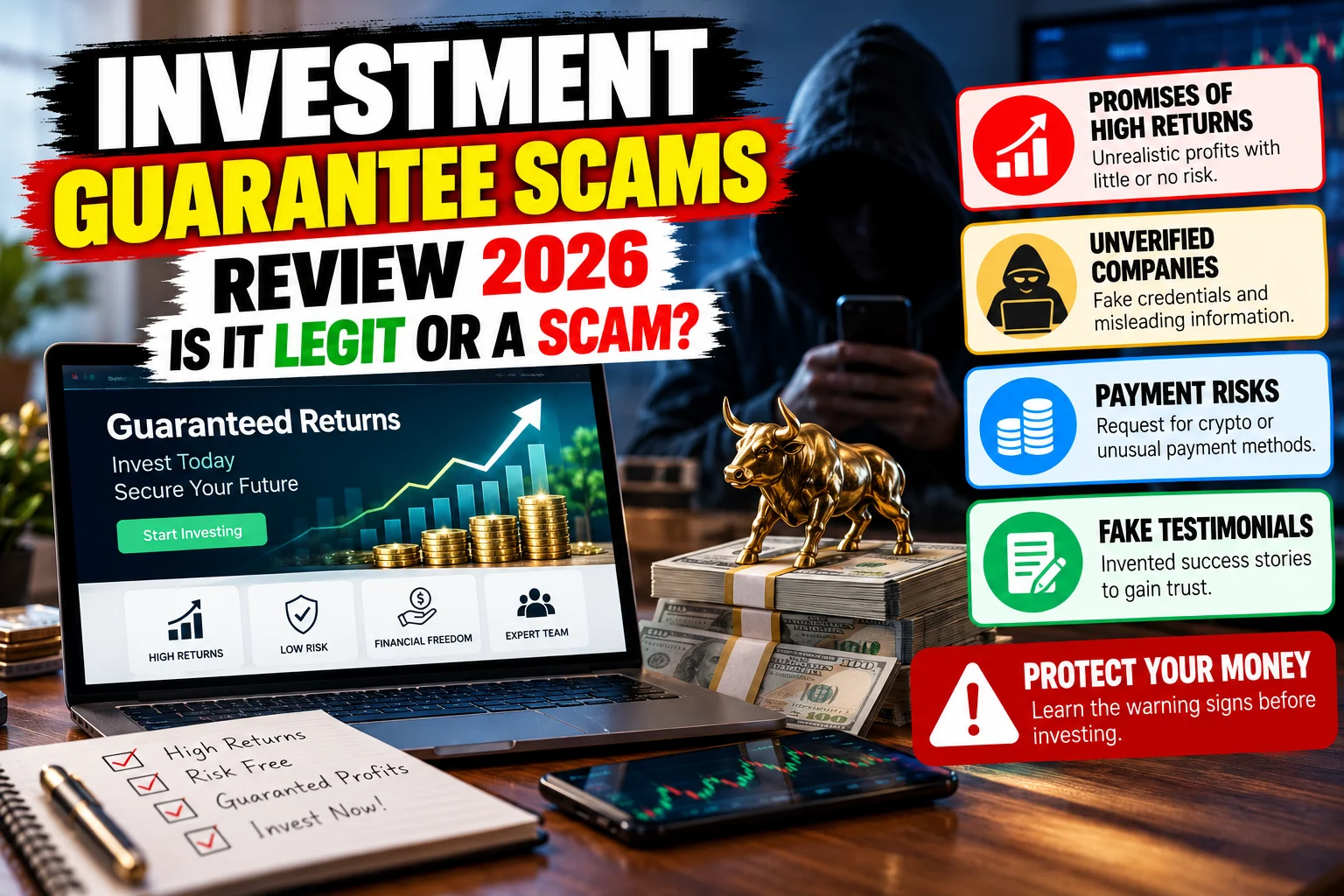
Verdict: Investment offers that guarantee unusually high returns with little or no risk are major warning signs of potential fraud. Legitimate investments can offer opportunities for growth, but returns depend on market conditions, business performance, interest rates, and other factors. No investment promising substantial profits should be trusted simply because its promoters call it “guaranteed,” display impressive earnings, or claim to use a proven strategy. Our investigation of official consumer-protection guidance found that guaranteed-return promises are a recognized warning sign of investment fraud, including schemes promoted through social media, cryptocurrency platforms, trading websites, and private investment groups.
This Investment Guarantee Scams Review 2026 examines how these schemes operate, what makes their promises suspicious, and how consumers can evaluate investment offers before handing over money. We also explain the limitations of online reputation checks, why professional-looking websites are not proof of legitimacy, and what to do if you have already transferred funds.
Research and update date: October 19, 2026.
Investment Guarantee Scams: Quick Risk Summary
| Investigation area | Findings | Risk assessment |
|---|---|---|
| Guaranteed high returns | Promises of substantial profits with little or no risk are a recognized investment-fraud warning sign. | High concern |
| Investment registration | Some fraudulent schemes involve unregistered securities or people who are not authorized to offer the relevant services. | Verify independently |
| Website credibility | Professional design, testimonials, and investment dashboards do not establish legitimacy. | Not sufficient evidence |
| Customer reviews | Reviews may be genuine, misleading, fabricated, or unrelated to the specific offer. | Use cautiously |
| Cryptocurrency payments | Crypto-related investment scams may display fabricated account balances and earnings. | Exercise extreme caution |
| Withdrawal promises | A displayed balance does not prove that money can actually be withdrawn. | Verify before investing |
| Recovery services | Requests for advance fees to recover lost investment money can indicate a second scam. | High concern |
| Overall conclusion | Guaranteed-return claims require careful scrutiny, especially when combined with pressure, secrecy, or unclear business information. | Avoid suspicious offers |
Important distinction: Investment guarantee scams are a category of deceptive activity, not one specific website or company. There is no single domain to investigate for WHOIS records, Trustpilot ratings, pricing, shipping policies, or returns. Those checks must be performed separately for each investment provider.
1. What Are Investment Guarantee Scams?
Investment guarantee scams involve claims that someone can earn a predetermined profit, receive unusually high returns, or avoid investment losses through a supposedly safe opportunity.
The offer may appear to involve a legitimate financial activity, such as stock trading, cryptocurrency, foreign exchange, real estate, gold, or a private business venture. The problem is not necessarily the type of investment. It is the promise being made and whether the person offering it can substantiate their claims.
For example, a promoter might claim that an investment will generate a fixed monthly profit regardless of market conditions. Another might promise to double an investor’s money within a short period without explaining the risks.
These claims deserve particular scrutiny when the promoter insists that the opportunity is risk-free.
The Federal Trade Commission warns consumers about investment offers promising large profits, guaranteed income, or high returns with little effort. Its guidance explains that fraudsters may use success stories, online advertisements, and claims of special investment knowledge to persuade people to part with their money.
The U.S. Securities and Exchange Commission also warns that high guaranteed returns accompanied by little or no risk are a classic warning sign of investment fraud.
The key lesson is simple: a guarantee is a claim to investigate, not proof that an investment is safe.
2. How Do Investment Guarantee Scams Work?
These schemes can be surprisingly convincing because they often borrow the appearance and language of legitimate financial services.
A typical approach may unfold in several stages.
Stage 1: Attracting attention
The promoter advertises an opportunity through social media, messaging applications, online videos, search advertisements, or investment communities.
The message might emphasize exceptional profits, financial independence, or an investment strategy supposedly unavailable to ordinary investors.
Some promotions use images of luxury vehicles, expensive homes, or impressive account balances to create an impression of success.
Others use the names or photographs of well-known businesspeople without permission. An endorsement should never be accepted as genuine without independent confirmation.
Stage 2: Building trust
After someone expresses interest, the promoter may direct them to a website, mobile application, private chat, or online investment group.
The operation might display company information, biographies, charts, performance figures, and testimonials. These details can make the service look professional.
However, their presence does not establish that the company exists as described, that its operators are qualified, or that the reported investment activity is real.
Stage 3: Encouraging a deposit
The promoter asks the prospective investor to transfer money into an account or platform.
They may describe the initial payment as an opportunity to secure a limited allocation or qualify for a special investment tier.
Pressure to act quickly is a warning sign because it prevents consumers from conducting independent checks.
Stage 4: Showing apparent profits
Some fraudulent platforms display a balance that increases after the deposit. The account may show daily earnings or impressive percentage gains.
Those numbers are not proof that actual trades occurred or that the money exists in a withdrawable account.
The FTC has warned about cryptocurrency investment schemes in which victims see fabricated reports of growing balances before the operators encourage further deposits.
Stage 5: Requesting additional money
The investor may be encouraged to deposit more to increase their returns or unlock a higher account level.
If they attempt to withdraw funds, the operator may introduce unexpected conditions or claim that additional payments are necessary.
A request for more money should be assessed independently rather than accepted simply because the platform displays a profit.
3. What Types of Investments Are Used in These Scams?
Investment guarantee scams can be attached to many different products and services. The following examples illustrate common patterns, not accusations against every business operating in these sectors.
Cryptocurrency investments
Crypto-related offers may promise fixed daily earnings, guaranteed trading profits, or returns generated by automated systems.
Promoters may claim that proprietary technology removes market risk.
Cryptocurrency markets can be volatile, and claims that a trading system eliminates risk deserve serious scrutiny. A platform’s displayed balance does not establish that funds have been invested or that withdrawals will be honored.
Forex and online trading
Foreign exchange and other trading offers may advertise highly accurate predictions, automated trading software, or exceptionally consistent profits.
A provider might suggest that its system can earn money regardless of market direction.
Legitimate trading involves uncertainty. Claims of consistent, substantial returns without meaningful risk should not be accepted at face value.
Real estate investments
A promoter may advertise a property development, rental-income arrangement, or private property investment with guaranteed returns.
Real estate can generate income, but vacancies, expenses, financing costs, market conditions, and project delays can affect results.
Before investing, consumers should establish who owns or controls the property, what legal rights the investment provides, how returns are calculated, and what risks apply.
Gold and precious metals
Some schemes use claims that gold or other precious metals provide guaranteed profits.
Although precious metals are established investment assets, their prices can fluctuate. A seller’s assurance that an asset will appreciate does not make that outcome certain.
Private investment programs
A private group may offer access to a supposedly exclusive fund, business opportunity, or investment pool.
The promoter might claim that wealthy investors, industry insiders, or experienced professionals already participate.
Such claims require independent verification. The existence of a private group or an impressive presentation does not establish that the investment is genuine.
4. Domain and WHOIS Investigation: What Can You Actually Verify?
A domain investigation can help evaluate an online investment provider, but it cannot independently determine whether an investment is legitimate.
Because this review covers a category of scams rather than a specific website, there is no single domain registration record to report.
For an individual investment website, these are the checks worth performing:
| Domain check | What to examine | What the finding means |
|---|---|---|
| Registration date | When the domain was first registered | A recently registered domain may warrant additional scrutiny, but age alone does not prove fraud. |
| Registrar | Which company manages the domain registration | Useful background information, not proof of financial legitimacy. |
| Expiration date | When the registration is scheduled to expire | A future expiration date does not establish that the operator is trustworthy. |
| Registration privacy | Whether public registration details are redacted | Privacy protection is common and is not inherently suspicious. |
| Historical records | Whether earlier versions of the website can be found | May reveal changes in business purpose or identity, although historical information can be incomplete. |
| Company identity | Whether the operator’s legal name matches independent records | Inconsistencies deserve investigation. |
| Website security | Whether HTTPS is enabled and the certificate is valid | Protects the connection but does not verify the business or investment. |
Why domain age matters
A newly registered domain may be used by a legitimate startup. Equally, an established domain can be used for deceptive purposes.
Domain age is therefore a supporting clue rather than a verdict.
A more meaningful assessment considers whether the company identity, registration status, contact details, investment claims, and payment arrangements are consistent.
Can a WHOIS report prove an investment is safe?
No.
WHOIS information can identify technical details about a domain, but it does not establish that an investment exists, that a company is financially sound, or that the people behind a website are authorized to offer financial products.
We could not independently verify domain-specific WHOIS information for this article because no particular investment website was identified.
5. Reputation Checks: Trustpilot, ScamAdviser, and Other Services
Reputation tools can provide useful leads, but their findings need context.
There is no universal Trustpilot score, ScamAdviser rating, or Gridinsoft assessment for investment guarantee scams as a category.
Any score quoted without naming a specific website would be misleading.
Trustpilot reviews
Trustpilot may contain customer feedback about a particular investment company or trading platform.
When reading reviews, consider:
- Whether the reviews describe identifiable transactions.
- Whether multiple reviewers report similar experiences.
- Whether the reviews are recent.
- Whether complaints concern withdrawals, unexpected fees, or misleading claims.
- Whether the company has responded to complaints.
- Whether the reviewer appears to be discussing the correct business.
A high rating does not guarantee financial legitimacy. A low rating also does not independently prove criminal conduct.
For a specific provider, we could not independently verify its Trustpilot status without its name or website address.
ScamAdviser
ScamAdviser evaluates websites using technical and reputation-related signals.
A positive rating should not override concerns about guaranteed returns, unclear company ownership, or unverified financial credentials.
Likewise, a low score should be treated as a reason to investigate rather than conclusive proof of fraud.
Gridinsoft and other reputation services
Other website reputation services may report domain age, technical information, reputation signals, or potential security concerns.
These checks can be helpful, particularly when several independent sources identify similar issues. However, a website’s technical reputation and an investment’s financial legitimacy are different questions.
A site can use HTTPS, have no obvious malware warning, and still present a misleading investment offer.
Our assessment: Reputation tools are useful supporting evidence, but the strongest checks concern the provider’s identity, authorization, investment documentation, and the specific claims being made.
6. Website and Company Checks: What Looks Normal and What Deserves Caution?
An investment provider’s website should make it possible to understand who operates the service and what is being offered.
The presence of professional design alone is not enough.
What looks normal
The following features can support credibility when independently verified:
- A clearly identified legal entity.
- Contact information that matches reliable external records.
- Transparent explanations of the investment.
- Written terms describing fees, risks, and withdrawal conditions.
- Verifiable authorization where required.
- Financial information appropriate to the type of investment.
- Clear explanations of how investor funds are held and managed.
- Risk disclosures that are consistent with the product being offered.
None of these features guarantees a successful investment. Together, however, they make it easier to investigate the provider.
What deserves caution
Concern increases when an investment provider:
- Guarantees unusually high profits.
- Claims that losses are impossible.
- Refuses to identify the legal entity receiving the money.
- Uses vague descriptions of its trading or investment activities.
- Provides unverifiable biographies or endorsements.
- Pressures customers to deposit immediately.
- Discourages independent financial advice.
- Changes payment instructions without a credible explanation.
- Gives unclear or contradictory information about withdrawals.
- Requests additional payments before releasing supposedly available funds.
An individual warning sign does not always establish fraud. Several serious inconsistencies, particularly when combined with guaranteed-return claims, should be taken seriously.
What could not be verified in this investigation
Because this is a category-level review, rather than an investigation of one named provider, we could not independently verify:
- A specific website’s SSL certificate.
- A company’s registered address.
- Its corporate registration.
- Its payment methods.
- Its customer-service performance.
- Its investment contracts.
- Its withdrawal policy.
- Its Trustpilot or other reputation scores.
- Its actual investment performance.
These findings must be established separately for each provider.
7. Are Guaranteed Returns Ever Legitimate?
The word guaranteed requires context.
Certain financial products may offer contractual payments or protections under specific conditions. However, these arrangements depend on the product, the issuing institution, the legal terms, and the applicable protections.
They should not be confused with an informal promise that an investment will produce unusually high profits without risk.
For example, a product may offer a stated interest rate while still exposing the investor to inflation, issuer default, liquidity restrictions, early-withdrawal penalties, or other risks.
Similarly, an investment may be described as capital-protected, but the protection may depend on the issuer remaining solvent and the investor meeting specific conditions.
Before accepting a guarantee, ask:
- Who is making the guarantee? Is it a regulated financial institution, a private company, or an unidentified individual?
- What exactly is guaranteed? Principal repayment, a contractual payment, or a projected profit?
- What conditions apply? Are there withdrawal restrictions, fees, exclusions, or maturity requirements?
- What happens if the provider fails? Is there an applicable protection scheme, and does the specific product qualify?
- Can the claim be independently verified? Do official documents support the promise?
If the promoter cannot answer these questions clearly, do not rely on the guarantee.
8. Pricing, Returns, and Investment Product Claims
Traditional shopping reviews examine product prices, shipping, returns, and product quality. Investment investigations require a different approach.
Instead of comparing retail prices, examine the promised return and the assumptions supporting it.
Examine the promised return
A statement such as “earn a fixed percentage every month” is not enough to evaluate an investment.
The provider should explain the source of the return, the strategy used, the costs involved, and the conditions under which losses can occur.
Be particularly cautious if the advertised return appears exceptionally high but the explanation is vague.
Understand the fees
Some offers advertise attractive returns without clearly explaining management charges, trading costs, performance fees, withdrawal charges, or other expenses.
A projected return may not reflect what an investor would actually receive after costs.
Ask for a complete fee schedule and written terms before committing funds.
Review the risk disclosures
A credible investment explanation should not present risk disclosures as irrelevant paperwork.
If a promoter promises large profits but dismisses every possible downside, the message is internally inconsistent.
Do not confuse historical results with future performance
Past performance does not establish that the same outcome will continue.
Screenshots, spreadsheets, testimonials, and charts are not independently verified financial statements. Even genuine historical performance may not predict future results.
We could not independently verify the performance of any particular investment product for this category-level review.
9. Payment Safety and Withdrawal Problems
The payment process can reveal important information about an investment offer.
Before transferring funds, establish who will receive the payment, why that recipient is involved, and whether the arrangement matches the provider’s legal identity.
Be cautious if an investment company asks you to send money to an unrelated individual or account without a clear, independently verified explanation.
Why displayed account balances are not enough
An online platform may show a growing balance, but the figure is only a displayed number until its underlying value and withdrawal arrangements are established.
Do not assume that an account is profitable simply because its dashboard says so.
Be wary of unexpected withdrawal charges
A provider may claim that an investor must pay an additional fee, tax, deposit, or verification charge before funds can be released.
Some legitimate financial transactions involve taxes or fees, but an unexpected payment demand should be independently verified before you act.
Do not send more money simply because the platform claims that a larger balance is waiting.
What if you have already transferred money?
Contact your bank, card issuer, or payment provider promptly and explain what happened. Ask whether any transaction can be stopped, recalled, disputed, or investigated.
Keep copies of payment confirmations, messages, account statements, contracts, and other relevant records.
Report the incident to the appropriate financial regulator or consumer-protection authority in your jurisdiction.
Be alert to follow-up messages from people claiming they can recover your money for an upfront fee. The UK’s Financial Conduct Authority warns that people who have already lost money may be targeted again by recovery scams. (FCA)
10. Customer Service and Business Transparency
A credible investment provider should make its identity and responsibilities understandable.
Look for a legal company name, a verifiable business address, reliable contact information, and written documentation explaining the investment relationship.
If the provider claims to be licensed, check the claim directly with the relevant regulator. Do not rely solely on a logo, certificate, or registration number displayed on the website.
Be careful with lookalike companies. Fraudsters may imitate legitimate firms by copying their names, branding, employee biographies, or website content.
Use contact details obtained independently from the relevant regulator or official company records rather than relying exclusively on information supplied by an unsolicited caller or message.
If a company refuses to answer basic questions about its identity or the investment, that lack of transparency is a meaningful warning sign.
For more general guidance on evaluating unfamiliar websites, see tricky magazine ‘s Deepfake Fraud Risks Review 2026 – Is It Legit or a Scam?. Although written for online shopping, the broader principle also applies to financial websites: verify the business independently rather than relying on its own claims.
11. Pros and Cons of Investment Opportunities Promising Guaranteed Returns
The term investment guarantee can describe different arrangements, so the following comparison focuses on how consumers should evaluate the claims rather than endorsing a particular product.
Potentially reassuring features
- The provider’s legal identity can be independently confirmed.
- Relevant licenses or registrations can be verified with the appropriate regulator.
- The investment terms are available in writing.
- The source of returns is explained clearly.
- Fees and material risks are disclosed.
- The meaning and limits of any guarantee are documented.
- The provider does not pressure investors into immediate decisions.
These features support further investigation, but they do not eliminate investment risk.
Concerning features
- Promises of unusually high returns with little or no risk.
- Claims that losses are impossible.
- Vague explanations of how profits are generated.
- Unverifiable credentials or testimonials.
- Pressure to deposit immediately.
- Unclear ownership or payment arrangements.
- Contradictory information about withdrawal conditions.
- Requests for additional payments to release funds.
When multiple concerning features appear together, the safest decision is to pause and seek independent verification.
12. Red Flags to Watch for in 2026
Investment scams continue to use familiar persuasion tactics across different technologies and platforms. The delivery method may change, but the underlying warning signs remain recognizable.
Watch out for these seven patterns:
1. Guaranteed profits regardless of market conditions. No promoter’s confidence should be treated as proof that an investment cannot lose money.
2. Pressure to act immediately. Claims that an opportunity will disappear within hours may be designed to prevent independent checks.
3. Unsolicited investment messages. An unexpected message from someone offering exclusive investment advice deserves scrutiny, particularly when the sender’s identity is difficult to establish.
4. Fake celebrity or professional endorsements. A familiar face or recognizable company name does not establish that the person or organization supports the offer.
5. Unverifiable performance claims. Screenshots and testimonials are not substitutes for independently confirmed records.
6. Unclear authorization. A company may use impressive financial terminology without having the authorization required for the activity it offers.
7. Unexpected demands for more money. Requests to pay additional charges before supposedly available funds can be withdrawn warrant independent verification.
The SEC’s Investor.gov guidance provides further information about these and other investment-fraud warning signs.
13. Positive Signs: What a More Credible Provider Looks Like
Not every investment offer involving a stated return is fraudulent. The objective is to distinguish documented financial arrangements from unsupported promises.
A more credible provider will generally make it possible to verify its identity, understand its services, and review the relevant terms without relying on pressure or secrecy.
Look for the following:
- Verifiable identity: The legal entity can be matched to independent records.
- Appropriate authorization: The provider’s regulatory status can be checked directly.
- Clear documentation: Fees, risks, and contractual obligations are explained.
- Realistic claims: Marketing does not suggest that ordinary investment risk has disappeared.
- Independent information: Relevant financial statements and performance claims can be assessed using reliable sources.
- Clear payment arrangements: The recipient of the money matches the documented relationship.
- Time to decide: The provider allows you to conduct checks and obtain independent advice.
Remember that even a legitimate provider can offer an unsuitable investment. Verifying a company’s identity is only one part of assessing whether a particular financial product meets your needs.
14. How to Protect Yourself Before Investing
Use the following checklist before transferring money to an unfamiliar investment provider.
- Verify the provider. Search the legal company name and check its status directly with the relevant financial regulator.
- Check the individual promoting the offer. Fraudsters can impersonate real financial professionals.
- Read the documentation. Understand what you are buying, how returns are calculated, and what could cause losses.
- Question guarantees. Ask who stands behind the promise and what legal terms support it.
- Investigate independently. Search for the company and its principals alongside terms such as complaints, warnings, and enforcement actions.
- Confirm the payment recipient. Do not rely on unexplained changes to bank details or payment instructions.
- Take your time. Do not let a deadline prevent you from carrying out essential checks.
- Consult an independent professional. Consider advice from a qualified professional who is not connected to the offer.
- Keep records. Save agreements, messages, transaction details, and the provider’s representations.
- Stop if the story does not add up. You do not need to prove that an offer is fraudulent before deciding not to participate.
15. Frequently Asked Questions
Are investment guarantee scams legitimate?
Promises of unusually high returns with little or no risk are a recognized warning sign of investment fraud. Some legitimate financial products may offer defined contractual payments or limited protections, but the terms and risks must be examined carefully. A guarantee should never be accepted solely on the promoter’s word.
Is every investment offering a guaranteed return a scam?
Not necessarily. Certain financial products may offer contractual interest, repayment terms, or specific protections. However, those arrangements have conditions and risks. Claims of exceptional profits with no possibility of loss deserve particular scrutiny.
Can I trust a website because it has HTTPS?
No. HTTPS helps protect the connection between a browser and a website, but it does not verify the operator’s identity, financial authorization, or investment claims.
Are Trustpilot and ScamAdviser ratings reliable?
They can provide useful background information, but neither should be treated as conclusive proof. Review authenticity, the specific business being assessed, the evidence behind the rating, and independent regulatory information all matter.
What should I do if an investment platform refuses to release my money?
Contact your bank or payment provider promptly and ask about available options. Preserve relevant records and report the incident to the appropriate authorities. Be cautious about anyone demanding an advance payment to recover your funds.
Can I recover money lost to an investment scam?
Recovery depends on the circumstances, the payment method, the time elapsed, and the relevant laws and financial institutions. Contact your bank or payment provider as soon as possible. Avoid recovery services that promise guaranteed results or demand unexplained upfront fees.
Final Verdict: Are Investment Guarantee Scams Legit or a Scam?
Our verdict: Investment offers promising unusually high, guaranteed returns with little or no risk should be treated as high-risk until their claims have been independently verified.
Official consumer-protection guidance consistently identifies these promises as warning signs of investment fraud. Other concerns include pressure to deposit quickly, unclear company information, unverifiable performance figures, and unexpected demands for additional money.
However, this article investigates a scam category rather than a specific website or investment provider. We could not independently verify a particular company’s domain registration, Trustpilot profile, business registration, financial authorization, customer complaints, or withdrawal policy. Those details require a separate investigation into the named provider.
Before investing, confirm who operates the service, check any required authorization directly with the relevant regulator, review the written terms, and understand the risks. Do not rely on testimonials, website design, reputation scores, or a displayed account balance as proof that an investment is safe.
The bottom line: A legitimate investment should withstand reasonable questions and independent checks. If the offer depends on promises of effortless profits, pressure, or claims that risk does not exist, walking away is safer than relying on a guarantee you have not verified.
SEO Details
SEO title: Investment Guarantee Scams Review 2026: Legit or a Scam?
Meta description: Are investment guarantee scams legit or a fraud? Learn the warning signs, guaranteed-return risks, reputation checks, and ways to protect your money in 2026.
Suggested URL slug: investment-guarantee-scams-review
Primary keyword: Investment guarantee scams review
Secondary keywords:
- Investment guarantee scams
- Investment guarantee scams reviews
- Investment guarantee scam warning signs
- Are guaranteed investment returns legit?
- Investment guarantee fraud
- Guaranteed returns investment scam
- How to identify investment scams
- Investment scam protection 2026