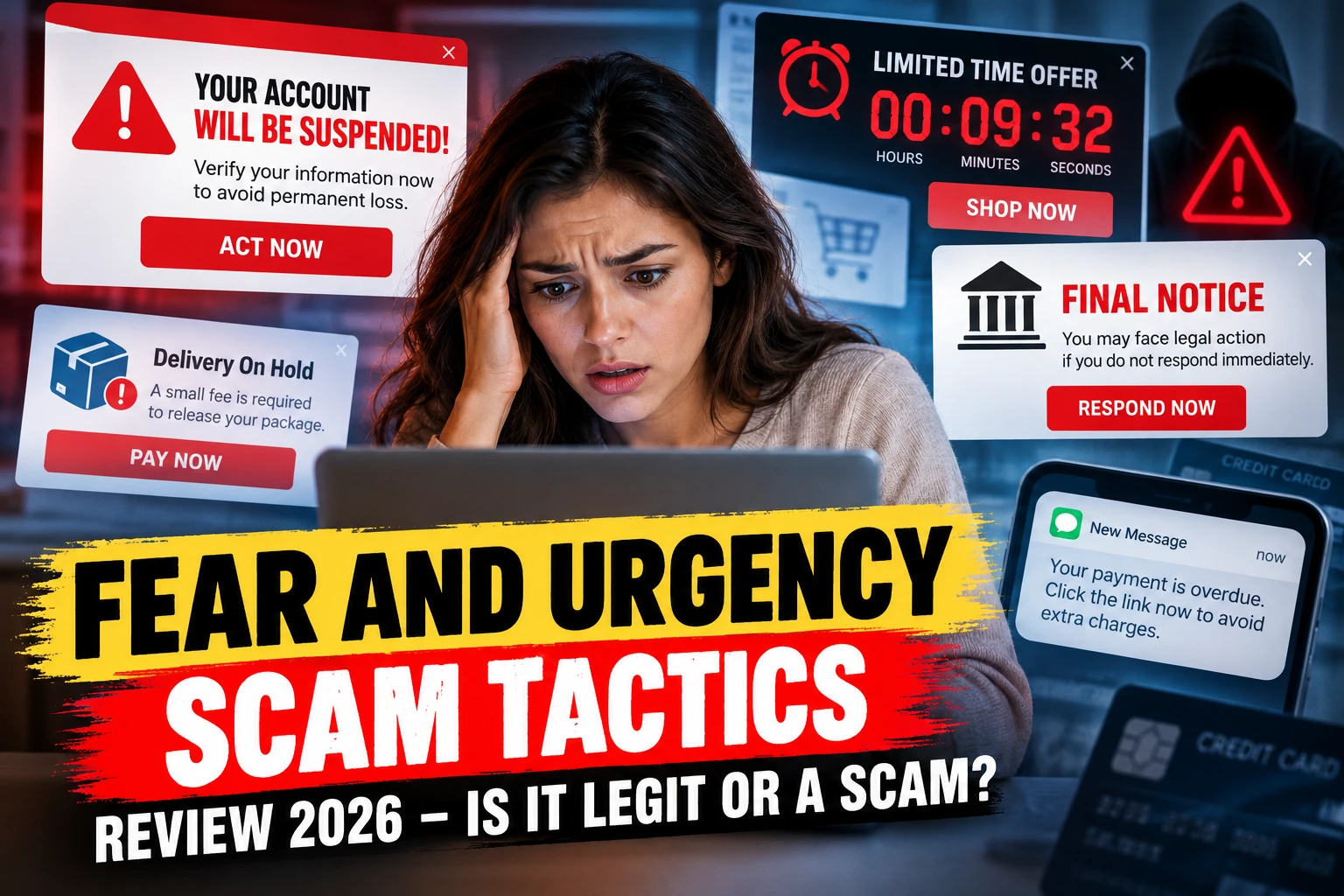
Fear and urgency are common tactics used in online scams, fraudulent shopping promotions, fake security warnings, and impersonation schemes. The tactics themselves are not a website, company, or shopping service, so they do not have a domain registration date, WHOIS record, Trustpilot rating, or individual scam score. Our assessment is that fear-based pressure deserves serious attention when it is used to force people into making payments, revealing personal information, or purchasing products before they can verify the claims. Legitimate businesses sometimes use countdown timers and limited-time offers, but threats, fabricated emergencies, and demands for immediate payment are significant warning signs.
In this investigation, we examine how fear and urgency scam tactics work, the evidence behind common warning signs, and how consumers can distinguish ordinary marketing from potentially fraudulent pressure. We also explain what to do if a website, message, phone call, or online advertisement makes you feel that you must act immediately.
Quick Risk Check: Fear and Urgency Scam Tactics
| Category | Findings |
|---|---|
| Subject | Fear-based pressure and urgency in scams |
| Type | Consumer fraud and social-engineering tactics |
| Is it a specific website? | No |
| Domain registration date | Not applicable |
| WHOIS information | Not applicable |
| Trustpilot rating | Not applicable to the tactic itself |
| ScamAdviser rating | Not applicable to the tactic itself |
| Common targets | Online shoppers, account holders, job seekers, investors, and other consumers |
| Common warning signs | Threats, artificial deadlines, alarming messages, and demands for immediate payment |
| Common payment concerns | Requests for gift cards, cryptocurrency, wire transfers, or other difficult-to-reverse payments |
| Can legitimate businesses use urgency? | Yes, but urgency alone does not prove fraud |
| Overall assessment | High caution when pressure prevents independent verification |
| Recommended response | Stop, verify the claim independently, and avoid rushed payments |
Important distinction: Fear and urgency are not automatically evidence of fraud. The concern arises when someone uses pressure to discourage questions, prevent independent verification, or push a person into an unsafe financial decision.
1. What Are Fear and Urgency Scam Tactics?
Fear and urgency scam tactics are methods used to influence decisions by making people believe that something bad will happen unless they act immediately.
The threat might involve losing money, having an account closed, missing a special offer, being arrested, receiving a large bill, or losing access to an important service.
In other cases, the pressure is positive rather than frightening. A seller may claim that a valuable product is almost sold out or that a special discount will disappear in a few minutes.
The emotional effect is similar: the person feels they have little time to think.
The US Federal Trade Commission (FTC) identifies pressure to act immediately as a warning sign of scams. Its consumer guidance explains that scammers may create a sense of panic to prevent people from checking whether their claims are genuine.
Why does urgency matter?
When someone believes they are facing an emergency, they may focus on resolving the immediate problem rather than examining the information presented to them.
A message claiming that an account is about to be suspended can encourage someone to click a link without checking the sender. A countdown timer may persuade a shopper to purchase an item before reading the refund policy. A caller pretending to represent an authority may pressure someone into making a payment before contacting the organisation directly.
The pressure itself does not establish that a claim is false. It does mean that the claim deserves careful verification before the consumer acts.
2. How Fear-Based Scams Work
Fear-based scams often follow a recognisable pattern.
First, the scammer introduces a problem or opportunity that demands attention. Next, they create pressure by setting a deadline, threatening a consequence, or insisting that the situation cannot wait. Finally, they direct the target toward a specific action, such as clicking a link, sharing a password, transferring money, or completing a purchase.
The FTC describes a similar pattern in its consumer guidance: scammers may claim that a person is in trouble, create pressure to act immediately, and insist on a particular payment method. These techniques can appear in impersonation scams, financial fraud, and other deceptive schemes.
Step 1: Create an emotional trigger
The message may suggest that the consumer is about to lose something important.
Examples include:
- An account supposedly being suspended.
- A payment supposedly being overdue.
- A delivery supposedly being held.
- A computer supposedly being infected.
- A product supposedly becoming unavailable.
- A supposedly exceptional investment opportunity disappearing.
Some of these situations can occur legitimately. The problem is when the sender uses an unverified claim to create panic and discourage the recipient from checking the facts.
Step 2: Introduce a deadline
The person may be told that they have only a few minutes to respond.
A shopping website might display a countdown. A caller might say that an account must be verified during the current conversation. An email might claim that a payment must be made before the end of the day.
Deadlines are not inherently fraudulent. Genuine sales, billing arrangements, and account procedures can involve deadlines.
A deadline becomes more concerning when the sender refuses to explain the terms, will not allow time for verification, or claims that ordinary safety checks must be skipped.
Step 3: Direct the target toward a specific action
After creating pressure, the sender usually presents a solution.
The recipient might be asked to pay a fee, enter account details, download software, provide personal information, or purchase a product.
At this point, it is important to ask whether the proposed action actually resolves a verified problem.
If the claim has not been independently confirmed, following the sender’s instructions may create a new risk rather than solve the supposed emergency.
3. Common Types of Fear and Urgency Scams
Fear-based pressure appears in several different forms. Recognising the context can help consumers identify when a message needs further investigation.
Fake account suspension warnings
A message may claim that an email, banking, shopping, or social media account will be closed unless the recipient clicks a link.
The link may lead to a page designed to collect login details or other sensitive information.
What to check: Open the service through its official app or a website address you already know. Check account notifications there instead of relying on a link supplied in an unexpected message.
Fake security and technical support warnings
Some deceptive messages claim that a device has been infected or that personal information is at immediate risk.
The sender may encourage the recipient to call a telephone number, install software, or pay for a supposed repair.
The FBI warns that technical-support scammers impersonate legitimate companies and create urgency to persuade people to pay for unnecessary services or give access to their devices.
An alarming pop-up is not sufficient evidence that a computer has been compromised. Likewise, a caller’s claim to represent a technology company does not establish their identity.
Fake legal or government threats
A scammer may claim that a person faces arrest, legal action, a fine, or another serious consequence unless payment is made immediately.
The threat can be especially persuasive when the sender uses official-sounding language or personal details.
Do not assume a message is authentic because it includes a reference number, a logo, or a person’s name. Verify the matter through independently obtained official contact information.
Fake delivery and customs messages
Consumers may receive messages claiming that a parcel is being held and that an immediate payment is required.
Some delivery companies do charge legitimate fees in certain circumstances, so the existence of a fee is not automatically suspicious.
The warning sign is an unverified message that pressures the recipient to provide payment or personal information through an unfamiliar link.
Check the shipment using the delivery company’s official tracking service and the tracking number from the original order.
Fake shopping discounts and stock warnings
Online retailers sometimes use phrases such as “limited-time offer,” “last chance,” or “only a few left.”
These claims can be legitimate, but they can also be used to encourage impulsive purchases.
Be particularly cautious when a large discount is combined with a newly encountered store, little independent customer feedback, unclear business information, or an unfavourable return policy.
A countdown timer is not proof of a scam. It is also not proof that the offer is genuine.
Investment and financial opportunity scams
A person may be promised an unusually profitable opportunity that supposedly must be accepted immediately.
The sender may claim that a special allocation, exclusive investment, or guaranteed return will disappear if the recipient delays.
Urgency is especially concerning when combined with claims that an investment is risk-free or that the person should not consult anyone else.
Financial decisions deserve independent research. No deadline should replace an understanding of the risks, costs, and terms involved.
4. Website and Message Warning Signs
Fear and urgency scams do not always contain obvious spelling mistakes or poorly designed pages. A message can appear professional and still make claims that have not been verified.
The following signs deserve attention when they appear together.
| Warning sign | Why it matters | What to do |
|---|---|---|
| A demand to act immediately | Reduces time for checking the claim | Pause and verify independently |
| Threats of arrest or severe consequences | May be designed to trigger panic | Contact the relevant organisation through an independently verified channel |
| An unfamiliar payment link | May lead to a fraudulent payment page | Check the request through the official service |
| Requests for passwords or security codes | Could allow account access | Do not share authentication details with an unverified sender |
| Unusually large discounts | May encourage a rushed purchase | Compare prices and investigate the seller |
| A countdown that repeatedly resets | Can create artificial pressure | Do not treat the timer as proof of a genuine deadline |
| Unclear business identity | Makes it harder to establish who is responsible | Check the company details and contact information |
| Pressure to keep the matter secret | Prevents others from identifying warning signs | Seek an independent opinion |
| Requests for unusual payment methods | May make recovery difficult | Verify the request and use established payment channels |
| Refusal to provide written terms | Prevents informed decision-making | Do not commit until the terms are clear |
No single item on this list proves fraud in every situation. The strongest concern arises when several warning signs appear together and the sender actively discourages verification.
5. Can a Countdown Timer Mean a Website Is a Scam?
Not necessarily.
Retailers use countdowns for genuine promotions, scheduled launches, seasonal sales, and limited-duration discounts. The existence of a timer is not sufficient evidence that a website is fraudulent.
The more important question is whether the promotion is presented honestly.
What should shoppers investigate?
Does the deadline have a clear explanation?
A sale tied to a published promotion period is easier to understand than a timer with no explanation.
Does the offer change when the timer expires?
If the same offer immediately restarts without a clear reason, the countdown may be intended to create pressure rather than communicate a meaningful deadline.
Is the advertised price reasonable?
Compare the product with equivalent items from other sellers. A large claimed discount is not necessarily a real saving if the reference price is misleading.
Can you find the terms?
Check shipping charges, return eligibility, refund conditions, and any recurring payments before completing the purchase.
Is the retailer independently verifiable?
Look for credible customer feedback, consistent business information, and contact details that can be checked independently.
A website may have a genuine promotion and still provide poor service. Conversely, a countdown alone does not establish that a retailer is dishonest.
The sensible approach is to evaluate the overall evidence rather than make a decision based on one design feature.
6. Fear and Urgency in Fake Online Shopping Stores
Online shopping scams often combine emotional pressure with attractive prices.
A consumer may see a heavily discounted product in a social media advertisement, visit an unfamiliar store, and encounter a message claiming that the offer will expire shortly.
The combination can make it tempting to purchase before checking the retailer’s history.
The FBI’s Internet Crime Complaint Center has previously warned about fraudulent online retailers advertising products at unusually low prices. Its public guidance describes complaints involving non-delivery, misleading contact details, and website content copied from legitimate retailers.
These reports demonstrate why consumers should evaluate the seller rather than relying solely on an appealing advertisement.
What should you check before buying?
Start with the store’s identity. Is a legal business name provided? Can the published address be verified? Does the contact information appear consistent across the website’s pages?
Next, examine the product listing. Are the material, dimensions, specifications, and shipping estimates clear? Do the photographs and descriptions appear consistent?
Then review the return policy. Who pays return shipping? Is the return address disclosed? Are there deadlines or exclusions that could make a refund difficult?
Finally, look for independent customer feedback. A retailer’s own testimonials are not equivalent to a history of reviews on independent platforms.
For more practical checks, read tricky magazin’s guide to the Refund Scams Explained: How Fake Refunds and Recovery Schemes Really Work
7. Fear-Based Scams Versus Legitimate Urgency
Not every urgent message is fraudulent. Consumers sometimes have real deadlines to meet, and businesses may reasonably limit the duration of an offer.
The difference is often found in the way the deadline is communicated and whether the claim can be verified.
| Situation | More consistent with a legitimate request | More concerning |
|---|---|---|
| A sale is ending | The promotion has clear terms and a stated end date | The timer resets repeatedly without explanation |
| An account needs attention | The notice can be confirmed through the official account | The message demands login details through an unexpected link |
| A parcel requires action | The request matches the order and can be checked through official tracking | The message demands immediate payment through an unfamiliar page |
| A payment is overdue | The bill appears in the official account or verified statement | A caller threatens immediate arrest unless payment is made |
| A product is selling quickly | Stock information is presented without discouraging questions | The seller pressures shoppers to pay before checking the business |
| A security problem is reported | The issue can be checked using trusted security tools or official support | A pop-up demands payment or remote access immediately |
These comparisons are indicators, not absolute rules. Legitimate organisations can send poorly worded messages, and scammers can imitate professional communications.
Verification matters more than appearance.
8. WHOIS and Domain Checks: Do They Help Identify Urgency Scams?
WHOIS records contain information about a domain’s registration, such as its creation date, registrar, expiration date, and sometimes the registrant’s details.
These records can help when investigating a specific website, but they cannot establish whether a general tactic is legitimate.
Because “fear and urgency scam tactics” is a category rather than a specific domain, there is no single WHOIS record or domain age to report for this topic.
If a particular online store uses aggressive urgency marketing, its domain history may provide useful context.
For example, a very recently registered domain combined with a large discount, missing business details, copied product descriptions, and no meaningful independent reputation may justify additional caution.
A recently registered domain alone does not prove fraud. Established domains can also be used for deceptive purposes, and legitimate new businesses need time to build a reputation.
Likewise, WHOIS privacy is common and should not automatically be treated as a red flag.
The best approach is to combine domain information with independent customer feedback, business transparency, product information, payment arrangements, and the site’s published policies.
9. Trustpilot, ScamAdviser, and Other Reputation Checks
Reputation services can be useful when investigating a particular company or website. They are not ratings of fear and urgency tactics as a category.
Trustpilot
Trustpilot hosts customer reviews of individual businesses. If an unfamiliar retailer has a profile, examine the overall rating alongside the number of reviews, the dates of recent feedback, and recurring complaints.
Pay attention to reports about non-delivery, product differences, refund problems, and customer-service communication.
A high rating does not guarantee that every transaction will go well, and a low rating does not automatically prove criminal activity.
ScamAdviser
ScamAdviser provides automated assessments of individual websites. Such assessments may consider domain information, technical signals, and other available indicators.
A score should be treated as a prompt for further investigation rather than a final judgment.
Gridinsoft and other security tools
Security services may identify suspicious technical behaviour, malware-related concerns, or other signals associated with a domain.
A clean technical result does not prove that a retailer fulfils orders reliably. Similarly, a low automated trust score does not independently establish that a business has committed fraud.
What if no independent reviews exist?
A lack of reviews is not proof of a scam, especially for a new or specialised business.
It does mean that consumers have less independent evidence about product quality, shipping performance, and customer support.
When reputation information is limited, look for stronger transparency in other areas and avoid making a rushed decision because of a countdown or a supposed last-chance offer.
For more warning signs to consider, read tricky magazine’s guide to Common Fake Website Red Flags: How to Spot Suspicious Sites Before You Buy
10. Payment Safety: Why Pressure to Pay Immediately Matters
One of the most important questions is what the sender wants you to do.
A message that asks you to verify a claim through an official account is different from a message that demands an immediate transfer to an unfamiliar recipient.
Be especially cautious when someone insists on a payment method that is difficult to reverse or challenges you for questioning the request.
Examples include demands for gift cards, cryptocurrency transfers, or wire transfers to resolve an unverified emergency.
These payment methods have legitimate uses, but an unexpected demand to use one can be a significant warning sign.
What should consumers do?
- Verify the identity of the person or organisation requesting payment.
- Check the claim through an independently obtained official contact channel.
- Read the terms before paying.
- Do not share passwords, one-time security codes, or banking credentials with an unverified sender.
- Keep receipts and correspondence for transactions you decide to make.
- If you suspect fraud, contact your financial institution or payment provider promptly.
Payment protections vary by provider and transaction type. Do not assume that every payment can be reversed.
11. What We Could and Could Not Verify
Because this article investigates a category of scam tactics rather than a named retailer, some checks do not apply.
| Investigation area | Finding |
|---|---|
| WHOIS and domain registration | Not applicable to the category itself |
| Domain age and registrar | Not applicable |
| Trustpilot rating | Not applicable to the tactic itself |
| ScamAdviser score | Not applicable to the tactic itself |
| Product prices | No single product catalogue exists for this category |
| Shipping and return policies | Depend on the individual retailer or service |
| Payment methods | Depend on the specific transaction |
| Customer complaints | Must be investigated for each named business or scheme |
| General pressure tactics | Documented in consumer-protection guidance |
| Risks of rushed decisions | Supported by official anti-scam guidance |
| Individual fraudulent websites | Require separate investigation before conclusions can be drawn |
We could not independently verify a particular website’s legitimacy, customer-service performance, domain history, or refund record because no specific domain was provided.
This distinction is important. It would be misleading to assign a trust score, invent customer complaints, or claim that a particular business is fraudulent when the subject is a general category of behaviour.
12. Pros and Cons of Fear and Urgency as a Warning Signal
Fear and urgency can help consumers recognise suspicious behaviour, but these signals should be interpreted carefully.
| Advantages of recognising the tactic | Limitations |
|---|---|
| Helps identify pressure designed to prevent verification | Legitimate businesses sometimes use genuine deadlines |
| Encourages consumers to pause before paying | Urgency alone does not prove fraud |
| Highlights threats and unusual payment demands | Scammers may use polished websites and professional language |
| Encourages independent verification | Some genuine account or delivery issues require timely attention |
| Helps consumers recognise emotional manipulation | No single warning sign can determine legitimacy in every case |
The main benefit is that recognising pressure can create an opportunity to verify a claim before taking action.
The limitation is that consumers should not automatically classify every limited-time offer or urgent notice as fraudulent. The surrounding evidence matters.
13. What to Do If You Receive a Fear-Based Scam Message
If a message makes you feel frightened or rushed, take a deliberate approach.
First, pause. You do not need to accept the sender’s deadline as genuine merely because the message states one.
Second, avoid using the contact details supplied in the unexpected message. Instead, open the relevant service through its official app or use contact information you obtain independently.
Third, check the claim. If a message says that an account is suspended, inspect the account directly. If it claims that a parcel is delayed, check the tracking details associated with the original order.
Fourth, do not provide sensitive information until the request is verified. This includes passwords, authentication codes, banking credentials, and unnecessary personal information.
Fifth, keep relevant records if you suspect fraud. Save the message, email address, telephone number, payment receipt, and other available evidence.
Finally, seek help when necessary. Contact the relevant company or financial institution through an independently verified channel. If you have already paid, contact your payment provider promptly and ask what options may be available.
Do not let embarrassment prevent you from seeking assistance. Scams are designed to influence decisions, and a person can make a rushed decision without being careless or unintelligent.
14. Final Verdict: Are Fear and Urgency Scam Tactics Legit or Fraudulent?
Our verdict: Fear and urgency are recognised manipulation techniques that deserve caution when used to pressure people into unverified payments, disclosures, or purchases.
The strongest warning sign is not urgency by itself. It is pressure combined with threats, secrecy, unusual payment demands, requests for sensitive information, or resistance to independent verification.
Official consumer-protection guidance supports taking these signals seriously. The FTC identifies immediate pressure as a warning sign, while the FBI has documented schemes in which scammers create urgency to persuade targets to pay or provide access to devices and accounts.
At the same time, a genuine promotion can have a real deadline, and legitimate organisations sometimes need consumers to respond to time-sensitive issues. The presence of a countdown timer or an urgent message does not automatically prove fraud.
Because this is a category review rather than an investigation of one named website, there is no individual domain age, Trustpilot score, or business rating to report.
The most practical conclusion is straightforward: do not allow fear or a deadline to replace verification. If a claim cannot be checked independently, avoid making an irreversible payment or sharing sensitive information until you have established that the request is genuine.
Frequently Asked Questions
1. What are fear and urgency scam tactics?
Fear and urgency scam tactics pressure people into acting before they can verify a claim. They may involve threats, alarming messages, artificial deadlines, or claims that an offer or opportunity will disappear unless the person acts immediately.
2. Is every countdown timer on a shopping website a scam?
No. Retailers can use countdown timers for legitimate promotions and scheduled sales. A timer deserves closer scrutiny when it repeatedly resets, has no clear explanation, or appears alongside misleading discounts and pressure to purchase without checking the terms.
3. How can I tell whether an urgent message is genuine?
Verify the claim independently through the organisation’s official app, website, or contact channel. Do not rely solely on links, telephone numbers, or payment instructions supplied in an unexpected message.
4. Why do scammers use fear to influence decisions?
Fear can make a person focus on resolving a supposed emergency rather than examining the evidence. Scammers exploit this reaction to discourage questions and encourage quick payments, disclosures, or other actions that benefit them.
5. Are fear and urgency scam tactics associated with one website?
No. These are techniques used across many types of scams, including shopping fraud, impersonation, fake security warnings, and financial schemes. A specific website must be investigated separately before its legitimacy can be assessed.
6. What should I do if I have already paid after receiving an urgent scam message?
Contact your bank or payment provider promptly and explain what happened. Keep relevant receipts and communications, ask what dispute or recovery options may be available, and report the suspected fraud to the appropriate authority in your jurisdiction.
SEO Details
SEO Title: Fear and Urgency Scam Tactics Review 2026: Warning Signs
Meta Description: Learn how fear and urgency scam tactics work in 2026, from fake threats and countdown timers to payment pressure. Discover warning signs and ways to protect yourself.
URL Slug: fear-and-urgency-scam-tactics
Primary Keyword: Fear and urgency scam tactics review
Secondary Keywords:
- Fear and urgency scam tactics
- Urgency scam warning signs
- Fear-based online scams
- Fake countdown timer scams
- Online shopping pressure tactics
- How to recognise scam pressure
- Is an urgent message a scam
- Fake limited-time offers
- Scam manipulation tactics
- Online shopping scam prevention
Featured Image Alt Text: Fear and urgency scam tactics review 2026 showing a worried online shopper facing an urgent warning message, a countdown timer, and alerts about payment pressure, fake threats, and suspicious online offers.
Research and update date: October 16, 2026. This article examines documented scam tactics and official consumer-protection guidance. It does not assign a trust score to a specific website because no individual domain was provided.