Some scams are designed to steal a small payment. Others can cost victims their savings, expose personal information or leave them dealing with identity theft long after the original contact has disappeared. In 2026, investment fraud, impersonation, online shopping fraud, romance scams, fake job offers and phishing remain among the categories consumers should understand. Official reports show that these schemes are not isolated incidents: they affect people through websites, social media, emails, phone calls and messaging platforms.
There is no single website behind these scams, so a traditional website legitimacy verdict would not apply. Instead, this investigation examines the most dangerous scam categories using recent findings from the US Federal Trade Commission (FTC) and FBI, explains how each commonly works, and identifies warning signs that can help consumers avoid becoming victims.
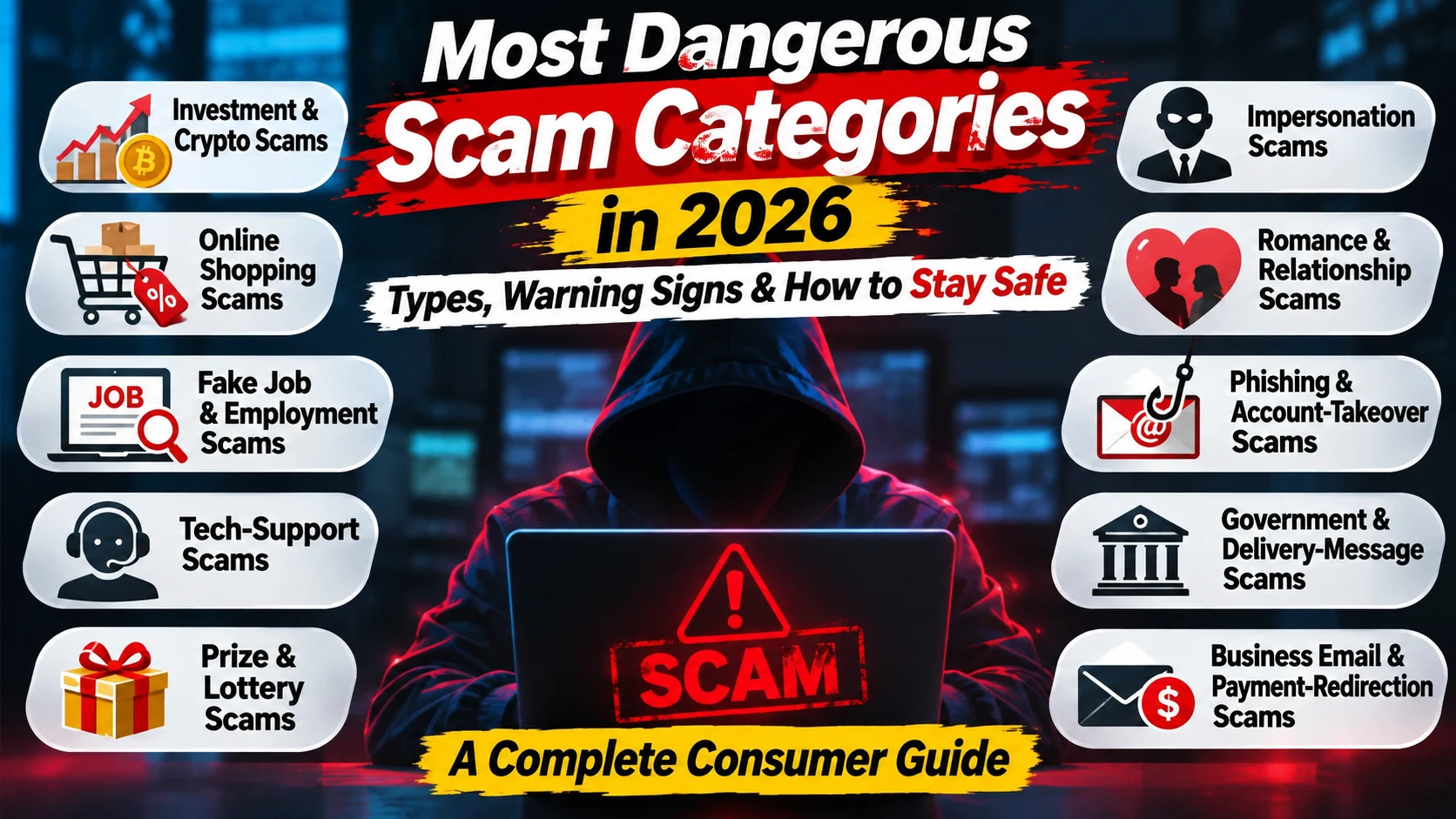
Quick Risk Check: The Most Dangerous Scam Categories
| Scam Category | Main Risk | Common Warning Sign | Risk to Consumers |
|---|---|---|---|
| Investment and cryptocurrency scams | Financial loss | Guaranteed or unusually high returns | Very high |
| Impersonation scams | Financial loss and personal-data theft | Someone pretends to be a trusted organisation | Very high |
| Online shopping scams | Payment loss and counterfeit goods | Unfamiliar stores with unrealistic offers | High |
| Romance and relationship scams | Financial and emotional exploitation | Online contact eventually asks for money | Very high |
| Job and employment scams | Money and identity theft | Requests for fees or sensitive information | High |
| Phishing and account-takeover scams | Account and identity compromise | Urgent messages asking for login details | High |
| Tech-support scams | Financial loss and device or account access | Unexpected warnings demanding immediate action | High |
| Government and delivery-message scams | Payment and personal-data theft | Threats, penalties or urgent payment demands | High |
| Prize and lottery scams | Advance-fee fraud | Payment required to receive a supposed prize | High |
| Business email and payment-redirection scams | Large financial transfers | Unexpected changes to payment instructions | Very high |
These categories overlap. For example, an investment scam may begin with a social-media message, move to a messaging app and eventually direct someone to a fake trading website. The categories below describe the main deception involved, not necessarily separate methods of contact.
Why Scam Categories Deserve More Attention in 2026
Recent official figures show why consumers should take online fraud seriously.
The FBI’s 2025 Internet Crime Report recorded 1,008,597 complaints and nearly $21 billion in reported losses from cyber-enabled crimes. Its report identified phishing and spoofing, extortion and investment schemes among the most frequently reported complaint categories. Investment fraud was a particularly significant source of financial losses.
The FTC also reported that people lost $2.1 billion to scams that started on social media in 2025. Investment scams accounted for $1.1 billion of those reported social-media losses, while shopping scams were the most frequently reported type of social-media scam among people who said they lost money.
These figures are based on reports received by US authorities. They do not represent every scam worldwide, and many incidents are never reported. Still, they provide a useful picture of the threats consumers encounter.
1. Investment and Cryptocurrency Scams
Investment scams are among the most financially damaging forms of fraud. They often promise unusually high returns, easy profits or access to an exclusive investment opportunity.
A scammer may approach someone through social media, a messaging group, an online advertisement or an unsolicited message. The person is then encouraged to invest through a website or application that appears professional. It may display account balances and apparent profits, even when no genuine investment is taking place.
Some schemes involve cryptocurrency. Others pretend to offer shares, foreign exchange trading, automated trading systems or investment education.
Warning Signs
- Returns are described as guaranteed or risk-free.
- Someone promises unusually large profits in a short time.
- The person contacting you pressures you to invest quickly.
- The investment cannot be clearly explained.
- You are directed to an unfamiliar platform.
- The person asks you to transfer money to a personal account or an unfamiliar wallet.
- You are told to keep the opportunity secret.
A displayed profit is not proof that an investment is real. A convincing dashboard can be created without genuine trading activity.
How to Protect Yourself
Do not make investment decisions based on messages from strangers or online acquaintances. Never rely solely on testimonials, screenshots of profits or claims that other people have already made money. Discuss unfamiliar financial offers with a trusted adult or qualified financial professional before taking action.
2. Impersonation Scams
Impersonation scams work by pretending to be someone the victim recognises or trusts. The scammer may claim to represent a bank, government department, delivery company, online platform, employer or even a family member.
The message usually creates a reason to act. It might claim that an account has been compromised, a payment is overdue, a parcel cannot be delivered or a relative needs urgent help.
The FTC reported that imposter scams remained its most frequently reported scam category in 2025, with more than one million reports and approximately $3.5 billion in reported losses.
Warning Signs
- The message creates panic or demands immediate action.
- The sender asks for passwords, verification codes or banking details.
- A caller insists that you must not contact anyone else.
- A supposed official demands payment through unusual methods.
- The sender’s email address or phone number does not match the organisation’s known contact details.
- A person claims to be a relative but communicates in an unusual way.
How to Protect Yourself
Stop and verify the request independently. If a message claims to come from a bank, delivery service or government department, contact the organisation through its official app or a contact method you already know is genuine. Do not use telephone numbers or links supplied in a suspicious message.
3. Online Shopping Scams
Online shopping scams are especially easy to encounter because fraudulent stores can look like ordinary retailers.
A fake store may advertise clothing, electronics, beauty products, accessories or household goods at unusually low prices. Its website might contain product photographs, reviews, a shopping cart and a checkout page. These details can create the appearance of a genuine business without proving that the seller is reliable.
Some customers report paying for products that never arrive. Others receive counterfeit items, damaged goods or products that differ significantly from the advertisements.
The FTC’s 2026 analysis of social-media scams found that shopping scams were the most commonly reported type of social-media scam among people who lost money through those platforms. More than 40% of such consumers said the scam began with an order for something advertised on social media.
Warning Signs
- Prices are dramatically lower than those at established retailers.
- The store has little independent customer feedback.
- Contact information is missing or difficult to verify.
- Product photographs and descriptions appear inconsistent.
- The return address or refund procedure is unclear.
- The website pressures visitors to buy immediately.
- The seller accepts only payment methods with limited buyer protection.
How to Protect Yourself
Research the store before ordering. Search its name alongside terms such as “reviews” and “complaints”, and check whether the business provides clear contact details and realistic return conditions.
A padlock symbol in the browser only indicates an encrypted connection. It does not prove that the shop is legitimate.
For more guidance, see our article on Fake Recruitment Websites.
4. Romance and Relationship Scams
Romance scams exploit trust and emotional connection. A scammer may contact someone through a dating service, social platform or messaging application and gradually build a relationship.
The person may claim to live far away, work overseas or have difficulty meeting in person. After developing a sense of trust, they introduce a financial problem or ask for help with an emergency.
Another variation involves a supposed romantic interest who offers investment advice. The person may encourage the victim to use a fake trading platform or send money to an account they control.
Warning Signs
- Someone quickly declares strong feelings without meeting in person.
- They repeatedly avoid video calls or in-person meetings.
- They invent emergencies that require financial help.
- They ask for gift cards, cryptocurrency or bank transfers.
- They discourage you from discussing the relationship with friends or family.
- They introduce an investment opportunity after building trust.
How to Protect Yourself
Never send money or financial information to someone you have only met online. Do not allow an online contact to make investment decisions on your behalf. If a person pressures you to keep financial requests secret, speak with someone you trust.
A genuine relationship should not depend on sending money or providing access to financial accounts.
5. Fake Job and Employment Scams
Fake job scams target people looking for work, including students seeking part-time opportunities and people applying for remote positions.
A fraudulent recruiter may advertise an attractive role with flexible hours and unusually high pay. The applicant may be asked to pay a registration fee, purchase equipment from a specific seller or provide identity and banking information before the employer has been properly verified.
Some scams involve fake task-based jobs. The applicant is told to complete simple online activities and may initially see a small payment. Later, they are asked to deposit money to unlock additional tasks or withdraw supposed earnings.
Warning Signs
- You receive a job offer without a meaningful interview.
- The salary is unusually high for very little work.
- The recruiter asks for money before employment begins.
- You are told to deposit funds to complete tasks.
- The company uses an email address unrelated to its official business domain.
- The recruiter requests sensitive personal information unusually early.
- The job description is vague about responsibilities.
How to Protect Yourself
Check the employer’s official website and contact its recruitment department independently. Do not pay someone simply to receive a job offer. Be especially cautious if the recruiter asks you to transfer money, receive funds for someone else or share account credentials.
6. Phishing and Account-Takeover Scams
Phishing is a method of tricking people into revealing information or opening malicious links. It can arrive through email, text messages, social-media messages or fake websites.
A phishing message may claim that an account will be suspended unless the recipient verifies their identity. It may imitate a bank, shopping service, school, social platform or delivery company.
The link leads to a page designed to look like the real service. If someone enters their login details, the information may be captured by the scammer.
Warning Signs
- A message demands immediate password verification.
- The link uses a misspelled or unfamiliar domain.
- The sender asks for a one-time verification code.
- An attachment arrives unexpectedly.
- The message threatens account closure or legal action.
- The website address does not match the official service.
How to Protect Yourself
Do not follow unexpected login links. Open the official app or type the known website address yourself. Use unique passwords and enable multifactor authentication where available. Never share verification codes with someone who contacts you unexpectedly.
7. Tech-Support Scams
Tech-support scams often begin with a frightening warning about a computer, phone or online account.
A fake support representative may claim that a device has a virus or that an account has been compromised. They may encourage the victim to call a number, install software or pay for a service that is not genuine.
Some versions involve impersonating a well-known technology company. Others begin with an unexpected phone call from someone claiming to have detected a problem.
Warning Signs
- A pop-up claims that your device is infected and demands an immediate call.
- An unexpected caller claims to be technical support.
- Someone asks for remote access to your device.
- The representative demands payment to remove a supposed threat.
- You are told to ignore warnings from your actual security software.
How to Protect Yourself
Do not call numbers displayed in unexpected security pop-ups. Close the page and use the official support channels of the device or software provider. Never give remote access to someone whose identity you have not independently confirmed.
8. Government, Toll and Delivery-Message Scams
These scams imitate public authorities, transport agencies or delivery services. A message may claim that an unpaid toll, customs charge, fine or delivery fee must be paid immediately.
The sender may threaten a penalty, account restriction or legal action if payment is not made. The link usually leads to a fake payment page designed to collect card details or personal information.
Warning Signs
- The message threatens immediate penalties.
- It asks for a small payment through an unfamiliar link.
- The sender’s web address does not match the official organisation.
- The message contains unusual wording or an unexpected attachment.
- You are asked to provide card details to resolve an issue you did not know existed.
How to Protect Yourself
Check the claim through the organisation’s official website or app. Do not assume a message is genuine because it includes a reference number, logo or official-sounding language.
9. Prize, Lottery and Giveaway Scams
Prize scams tell people they have won a competition, lottery or giveaway they may not remember entering.
The supposed organiser then asks for a fee, tax payment, delivery charge or personal information before releasing the prize.
A real prize should not require a stranger to collect an unexplained advance payment through an unusual method.
Warning Signs
- You are told you won a prize you never entered to win.
- The organiser demands payment before releasing it.
- You are asked to provide banking details or identity documents.
- The offer has an unrealistic prize value.
- You are pressured to respond immediately.
How to Protect Yourself
Verify the competition through the official organisation’s published channels. Do not pay unexpected fees to claim a supposed prize, and do not provide sensitive information to an unverified organiser.
10. Business Email and Payment-Redirection Scams
Business email compromise is a form of fraud in which criminals impersonate or compromise a business email account to manipulate payments.
A scammer may pretend to be a supplier, manager, contractor or business partner. They send a message claiming that bank details have changed and ask the recipient to transfer money to a different account.
These scams can be particularly damaging because a payment may be sent before anyone realises that the instructions were fraudulent.
Warning Signs
- A supplier suddenly changes its bank details.
- A message creates pressure to pay an invoice immediately.
- The sender asks for secrecy.
- The email address differs slightly from the genuine one.
- Payment instructions change without a normal verification process.
How to Protect Yourself
Verify changes to payment instructions through a separate, trusted communication channel. Businesses should have a clear process for confirming new bank details before transferring funds.
Which Scam Categories Cause the Greatest Financial Losses?
The number of complaints and the total amount of money lost are different measures. A scam can generate many small losses, while another may affect fewer people but cause much larger financial damage.
The FBI’s 2025 report illustrates this difference. Investment fraud was the largest category by reported cyber-enabled fraud losses, while extortion had the highest complaint count among the listed cyber-enabled fraud categories. Business email compromise and technical-support fraud also produced substantial reported losses.
For consumers, this means there is no single category to watch for. A fake shopping website may put a small purchase at risk, while a convincing investment or impersonation scam can lead to much larger financial consequences.
What Makes These Scams So Convincing?
Many scams do not rely on sophisticated technology. Their success often depends on manipulating ordinary human reactions.
Urgency
A message claims that something terrible will happen unless the recipient acts immediately. The pressure makes it harder to pause and verify the request.
Authority
The scammer pretends to be a bank, government official, employer or respected company. The false identity is intended to discourage questions.
Trust
Some fraudsters spend time building a relationship before asking for money or personal information.
Attractive Offers
A supposed discount, investment opportunity or job offer may seem too good to ignore.
Familiar Design
Fake websites and messages can copy logos, colours and layouts from real organisations. Appearance alone is not reliable evidence of legitimacy.
What Looks Normal, What Deserves Caution and What Cannot Be Verified?
Because this article covers categories rather than one specific business, the following table separates general observations from evidence that would need to be checked in an individual case.
| Finding | Assessment | Explanation |
|---|---|---|
| A website uses HTTPS | Normal technical feature | Encryption does not establish business legitimacy |
| A retailer offers discounts | Not automatically suspicious | Compare prices and investigate the seller |
| A recruiter contacts an applicant | Not automatically suspicious | Verify the employer and the job |
| Someone asks for an unexpected payment | Strong warning sign | Verify the request independently |
| A website has no independent reviews | Deserves caution | There may be limited evidence of customer experience |
| A business has private WHOIS information | Not proof of fraud | Privacy protection is common |
| A message requests a verification code | Strong warning sign | Codes should not be shared with unexpected contacts |
| A seller publishes a return policy | Positive but limited | The actual terms and business identity still need checking |
| A supposed investment guarantees high returns | Serious warning sign | Genuine investments involve risk |
There is no universal trust score that can reliably determine whether every website, message or offer is genuine. A useful assessment considers multiple independent details.
How to Protect Yourself From Dangerous Scams
A few consistent habits can make a meaningful difference.
- Pause before responding. Urgent messages are designed to discourage careful thinking.
- Verify the sender. Contact organisations through official channels rather than using links or phone numbers in unexpected messages.
- Protect personal information. Do not share passwords, verification codes, identity documents or banking details with unverified contacts.
- Research unfamiliar websites. Check business details, customer feedback, policies and independent reports.
- Question unrealistic promises. Guaranteed profits, effortless income and unbelievable discounts deserve scrutiny.
- Avoid secret payment requests. Be cautious when someone asks you to keep a transaction private.
- Talk to someone you trust. A second opinion can help identify pressure tactics that are difficult to recognise in the moment.
- Keep evidence. Save relevant messages, receipts and transaction records if something appears suspicious.
If you are under 18, do not handle suspicious financial requests alone. Ask a parent, guardian or another trusted adult to help verify the message or offer.
What Should You Do If You Have Already Responded to a Scam?
If you think you have shared information or sent money to a scammer, act promptly.
- Stop communicating with the suspicious person.
- Tell a trusted adult if you are a minor.
- Contact your bank or payment provider through its official contact details if money or payment information is involved.
- Change affected passwords using the genuine service’s website or app.
- Enable additional account security where available.
- Save messages, receipts and other relevant evidence.
- Report the incident to the appropriate consumer-protection or law-enforcement authority in your country.
Do not pay someone who promises to recover lost money for an advance fee. Recovery scams often target people who have already experienced fraud.
For more practical information, read our guide to Telegram Earning Scams.
Frequently Asked Questions
What is the most dangerous type of scam?
Investment scams are among the most financially damaging categories in recent FBI and FTC reporting. Impersonation scams are also widespread and can lead to both financial loss and identity theft.
Which scams are most common on social media?
The FTC’s 2025 data identified shopping, investment and romance scams among the major types reported through social media. Fake advertisements, impersonated brands and fraudulent investment groups are recurring patterns.
How can I tell whether a website is a scam?
Check its domain history, company information, contact details, independent reviews and policies. Do not rely on a professional design, HTTPS certificate or testimonials alone.
Are cryptocurrency scams dangerous?
Yes. Cryptocurrency transactions can be difficult to reverse, and scammers may use fake investment platforms or impersonate advisers. Never send money based on an unsolicited investment recommendation.
Can a legitimate-looking job offer be fake?
Yes. Scammers can copy real company names and job descriptions. Verify the vacancy through the employer’s official recruitment channels, and be suspicious of requests for advance fees or deposits.
What should I do if someone asks for a verification code?
Do not share it. Stop the conversation and check your account through the official app or website. Contact the service directly if you suspect someone is trying to access your account.
Final Verdict: Awareness Is the Best First Defence
The most dangerous scam categories in 2026 are not limited to fake shopping websites or suspicious emails. Investment fraud, impersonation, romance scams, fake employment offers, phishing and payment-redirection schemes can all cause serious harm.
The latest official reporting shows that online fraud remains financially significant, with investment and social-media scams accounting for substantial reported losses. The methods differ, but the warning signs often overlap: pressure to act quickly, unrealistic promises, requests for money or sensitive information, and attempts to prevent independent verification.
Our conclusion is simple: do not trust an offer merely because it looks professional, comes from a familiar name or has positive testimonials. Verify the person, organisation and payment request independently before taking action. A few minutes spent checking an unexpected message can prevent a much larger problem.
Research update: November 10, 2026. This article uses publicly available US FTC and FBI reporting, including the 2025 reporting year. Scam patterns and reported figures vary by country, and not every incident is reported to authorities.