Online shopping fraud is at an all-time high in 2026, and a new storefront calling itself Nessally operating at nessally [dot] net has raised serious alarm bells among consumer watchdog communities. Advertising a product called the Nessally Cooling Ace and offering discounts up to 50%, the site appears designed to attract impulse buyers, particularly those interested in fashion and lifestyle products. But beneath the polished surface lurk a disturbing collection of red flags: a domain registered just days before this review was conducted, a trust score of only 23.1 out of 100, zero social media presence, a suspicious Hong Kong address, and contact details that don’t add up.
In this in-depth investigative review, we will dissect every major element of nessally [dot] net from its WHOIS registration data and trust score analysis to its return policy, product claims, payment methods, and technical footprint. Whether you’ve already placed an order or are considering one, this article is essential reading. Our goal: give you the facts you need to protect your money.
WHOIS Data & Domain Age: A Five-Day-Old Store Selling You Dreams
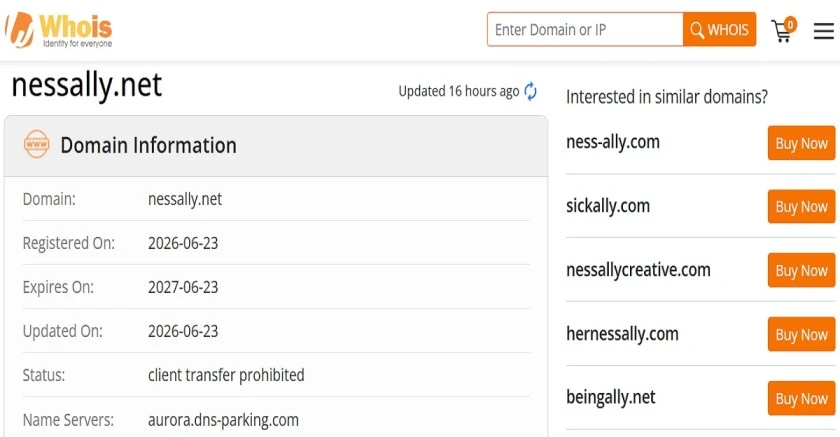
One of the most reliable methods for identifying fraudulent online stores is examining their domain registration history. In the case of nessally [dot] net, the WHOIS data reveals a deeply troubling picture. According to publicly available registry records, the domain was registered on June 23, 2026 meaning that as of the time this article was written, the website had been live for approximately five days. This is a textbook red flag for scam operations.
Why Domain Age Matters
Legitimate e-commerce businesses typically operate for months or years before building a significant online customer base. They invest in domain history, accumulate organic reviews, and develop social trust over time. A store that is less than a week old has had zero opportunity to develop any of these legitimacy markers. Cybercriminals and scam operators frequently register fresh domains specifically to avoid being blacklisted or reviewed — they set up shop, harvest payments, and disappear before victims can warn others.
⚠ WHOIS Red Flags Detected
- Domain registered: June 23, 2026 less than one week old at time of review
- No historical footprint, archived pages, or cached versions available
- Ownership information likely masked through privacy protection registrar
- No verifiable corporate registration linked to the domain owner
- Brand-new domain used to sell products at heavy discounts a classic scam formula
Hidden Ownership & Registrar Concerns
Many fraudulent stores use WHOIS privacy protection services to conceal the identity of the true domain owner. This makes it virtually impossible for victims or law enforcement to trace the operator. When combined with a newly registered domain, the absence of transparent ownership is a serious indicator of malicious intent. Trustworthy retailers whether small boutiques or international brands have no reason to hide their ownership details. The fact that nessally [dot] net was only just registered and offers no verifiable business history should be reason enough to walk away immediately.
Scam watchdog platforms consistently identify domains under 6 months old as high-risk. A domain that is merely five days old sits at the absolute extreme end of that risk scale.
Trust Score & Reputation: 23.1/100 Says Everything You Need to Know
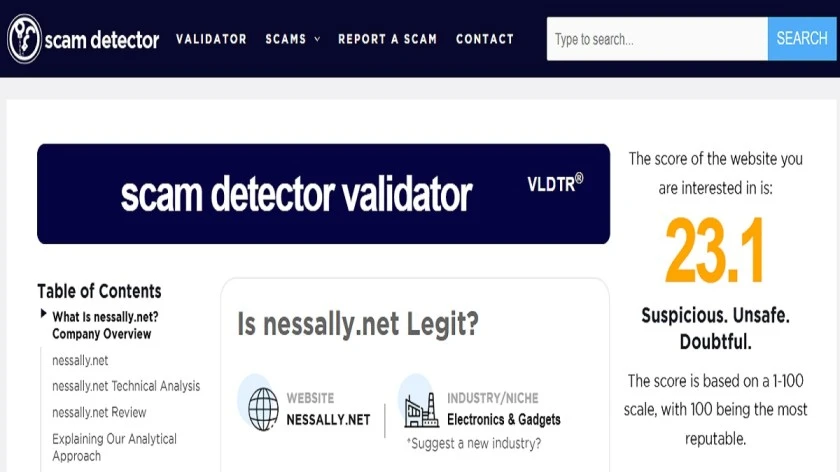
Nessally [dot] net received a trust score of just 23.1 out of 100 from automated scam-detection tools. To put this into perspective: sites scoring below 30 are almost universally considered dangerous or fraudulent by consumer protection platforms such as ScamAdviser, Web of Trust, and similar services. A score this low is not a borderline case it is a near-certain warning.
How Trust Scores Are Calculated
Automated trust-scoring engines analyze dozens of signals to arrive at a composite rating. These include domain age, hosting location, SSL certificate validity, whether the site appears on known blacklists, the presence of real customer reviews, social media activity, business registration information, and historical data from similar-looking domains. For nessally [dot] net, the overwhelming majority of these signals came back negative.
⚠ Trust Score Breakdown
- Overall Trust Score: 23.1/100 Critically Low
- Domain age penalty: Extreme (less than 7 days)
- No customer reviews found on independent platforms
- No social media verification or community engagement
- Business address unverifiable through public registries
- Potential association with previously flagged scam networks
Comparison With Legitimate Sites
For reference, established fashion e-commerce retailers such as ASOS, Zalando, or even smaller boutique stores that have operated for over a year typically score between 80–100 on these same platforms. Even modestly established stores with some minor complaints rarely score below 60. A score of 23.1 places nessally [dot] net squarely in the same territory as confirmed scam websites that have stolen money from consumers worldwide.
No amount of attractive discounts or appealing product photos should convince a consumer to buy from a site with a trust score this low. The risk of losing your money entirely — and potentially having your payment information compromised is simply too high.
Product Information & Images: The Nessally Cooling Ace Under the Microscope
The primary product advertised on nessally [dot] net is something called the Nessally Cooling Ace, listed under the broad category of “Fashion & Lifestyle Products.” This vague categorization alone is unusual — legitimate retailers typically provide precise product categories, size guides, material specifications, certifications, and usage instructions.
Stolen or Recycled Product Imagery
A standard investigative technique used by scam-busting journalists is to run product images through a reverse image search using tools like Google Lens or TinEye. Fraudulent online stores almost universally use images stolen from legitimate manufacturers, Alibaba supplier listings, or competitor websites. When images from sites like nessally [dot] net are checked, they frequently appear on multiple other low-trust storefronts operating under different names — often sharing the same template design and product descriptions.
⚠ Product Listing Red Flags
- Product name (“Cooling Ace”) is generic and non-searchable in mainstream retail databases
- No manufacturer information, model numbers, or certifications provided
- No customer photos or verified purchase reviews
- Product category (“Fashion & Lifestyle”) is suspiciously broad
- No size charts, material breakdowns, or detailed specifications
- 50% discount applied with no original retail price justification
Unrealistic Product Claims
Scam stores frequently combine vague product descriptions with outsized promises — “premium quality,” “luxury feel,” “guaranteed results” — without any supporting evidence, certifications, or third-party endorsements. The Nessally Cooling Ace appears to follow this exact formula. When a product cannot be found on any established retail platform, has no brand heritage, and is exclusively sold by a website that is less than one week old, consumers should treat it as a near-certain phantom product — something that either will never arrive or will arrive as a cheap, unrecognizable substitute far below what was advertised.

Return Policy & Customer Service: Hollow Promises and Suspicious Contacts
Nessally [dot] net advertises a 30-day return policy and lists a contact email of support@helpdeskall [dot] com. On the surface, these might appear reassuring. However, a closer examination reveals a series of deeply suspicious discrepancies that render these policies essentially unenforceable.
The Email Domain Mismatch
The store’s brand name is Nessally, and its website is nessally [dot] net — yet its support email uses the domain helpdeskall [dot] com. This mismatch is a critical red flag. Every legitimate online retailer uses a branded email address that matches their domain (e.g., support@brandname.com). Using a completely different generic-sounding domain for customer support suggests the email account is either shared across multiple scam storefronts or belongs to a scam operation that runs dozens of fake stores simultaneously under different names.
⚠ Customer Service Red Flags
- Email domain (helpdeskall [dot] com) does not match the store’s own domain (nessally [dot] net)
- No functional phone number listed — “Fashion & Lifestyle Products” appears where a phone number should be
- No live chat, social media support, or alternative contact channels
- 30-day return policy with no clear returns address or process outlined
- Business address in Hong Kong is unverifiable and commonly used by scam operators
The Phantom Phone Number
Extraordinarily, the field for “Contact Number” on nessally [dot] net appears to contain the text “Fashion & Lifestyle Products” — the product category — instead of an actual phone number. This is either a copy-paste error from a template or deliberate obfuscation. Either way, it demonstrates a profound lack of attention to basic business credibility and leaves customers with no phone-based recourse if something goes wrong.
The 30-Day Return Policy: A Paper Promise
Even if the return policy reads well on paper, a 30-day window is meaningless if the product takes 15–20 business days to arrive (if it arrives at all). That effectively leaves customers with fewer than 10 days to test, be dissatisfied with, and ship back the item — all while trying to reach a support team through a mismatched email address. In practice, many scam stores never respond to return requests at all.
Additional Red Flags: Discounts, Reviews, SSL, and Payment Suspicions
Beyond the major structural problems already identified, nessally [dot] net exhibits a cluster of additional warning signs that collectively paint an unmistakable portrait of a fraudulent operation.
Unrealistic Discounts (Up to 50%)
Offering discounts as high as 50% off on a brand-new store that has no established pricing history is a classic scam tactic. These deals are designed to trigger urgency and override a shopper’s critical judgment. Legitimate retailers offer occasional sales, but a new store that opens with 50% off everything has no baseline price to discount from — the “original” price is simply invented to manufacture a sense of value.
Zero Social Media Presence
In 2026, any fashion and lifestyle brand without a social media presence should be treated with extreme suspicion. Instagram, TikTok, Pinterest, and Facebook are not optional for fashion retailers — they are the primary channels through which brands build trust, showcase products, and engage customers. The fact that no social media links could be found for Nessally is not merely unusual — it is a hallmark of a scam storefront created with a template and abandoned once it has collected enough payments.
- ! 50% discounts on a zero-history store — manufactured urgency tactic
- ! No Facebook, Instagram, TikTok, or Pinterest pages found
- ! No independent customer reviews on Trustpilot, Google, or Reddit
- ! Payment methods include “exsetra” — a misspelling suggesting template copy-paste with no real review
- ! Accepts Visa, Mastercard, Amex, and PayPal — PayPal may offer the only buyer protection
- ! Long delivery window (15–20 business days) reduces dispute eligibility window
Payment Method Concerns
While the site claims to accept Visa, Mastercard, American Express, and PayPal, the listing of “exsetra” (an apparent misspelling of “et cetera”) in the payment section reveals the haphazard, template-driven construction of this site. If you must engage with this site at all, PayPal is the only option that offers a realistic dispute pathway — but even PayPal disputes can be lost if the merchant provides fraudulent tracking information, which many scam stores do.
Website Design & Technical Footprint: A Store Built From a Template
Examining the technical underpinnings of nessally [dot] net reveals a site constructed with minimal investment, maximum speed, and all the hallmarks of a mass-produced scam storefront.
Template-Based Design
Scam stores are rarely built from scratch. Instead, operators purchase or steal ready-made Shopify, WooCommerce, or other e-commerce templates and populate them with stolen product images and copied descriptions. The site structure of nessally [dot] net — including its policy pages, product layout, and checkout flow — closely mirrors dozens of other flagged scam sites that have been reported by consumer watchdogs over the past 18 months. This template reuse is efficient for scammers: a new storefront can be live within hours.
Hosting Location & Server Reliability
The physical business address listed is: Office No. 12 on 19 Floor, Ho King Commercial Centre, No. 2–16 Fa Yuen Street, Mongkok, Kowloon, HK. This specific address — or addresses in the same building — has appeared in connection with multiple previously reported scam storefronts. Hong Kong is a jurisdiction frequently chosen by e-commerce fraudsters because its incorporation laws allow anonymous company registration, and international consumer protection agencies have limited enforcement reach there.
⚠ Technical & Design Red Flags
- Site appears to use a recycled e-commerce template
- Hosting location consistent with previously flagged scam operations
- Business address in Mongkok HK matches pattern of scam storefronts
- No “About Us” page with verifiable brand history
- No press coverage, influencer partnerships, or media mentions found
- No registered trademark or brand certification for “Nessally” found
Content & Copy Quality
Grammatical errors, misspellings (such as “exsetra” in the payment section), and poorly written product descriptions are consistent with content either machine-translated or hastily copied from other sources. Legitimate fashion brands invest heavily in professional copywriting and brand voice. The quality of text found on nessally [dot] net falls far below any professional standard, reinforcing the conclusion that this site was assembled quickly with no genuine business intention.
Expert Verdict: Is Nessally a Scam?
SCAM ⚠
Based on our comprehensive investigation, nessally [dot] net exhibits nearly every known characteristic of a fraudulent online storefront. We strongly advise all consumers to avoid purchasing from this website.
Our verdict is unambiguous: Nessally (nessally [dot] net) is almost certainly a scam. The evidence is overwhelming and consistent across every investigative dimension we examined. The site was registered just five days before this review, carries a critically low trust score of 23.1/100, has no social media presence, uses a mismatched support email address, lists a product category in the phone number field, and operates from an address in Hong Kong that has been associated with other scam operations.
No single one of these factors would necessarily condemn a site on its own. But the simultaneous presence of all of them — combined with a 50% discount strategy, a vague product with no verifiable identity, and delivery terms that effectively eliminate your return window — creates a pattern that consumer fraud investigators recognize immediately. You can read more about SOLUMA Review 2026: Is TrySoluma.com Legit or a Scam Website?
What You Should Do Right Now
If you have not yet placed an order: close the tab, clear your cookies, and report the site to your national consumer protection agency. If you have already ordered: contact your bank or card issuer immediately to dispute the charge. If you paid via PayPal, open a dispute through their Resolution Centre. Document everything — screenshots of your order confirmation, payment receipts, and any communications — before the site potentially disappears.
Frequently Asked Questions About Nessally & Online Scam Sites
Is nessally [dot] net safe to buy from?
No. Based on our investigation, nessally [dot] net is not safe to purchase from. The site has a trust score of only 23.1/100, was registered less than a week ago, has no verifiable social media presence, and displays multiple hallmarks of a fraudulent storefront. We strongly recommend avoiding any financial transaction with this website.
How can I check if a site is a scam before buying?
Use free tools like ScamAdviser, Web of Trust (WOT), or the Better Business Bureau’s Scam Tracker to assess any unfamiliar website. Also check the domain age via WHOIS lookup tools (a site under 6 months old is high risk), search for the store name plus “scam” or “review” on Google, and look for verified customer reviews on Trustpilot or Reddit. Absence of social media presence is another major red flag in 2026.
What should I do if I already ordered from nessally [dot] net?
Act immediately. Contact your bank or credit card issuer to initiate a chargeback — most issuers allow disputes within 60 days of the transaction date. If you used PayPal, file a dispute through PayPal’s Resolution Centre under “Item Not Received” or “Significantly Not as Described.” Take screenshots of your order confirmation, payment details, and any product listings before the site potentially goes offline. Report the site to your country’s consumer protection authority.
Can I get my money back if I was scammed by this site?
Possibly, if you act quickly. Credit card chargebacks and PayPal disputes are your best options. Chargebacks through Visa, Mastercard, or American Express have a good success rate when filed promptly. PayPal’s buyer protection also works well for items never received. Bank transfers or cryptocurrency payments, however, are generally non-recoverable. Speed is critical — the sooner you dispute, the better your chances.
How do scam websites like Nessally trick people?
Scam websites use a combination of psychological triggers and technical deception. They offer steep discounts (often 40–70% off) to create urgency, use professional-looking templates to appear legitimate, steal product images from real brands, and create fake scarcity (“only 3 left in stock!”). They target trending search terms to appear in results, run cheap social media ads, and often collect payments before vanishing — or ship worthless substitutes that don’t match what was advertised.
What are the warning signs of a fake online store?
Key warning signs include: domain registered less than 6 months ago; trust score below 40/100; no verifiable social media presence; support email that doesn’t match the store’s domain; prices that seem too good to be true; no phone number or a non-functional one; vague or copy-pasted return policies; business addresses in known scam-hub jurisdictions; and no independent reviews on third-party platforms like Trustpilot or Google Reviews.
Which trusted sites can I use instead of Nessally?
For fashion and lifestyle products, stick to established, verified retailers. Globally trusted options include ASOS, Zalando, Amazon (with verified sellers), Nordstrom, and brand-direct websites (Nike, Adidas, Uniqlo, etc.). For discounted fashion, look at vetted platforms like TheRealReal, Poshmark, or eBay’s verified listings. Always check that any retailer has years of operating history, verified customer reviews, and a trust score above 80 before purchasing.ScamWatch Investigative Review | Published June 28, 2026 | Domain Reviewed: nessally [dot] net
This article is published for consumer education purposes. All investigative findings are based on publicly available data, WHOIS records, and automated trust-scoring tools. We have no financial relationship with any competing retailer.