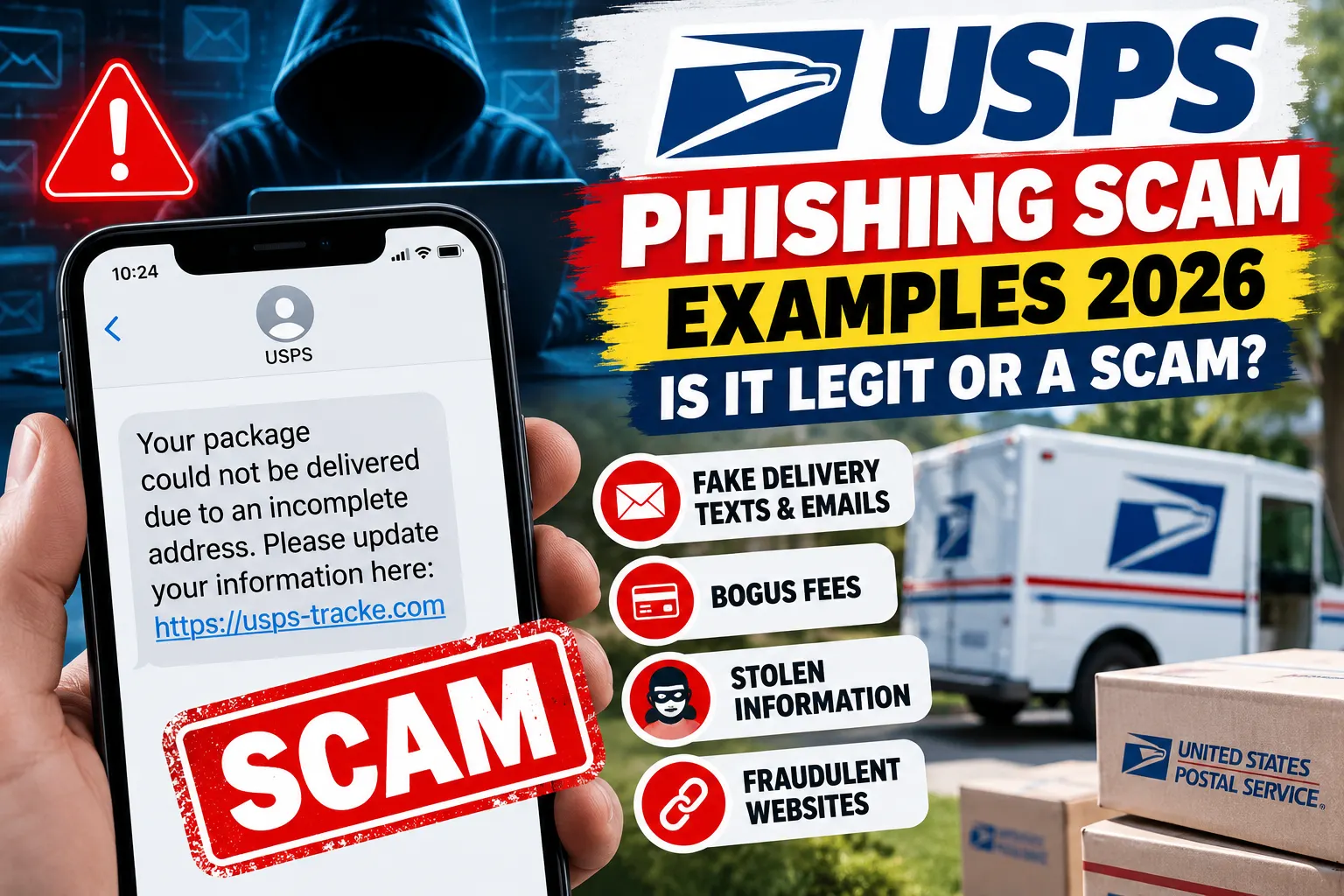
Verdict: USPS is a legitimate United States government postal service, but phishing messages impersonating USPS are a documented and ongoing scam. Fraudsters send fake package-delivery alerts, unpaid postage notices, address-correction requests, and delivery-failure emails to trick people into clicking fraudulent links or sharing personal and financial information. The United States Postal Inspection Service has specifically warned consumers about these schemes, and the Federal Trade Commission has identified fake package-delivery messages as a major category of text-message fraud. The main risk is not the genuine postal service itself, but the criminals using its name, branding, and delivery notifications to make fraudulent messages appear trustworthy.
This USPS phishing scam examples review explains how these scams work, what suspicious messages look like, how to distinguish genuine delivery notifications from impersonation attempts, and what to do if you have already clicked a link or provided information.
Because USPS phishing scams are a category of fraud rather than a single website, there is no one scam domain to investigate. Domain registration dates, WHOIS records, Trustpilot ratings, product prices, shipping policies, and refund terms must be evaluated for the particular website or message involved.
Research updated: October 13, 2026.
USPS Phishing Scams: Quick Risk Check
| Category | Findings |
|---|---|
| Organization being impersonated | United States Postal Service (USPS) |
| Is USPS legitimate? | Yes. USPS is a genuine postal service. |
| Are USPS phishing messages real scams? | Yes. Postal inspectors have documented and warned about these schemes. |
| Common scam methods | Fake delivery texts, fraudulent emails, counterfeit tracking pages, and impersonation calls |
| Typical objective | Stealing personal information, payment details, passwords, or money |
| Domain age and WHOIS | Not applicable to the entire scam category; individual fraudulent domains must be checked separately |
| Trustpilot rating | Not applicable to the scam category |
| ScamAdviser rating | No single rating applies to every fake USPS website |
| Common warning signs | Unexpected messages, unfamiliar links, urgent demands, and requests for payment or sensitive information |
| Shipping and refunds | Not applicable to the scam category; fraudulent websites may imitate genuine postal services |
| Overall assessment | USPS is legitimate, but messages impersonating USPS can be fraudulent and should be verified independently. |
The most important distinction is that a real package may be on its way even when a message claiming to provide tracking information is fake. A scammer does not need to know whether you are expecting a delivery; the message only needs to look plausible enough to make you click.
What Are USPS Phishing Scams?
USPS phishing scams involve criminals pretending to represent the United States Postal Service to obtain information or money from unsuspecting recipients.
When the deception happens through text messages, it is commonly called smishing, a combination of SMS and phishing. Similar schemes also appear in emails, phone calls, social media messages, and fraudulent websites.
The scam often begins with an apparently routine notification:
- A package cannot be delivered.
- The shipping address is incomplete.
- A small postage fee remains unpaid.
- A parcel is waiting at a local post office.
- A delivery needs to be rescheduled.
- Tracking information requires confirmation.
These situations sound ordinary because legitimate delivery services sometimes communicate about shipping problems. Scammers exploit that familiarity to make their messages seem credible.
The next step usually involves persuading the recipient to open a link. The link may lead to a counterfeit website that imitates a postal service page and asks for personal details, payment information, or account credentials.
The genuine postal service’s identity is being misused. A professional-looking logo, tracking number, or delivery notification is not proof that the message came from USPS.
USPS Phishing Scam Examples: Six Common Warning Signs
The following examples are illustrative descriptions of documented scam patterns, not quotations from specific messages received by individual victims.
1. Fake USPS Package-Delivery Texts
One of the most common examples is a text claiming that a parcel cannot be delivered until the recipient takes action.
The message may refer to a missing apartment number, an incorrect address, or an unsuccessful delivery attempt. It then directs the recipient to a link to correct the problem.
Why it is suspicious: An unsolicited message containing an unfamiliar link should not be trusted simply because it mentions a package.
The Postal Inspection Service warns about unsolicited delivery-related texts that use unfamiliar links to solicit personal or financial information. Its guidance also explains that USPS tracking texts are associated with customer requests rather than indiscriminate messages sent to random phone numbers.
What to do: Open the retailer’s official account or independently access the genuine postal service’s tracking tools. Do not use the link in the unexpected text.
2. Fake Unpaid Postage or Redelivery Fees
Another common variation claims that a small fee must be paid before a parcel can be delivered.
The amount may appear insignificant, making the request seem harmless. The fraudulent page may ask for a debit or credit card number, billing address, or other information.
The financial danger is not limited to the advertised fee. Submitting payment details to a fraudulent website may expose the information to criminals who can misuse it.
The FTC has warned about delivery-related text scams in which recipients are directed to fake websites and asked to pay a redelivery fee.
What to do: Do not pay through an unexpected text-message link. Independently verify whether any genuine delivery issue exists.
3. Fake Address-Correction Notifications
A message may claim that a parcel cannot be delivered because the recipient’s address is incomplete or invalid.
It may ask for a full name, street address, phone number, email address, or other identifying information.
Some people respond because the requested details appear routine. The problem is that the recipient has no reliable way to know who operates the linked website.
Why it is suspicious: A request to confirm personal information through an unsolicited link creates an opportunity for identity theft.
What to do: Check your tracking information through a trusted source. Do not provide additional personal details through the message.
4. Fake Delivery-Failure Emails
USPS phishing is not limited to text messages.
Fraudulent emails may use subject lines referring to a delivery failure, an unsuccessful delivery attempt, or an outstanding postage charge.
The email may contain a button to confirm an address or a file presented as a shipping document.
The United States Postal Inspection Service has warned that fake USPS emails can direct recipients to fraudulent websites or contain attachments that may expose them to malicious software.
What to do: Do not open unexpected attachments or sign in through links in suspicious emails. Verify delivery information independently.
5. Fake Tracking Websites
Some scams send recipients to a page designed to resemble a genuine postal tracking website.
The page may display a tracking-style interface, a delivery status, a form requesting personal information, or a demand for payment.
A website’s visual appearance is not a dependable indicator of authenticity. Criminals can copy logos and page layouts, and they may use domain names containing words associated with postal delivery.
Why it is suspicious: A tracking page that requests unnecessary payment details or sensitive information deserves particular scrutiny.
What to do: Do not assume a page is genuine because it contains a familiar logo or appears to display a tracking number. Navigate independently to the official service and check the shipment there.
6. Fake USPS Phone Calls
Some fraudsters use telephone calls or voicemails instead of written messages.
A caller may claim to be a postal employee and ask you to confirm personal information before a package can be delivered. Other impersonators may claim to be postal inspectors and use threats or pressure to obtain money or sensitive information.
Caller ID is not conclusive proof of identity because displayed numbers can be spoofed.
What to do: Do not provide personal or financial information during an unexpected call. End the conversation and contact the organization through independently verified contact details if you need to check a claim.
What Do USPS Scam Messages Usually Have in Common?
Although the wording varies, several characteristics appear repeatedly in phishing attempts.
| Warning sign | Why it matters |
|---|---|
| Unexpected delivery notification | The message may have been sent without any connection to a genuine shipment. |
| Unfamiliar link | The destination may be controlled by someone impersonating USPS. |
| Urgent demand | Pressure can discourage recipients from checking the facts. |
| Request for a small payment | Payment information may be the real target. |
| Request for personal details | Information may be collected for identity theft or further fraud. |
| Suspicious email attachment | The file may contain malicious content. |
| Inconsistent branding or wording | The message may not come from the organization it claims to represent. |
| Unexpected request for passwords or verification codes | Sensitive credentials could be misused to access accounts. |
No single feature necessarily proves a message is fraudulent. The context matters.
For example, a legitimate company may send an email about an order you placed. A message becomes more concerning when it arrives unexpectedly, contains an unfamiliar link, and demands information or payment that you cannot independently verify.
How to Check a Suspicious USPS Website
If a message directs you to a website, assess the destination before entering any information.
Check the domain carefully
Do not rely on the words appearing in the address alone. A fraudulent website may include terms such as “USPS,” “tracking,” “delivery,” or “package” without being operated by the postal service.
Look at the complete domain, including the ending. Be cautious with misspellings, unusual combinations of words, and unrelated domain extensions.
Do not click the link simply to investigate it. If you need to verify a delivery, open a trusted browser window and navigate to the official service independently.
Review the domain’s registration information
WHOIS records can sometimes reveal when a suspicious domain was registered and which registrar manages it.
A recently registered domain may deserve additional scrutiny, particularly if it appears in an unsolicited message asking for money or personal information.
Nevertheless, domain age is not conclusive evidence. Legitimate businesses can have new domains, and fraudulent websites can sometimes use older domains.
Privacy-protected registration information is also common. It should not be treated as proof of wrongdoing on its own.
Because USPS phishing scams use many different domains, there is no single WHOIS record or creation date that applies to all of them.
Understand automated trust ratings
Services such as ScamAdviser and Gridinsoft may provide information about individual domains.
Their assessments can help identify potential concerns, but a rating for one domain cannot establish the safety of every website using USPS-related branding.
A low score is a reason to investigate further, not necessarily definitive proof of fraud. Likewise, a high score or encrypted connection does not guarantee that a website is genuine.
Check the request itself
Consider what the message asks you to do.
Does it demand an unexpected payment? Does it ask for a password or sensitive personal details? Does it pressure you to act immediately?
A request can be suspicious even when the website looks convincing.
Does USPS Have a Trustpilot Rating for These Scams?
There is no single Trustpilot rating for USPS phishing scams because they are a category of fraudulent activity, not one company or website.
The genuine postal service and individual websites impersonating it are different entities. Reviews of an unrelated business with a similar name should not be treated as evidence about a particular phishing domain.
The same distinction applies to customer complaints and other reputation services.
When researching a specific suspicious link, consumers should look for reports about that exact domain. Even then, the absence of complaints does not prove that a website is safe, especially if it was created recently or has reached few people.
WHOIS, Domain Age and Website Security: What Can Be Verified?
For a category such as USPS phishing scam examples, several website-review fields cannot be assigned one universal answer.
| Investigation item | Applicable finding |
|---|---|
| Domain creation date | Varies by fraudulent domain |
| Domain registrar | Varies by domain |
| Domain expiration | Varies by domain |
| WHOIS privacy | Must be checked for the specific domain |
| SSL certificate | Must be checked for the specific domain; encryption does not prove legitimacy |
| Website platform | Varies by fraudulent website |
| Trustpilot rating | Not applicable to the scam category as a whole |
| ScamAdviser rating | No universal rating; individual domains may have reports |
| Gridinsoft rating | No universal rating; individual domains may have reports |
| Products and prices | Not applicable to the scam category |
| Shipping and returns | Not applicable to the scam category |
| Payment methods | Depend on the particular fraudulent page |
We could not independently verify a single domain history, registrar, company registration, or reputation score that represents all USPS phishing scams.
Anyone investigating a particular message should evaluate the exact link rather than assume that findings about one fraudulent website apply to another.
What Does a Genuine USPS Message Look Like?
A genuine delivery notification should be consistent with a real transaction or a tracking request you made.
If you have signed up for tracking notifications, a message may contain information about a shipment. That does not mean every message using the USPS name is legitimate.
Consider these checks:
- Did you request the tracking notification?
- Does the shipment match an order you placed or a package you are expecting?
- Can you independently locate the same tracking information?
- Is the message asking for unexpected payment or sensitive information?
- Does the destination match the genuine service you intended to use?
Do not use the presence of a tracking number as your only test. Scammers can include plausible-looking numbers or send messages to people who happen to be expecting packages.
The safest approach is to verify the shipment independently.
Payment Safety: What If a Message Requests a Fee?
Do not submit payment through an unfamiliar link simply because a message claims that a package is waiting.
A small charge can be used to obtain payment information, and a fraudulent payment page may request more information than is needed for a normal transaction.
If a delivery problem appears genuine, check it through the retailer or postal service using contact information you obtained independently.
If you already submitted payment details to a suspicious website:
- Contact your bank or card issuer promptly.
- Explain that your payment information may have been exposed.
- Ask about appropriate steps to protect the account and dispute unauthorized transactions.
- Monitor account activity for unfamiliar charges.
- Keep any transaction records and messages related to the incident.
The appropriate response depends on what information was shared and whether any money was taken.
What If You Clicked a USPS Phishing Link?
Clicking a link does not automatically mean that your identity or money has been stolen. The risk depends on what happened after you opened it.
If you only opened the page and did not enter information, download a file, or grant permissions, the next steps may be different from those required after submitting payment details.
Take these precautions:
- Close the suspicious page.
- Do not enter additional information.
- Do not download files or install anything the page recommends.
- If you entered a password, change it through the genuine service and update it anywhere else you reused it.
- If you supplied payment details, contact your financial institution.
- If you entered sensitive personal information, consider appropriate identity-protection measures.
- If you downloaded a file, use your device’s trusted security tools and seek help from a trusted technical-support professional if needed.
If you are unsure what information was exposed, ask a trusted adult or qualified professional to help assess the situation.
What If You Received a USPS Scam Text?
If you receive a suspicious delivery message, you do not need to reply to prove that it is fraudulent.
Instead:
- Do not click the link.
- Do not provide personal or payment information.
- Report the message as spam using your phone’s available reporting feature.
- Block the sender if appropriate.
- Independently check any real package you are expecting.
- Report suspected fraud through the appropriate official channel.
The Federal Trade Commission also recommends forwarding unwanted text messages to 7726 (SPAM) where supported by your mobile provider and reporting fraud through its official reporting service.
You can find further guidance from the United States Postal Inspection Service, which explains how package-tracking text scams operate and what recipients should do.
Pros and Cons of USPS Phishing Scam Awareness
This article reviews a scam category rather than a retailer, so product-quality pros and cons do not apply. The useful comparison is between the evidence available and the limitations of investigating a specific message.
| Positive findings | Limitations and risks |
|---|---|
| Postal authorities have published specific warnings about impersonation schemes | Fraudulent messages can change wording and appearance quickly |
| Common warning signs can be identified | A convincing message may still be difficult to assess at first glance |
| Shipments can be checked independently | Recipients may be pressured to act before verifying a claim |
| Suspicious texts can be reported and blocked | Reporting a message does not guarantee immediate removal of every fraudulent domain |
| Domain information can sometimes help assess a suspicious website | Domain age and automated ratings are not conclusive proof |
| Consumers can take steps to limit exposure | People who submit payment or personal information may need additional protective action |
The strongest protection is independent verification rather than trying to memorize every possible scam message.
Red Flags We Found
The evidence supports several recurring warning signs in USPS impersonation scams.
Unexpected messages requesting action
Fraudulent texts and emails often claim that a delivery is blocked until the recipient responds.
This matters because the recipient may act before confirming whether a real package problem exists.
Unfamiliar links
The link may lead to a website that imitates the genuine postal service and requests personal or financial information.
This is one of the most important reasons not to follow unexpected delivery links.
Requests for payment
A demand for an unexpected delivery or redelivery fee should be independently verified before any payment is made.
Requests for sensitive information
A suspicious message may ask for personal details, payment information, passwords, or other credentials.
Sharing this information can expose the recipient to financial loss or identity-related fraud.
Pressure and urgency
Messages that imply a parcel will be lost or delayed unless the recipient acts immediately are designed to reduce the time available for checking the facts.
Our assessment: These patterns are consistent with documented phishing and smishing methods. They justify caution toward suspicious messages, but a particular message should be assessed using its actual content and destination.
Positive Signs to Look For
There are also useful indicators that can help you verify a delivery claim.
- You can independently locate the shipment through a trusted tracking service.
- The tracking information corresponds to a genuine order or package.
- You initiated the notification or tracking request.
- The information matches details available through the retailer or sender.
- You can confirm the situation without using the link in the suspicious message.
No single indicator guarantees authenticity. A message may refer to a real shipment while still including a fraudulent link.
Independent confirmation is more reliable than judging a message solely by its appearance.
How to Stay Safe From USPS Phishing Scams
The following habits can reduce the risk of losing money or personal information.
Check before clicking. Treat unexpected delivery links with caution, even if the message looks professional.
Use independently accessed tracking tools. Open the retailer’s official account or navigate to the genuine postal service without following the message’s link.
Never rush a payment. Verify unexpected charges before providing card details.
Protect passwords. Do not enter account credentials through a page reached from an unsolicited message.
Keep devices updated. Install security updates through trusted settings and use reputable security tools.
Review financial accounts. If you shared payment details, check for unauthorized transactions and contact your financial institution if necessary.
Be cautious with personal information. A delivery notification should not be treated as sufficient proof that a sender is entitled to sensitive details.
For more general guidance on evaluating unfamiliar websites, see Social Engineering Scams Review 2026: Are They Legit or a Scam?
You can also read our guide to Why Scammers Prefer Crypto Payments: The Real Reasons Behind the Growing Fraud Risk to learn how deceptive websites use branding, payment requests, and misleading claims to gain consumers’ trust.
Frequently Asked Questions
Is USPS legit or a scam?
USPS is a legitimate postal service. Messages that impersonate USPS and attempt to steal information or money are a separate matter and may be fraudulent.
What is a common USPS phishing scam example?
A common example is a text claiming that a package cannot be delivered until the recipient corrects an address or pays an unexpected fee. The message links to a website that requests personal or payment information.
Does USPS send text messages about packages?
USPS tracking notifications may be available when a customer requests them. An unsolicited text containing an unfamiliar link and demanding action should be treated cautiously and verified independently.
How can I tell whether a USPS delivery text is fake?
Look for an unexpected message, an unfamiliar link, pressure to act quickly, and requests for payment or sensitive information. Confirm the package through a trusted tracking service instead of using the message’s link.
What should I do if I entered my card details on a fake USPS website?
Contact your bank or card issuer promptly, explain that your details may have been exposed, and ask about appropriate protective steps. Monitor your account and dispute unauthorized transactions.
Do all USPS scam websites have new domains?
No. Fraudulent domains can have different registration histories. A new domain may be a warning sign, but domain age alone cannot prove whether a website is legitimate or fraudulent.
Final Verdict: USPS Phishing Scam Examples Review 2026
USPS is legitimate, but USPS impersonation scams are real and warrant caution. Postal authorities have documented fraudulent delivery texts and emails designed to trick recipients into clicking links, providing sensitive information, or paying bogus fees.
The strongest warning signs are unexpected messages, unfamiliar links, pressure to act quickly, and requests for payment or personal information that cannot be independently verified.
There is no single domain age, WHOIS record, Trustpilot rating, or automated trust score that applies to every USPS phishing scam. If you are investigating a specific message, evaluate the exact link and verify the delivery through a trusted source.
If the message asks for money or sensitive information, do not rely on its branding or apparent urgency. Check independently before taking action.
Overall assessment: USPS is legitimate; messages impersonating USPS can be fraudulent. Verify unexpected delivery requests before clicking, paying, or sharing information.