Fake shopping websites have become harder to identify than they were a few years ago. The obvious signs still exist—broken English, unbelievable discounts, strange domain names—but those are no longer enough. Some suspicious stores now use polished themes, professional product photography, HTTPS encryption, working shopping carts, PayPal or card logos, detailed policy pages, and even apparently convincing customer reviews.
That changes the way I approach an unfamiliar online store. I rarely decide whether a website is trustworthy from one signal. Instead, I look for consistency. Does the company identity match the domain history? Does the return address make sense? Are the product photos original? Do the policies appear to belong to the same business? Can the seller be independently verified outside its own website?
Those questions tell us far more than whether a homepage simply “looks professional.”
Based on patterns commonly seen while reviewing questionable online stores, one thing becomes clear: the most convincing high-risk shopping websites often reveal their weaknesses in the boring details rather than on the homepage. A store may spend considerable effort making its product pages attractive while leaving copied return policies, conflicting company names, recently registered domains, unverifiable addresses, or poorly explained refund procedures elsewhere on the site.
That is why learning how to identify fake shopping websites requires a little more investigation than spotting spelling mistakes. This guide explains the process consumers can use when examining unfamiliar online stores and the signals worth checking before entering payment information.
Start With the Website’s Story, Not Its Design
A well-designed website proves very little.
Modern ecommerce templates allow almost anyone to create a convincing storefront quickly. Product pages, countdown timers, review widgets, payment icons, stock warnings, pop-ups and polished checkout pages can all be installed without operating an established retail business.
When reviewing a store, I prefer to understand the story it is presenting.
Suppose a website says it is a “family-owned American retailer serving customers for more than 15 years.” That statement gives us several things to verify. Has the domain existed for anything close to 15 years? Is there a company name? Does that business appear in public records or independent directories? Does the listed address belong to a retailer? Are there older references to the brand online?
A legitimate company may still use a relatively new domain. Businesses rebrand, migrate websites and launch new online stores all the time. A newly registered domain therefore does not automatically mean fraud. The problem appears when the surrounding story becomes inconsistent.
If a website claims decades of history while the domain was registered a few weeks ago and there is no older digital footprint for the company, that contradiction deserves further checking.
Domain Age Is Useful, but It Is Not a Verdict
Domain-registration information is one of the first things worth checking because it provides context that the storefront itself may not explain.
WHOIS or ICANN registration records may show when a domain was created, when it was last updated and when registration expires. Privacy protection is common today, so a hidden registrant should not automatically be treated as suspicious. Plenty of legitimate businesses use domain privacy.
The registration date becomes more useful when compared with the website’s claims.
Imagine a store advertising an “Anniversary Sale—Celebrating 12 Years” while its domain was registered last month. There could be an innocent explanation, such as a recent domain change, but an established company would normally be expected to leave some independent evidence behind: older social profiles, business listings, previous domains, press mentions or archived pages.
A young domain paired with huge discounts, no verifiable company identity and no independent reputation is considerably more concerning than a young domain belonging to a clearly identifiable business.
This distinction matters. Domain age should influence a risk assessment, not replace one.
Check Whether a Real Business Exists Behind the Store
One of the strongest questions you can ask is surprisingly simple: Who am I actually buying from?
Look beyond the brand name printed in the website header. Search the About, Contact, Terms and Privacy pages for the legal company name. Sometimes the footer contains one name, the Terms page mentions another, and the refund policy refers to a completely different store.
When reviewing common ecommerce warning signs, inconsistent company names are particularly useful to notice. Template-based stores can sometimes reveal poor setup through these mistakes. The homepage branding may have been changed carefully while an older company or store name remains buried in policy text.
That does not prove malicious intent. Small merchants sometimes reuse templates badly. Still, consumers should understand what that inconsistency means: if the seller itself cannot clearly identify the business responsible for an order, obtaining support or pursuing a refund may become more difficult.
A credible store should normally provide enough information for customers to understand who operates it. Depending on the country and business model, that could include a registered company name, physical or correspondence address, customer-support email, telephone number, tax or registration details, and clear terms of sale.
The absence of one item is not automatically suspicious. The absence of nearly everything is more meaningful.
Investigate the Address Instead of Simply Seeing Whether One Is Listed
An address on a website creates reassurance, which is precisely why it needs verification.
Copy the address into a search engine and mapping service. Check what is actually located there. Is it an office building, residence, warehouse, virtual mailbox, unrelated company or another type of property?
Using a residential address is not inherently suspicious. Many small ecommerce businesses operate from homes. Virtual offices are also legitimate.
What matters is whether the address fits the company’s claims.
A website describing itself as a major international fashion retailer with “hundreds of employees” would raise questions if its only corporate address leads to a mailbox service and there is no independently identifiable business associated with the location.
Another pattern worth checking is address recycling. Search the exact address inside quotation marks. If numerous unrelated online stores use precisely the same suite or formatting, investigate further. There may be a legitimate fulfillment company behind them, but it can also indicate that several stores are relying on the same generic contact location.
Look Closely at the Contact Information
Customer-service information can reveal a lot about how seriously a retailer expects to support buyers after payment.
A contact form alone is not necessarily a problem, especially for small businesses, but a traceable email address associated with the domain generally provides more context than a store relying exclusively on free email accounts.
Telephone numbers can also be checked. Search the number online and see whether it is associated with the same business. The same applies to email addresses.
One situation that deserves extra attention is a store where the sales process is extremely sophisticated but customer support is almost invisible. The site may contain multiple upsells, timed promotions and abandoned-cart pop-ups, yet the buyer receives only a generic form for handling refunds.
That imbalance does not establish fraud, but it can tell consumers something useful about the merchant’s priorities.
Read the Refund Policy Like Someone Who Has Already Lost Money
Most consumers read return policies too quickly. A better approach is to imagine that something has already gone wrong.
Assume the product has arrived damaged, incorrect or significantly different from the advertisement. Then ask: what would I actually have to do to recover my money?
Check the return period, restocking fees, return-shipping responsibility, required authorization process, refund timing and return location.
Pay particular attention to vague statements such as “returns may be accepted at our discretion” or instructions requiring customers to contact support before receiving the actual return address.
International returns can become especially expensive. A store may appear local because it uses dollars, pounds or euros and references domestic shipping, but its return warehouse could be overseas. Returning a low-cost product internationally may cost nearly as much as the item itself.
The policy can therefore be technically real while still making practical refunds difficult.
Also search the refund-policy text. Copy an unusual sentence and put it into a search engine inside quotation marks. If the identical policy appears across multiple unrelated stores, you may be looking at reused template content.
Template policies are common and not automatically evidence of fraud, but copied documents become more meaningful when company names, contact details or jurisdictions were not updated correctly.
Product Photos Can Tell You Where the Store Came From
Product imagery is another useful investigative clue.
Reverse-image searching a product photograph may show that the same item is being sold on established marketplaces, manufacturer websites or wholesale platforms. Again, this does not automatically mean the retailer is fake. Dropshipping and product reselling are legitimate business models when handled transparently.
The interesting part is the relationship between the source and the claim.
Suppose an online store presents a generic mass-produced product as an exclusive invention, uses photos found on several wholesale marketplaces and charges four times the typical market price. That does not necessarily make the website fraudulent, but it changes how the marketing should be evaluated.
TrickyMagazine’s review approach focuses on checking these kinds of inconsistencies rather than judging a store from appearance alone. Product-description language can be particularly revealing. Some websites reuse unusual phrases, specification errors or formatting found on other retailers. Searching a distinctive sentence from the description can sometimes show where else the same material appears.
The goal is not to prove plagiarism. It is to understand whether the store’s claims about a product or brand are supported by information outside its own website.
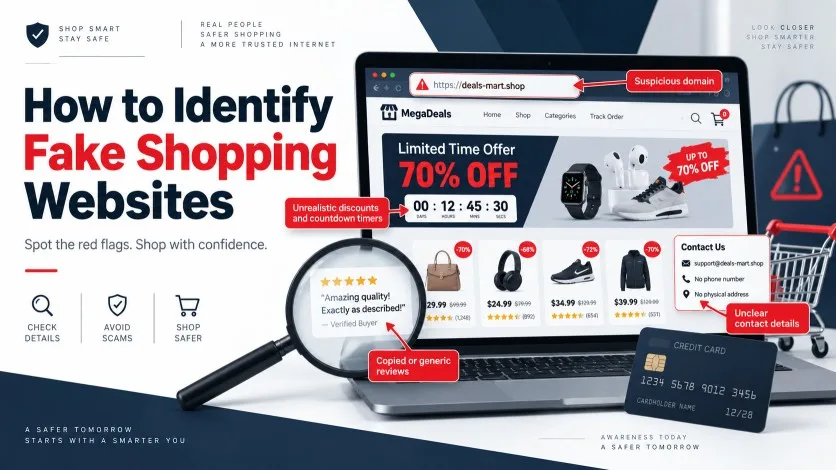
Discounts Should Make Economic Sense
Large discounts are one of the oldest ecommerce persuasion tactics, but the percentage itself is less important than the surrounding context.
A 70% discount during clearance can be completely legitimate. A luxury item supposedly reduced from $799 to $69 deserves more scrutiny.
Ask whether the original price appears believable. Some stores use inflated “compare at” prices to make the current price look extraordinary. Search the exact product elsewhere and compare typical pricing.
The psychological strategy behind extreme discounts is easy to understand. The shopper becomes focused on potentially losing the bargain rather than verifying the seller.
That pressure can be reinforced with countdown timers, “only three remaining” notices and messages claiming that numerous other shoppers are viewing the item.
None of those features proves fraud. Legitimate retailers use urgency marketing too. The concern grows when nearly every persuasion mechanism points in the same direction while basic company information remains weak.
Countdown Timers Are Worth Testing
One useful quick check is extremely simple: refresh the page.
If a promotion supposedly expires in nine minutes, reload the site later or open it in a private browser window. Does the clock restart?
A consistently resetting countdown suggests that the timer may be a marketing mechanism rather than a genuine one-time deadline.
The same applies to inventory warnings. A page may say “Only 2 Left” every time you visit. Some ecommerce systems do show real stock levels, while others generate scarcity messages independently of inventory.
The lesson is not that countdown timers equal scams. It is that artificial urgency should never be allowed to replace verification.
Reviews Need to Be Verified Outside the Store
On-site reviews are relatively weak evidence because the seller controls the website.
A store can publish genuine customer reviews, but consumers have no easy way to determine whether the displayed feedback represents all customers, selected customers or promotional content.
Search the company name, domain name and product name across independent platforms, forums, social networks and search results.
The absence of reviews is not automatically suspicious for a new business. More useful is whether the reputation makes sense for the age and claimed scale of the company.
A retailer claiming to have shipped “over one million orders worldwide” would reasonably be expected to have some meaningful footprint outside its own website.
Be careful with extremely positive independent-looking articles too. Search results can contain affiliate reviews, advertorials and automatically generated reputation pages. Sources containing specific experiences and verifiable details usually offer more value than pages simply repeating marketing claims.
Specific complaints also deserve more attention than generic accusations. For example, multiple independent buyers describing the same problem—such as receiving a different product, being unable to obtain a return address or facing unexpected charges—provide more useful information than one unsupported comment simply calling a business a scam.
Social Media Presence Can Be Genuine or Decorative
Many shopping sites display Facebook, Instagram, TikTok or Pinterest icons. Clicking them is part of a useful legitimacy check.
Sometimes the icons do nothing. Sometimes they link to the homepage of the social network instead of the merchant’s profile. In other cases the account exists but was created recently and has almost no genuine engagement.
A legitimate new store may naturally have a small audience, so follower count should not become a verdict.
Instead, look at history and interaction. Are there older posts? Do customers ask questions? Does the company respond? Do tagged posts appear to come from genuine buyers? Do large numbers of comments look unusually repetitive?
A modest account with believable conversations may provide more confidence than a profile with 100,000 followers and virtually no meaningful interaction.
Understand the Difference Between HTTPS and Trust
Consumers are often told to look for the padlock symbol. That advice is incomplete.
HTTPS means the connection between your browser and the website is encrypted. It helps protect data while it is being transmitted.
It does not establish that the merchant itself is trustworthy.
Questionable websites can obtain valid SSL certificates just as legitimate sites can. Free certificates have made encrypted websites standard across the internet, which is generally positive, but the padlock should now be viewed as a technical minimum rather than proof of legitimacy.
If your browser warns that a certificate is invalid or the connection is insecure, avoid entering payment information. If HTTPS is present, continue checking the business itself.
Payment Methods Reveal the Amount of Protection You Have
How a store asks you to pay can significantly change your practical risk.
Credit cards and established payment platforms may provide dispute procedures in certain circumstances. Direct bank transfers, cryptocurrency payments, gift cards and other difficult-to-reverse methods generally give consumers fewer recovery options.
That does not mean every business accepting cryptocurrency or bank transfers is suspicious. Context matters.
The concern is when an unfamiliar retailer insists on a difficult-to-reverse payment method while discouraging alternatives that may provide greater buyer protection.
Also check whether familiar payment logos displayed on the homepage actually correspond with the options available during checkout. A footer may show Visa, Mastercard, PayPal and other badges while the actual checkout offers something different.
Judge the payment method you are actually asked to use, not the logos displayed for reassurance.
A Practical 10-Step Verification Process
When someone asks how to check whether an online store is legitimate, this is a sensible sequence to follow:
- Search the exact domain name. Look for complaints, reviews, discussions and references outside the website itself. Search both the brand and the full domain because they may produce different results.
- Check domain-registration history. Compare the registration date with claims about how long the business has operated. Treat a young domain as context, not automatic evidence of fraud.
- Identify the legal operator. Examine the About, Contact, Terms, Privacy and Refund pages. Check whether the same company name appears consistently.
- Verify the address and contact details. Search the address, email and telephone number independently and see whether they logically connect to the claimed business.
- Check policy pages for copied or conflicting information. Search unusual sentences from refund or shipping policies and look for leftover names belonging to unrelated stores.
- Reverse-search product images. Determine whether photographs appear on manufacturer sites, marketplaces, competing retailers or wholesale listings, then compare those findings with the seller’s claims.
- Compare the price. Search the same or equivalent product elsewhere. Extreme discounts deserve additional investigation, particularly when the supposed original price appears unrealistic.
- Check independent reputation. Look at detailed reviews, complaints, community discussions and social activity. Give more weight to consistent patterns than isolated praise or criticism.
- Inspect the checkout before paying. Confirm the merchant name, payment processor, total cost, currency and whether any recurring-payment or subscription language appears.
- Ask whether you could recover your money. Imagine the product never arrives. If you cannot identify the company, understand the refund process or use a payment method offering reasonable consumer protections, the purchase may not be worth the risk.
No individual step is perfect. The strength comes from combining them.
Fake Store or Simply a New Small Business?
This is where online scam analysis requires restraint.
A newly created website with ten social-media followers, limited independent reviews and domain privacy may be a completely legitimate business that launched yesterday.
That same profile can also describe a disposable ecommerce store.
The difference usually appears when the full picture is examined.
| Signal | New but potentially legitimate store | Higher-risk pattern |
|---|---|---|
| Domain | Recently registered | Recently registered while claiming many years of history |
| Company details | Small business but identifiable | No clear legal operator |
| Address | Home, office or fulfillment location that can be explained | Unrelated, unverifiable or repeatedly reused address |
| Reviews | Few because the company is new | Large numbers of suspicious reviews despite almost no business history |
| Pricing | Competitive launch discount | Implausibly cheap pricing across nearly everything |
| Policies | Clear, consistent and specific | Copied, contradictory or missing details |
| Customer service | Limited but reachable | Forms only, nonworking information or unclear support |
| Payment | Recognizable checkout with clear terms | Pressure toward difficult-to-reverse methods |
When evidence is limited, describing a business as unverified is usually more accurate than declaring it fraudulent simply because it lacks history.
That distinction helps protect consumers without unfairly accusing legitimate businesses.
How Questionable Shopping Sites Influence Buyer Behavior
The technical side of fake ecommerce is only half of the story. The other half involves buyer psychology.
Some operators know that people make faster purchasing decisions when they believe an opportunity is disappearing.
That is why high-pressure stores can combine discounts, scarcity and social proof. The visitor might see a 75% discount, a timer showing 14 minutes remaining, “six people viewing this product,” recent-purchase notifications and a banner claiming the promotion ends tonight.
Each feature encourages faster decision-making.
Another common marketing technique is price anchoring. A product may be shown as originally costing $399 before being discounted to $59. The shopper starts thinking about a supposed $340 saving instead of asking whether the product was ever realistically worth $399.
Trust symbols can work similarly. Security shields, payment logos, review stars and “100% Satisfaction Guarantee” graphics create reassurance, although some of these elements may simply be visual graphics rather than independent certifications.
This is why slowing the buying process down remains one of the simplest consumer-protection strategies.
If a deal is genuinely worthwhile, spending ten minutes investigating the seller should not make the purchase less sensible.
Situational Example: The Viral Gadget Store
Imagine seeing a social-media advertisement for a miniature projector normally advertised elsewhere for around $150. The unfamiliar store claims to sell an “upgraded professional edition” for $39.99.
The website looks good. There is a countdown timer, thousands of five-star reviews and a banner saying the product is almost sold out.
Further checks show that the domain was registered three weeks ago, while the About page claims the company began in 2014. Reverse-image searching the projector shows visually identical products sold through several marketplaces. The return policy does not clearly provide a return location, and searching one distinctive sentence from the policy finds similar wording on unrelated sites.
None of those findings alone proves fraud.
Together, though, they create a considerably higher-risk profile. In that situation, I would personally avoid the purchase unless the seller’s identity and claims could be independently verified.
That is the kind of evidence-based reasoning consumers should use.
Situational Example: The New Boutique That Looks Suspicious but Checks Out
Now consider the opposite situation.
A clothing boutique’s domain was registered only two months ago. It has around 300 Instagram followers and very few independent reviews.
At first glance, that can look risky.
Further research, though, identifies a local business using the same name, consistent contact information, active social posts showing the business before the website launched, a clear returns address and checkout through an established payment provider.
The domain may simply be young because the business recently expanded online.
This is why domain age or review count should never be used mechanically.
Good investigations try to explain inconsistencies. Weak investigations merely count red flags.
Watch for Unexpected Subscription Terms
Some websites sell ordinary products through checkout systems that can include subscriptions, memberships or recurring-delivery programs.
Before placing an order, read the checkout page carefully.
Look for phrases such as “monthly delivery,” “membership,” “autoship,” “rebill,” “recurring charge” or language stating that ordering enrolls the customer in an ongoing program.
Subscription models are legitimate when the terms are clearly disclosed and customers knowingly agree to them.
The concern comes when recurring charges are buried in small print or explained far less prominently than the advertised one-time purchase price.
Taking screenshots of the checkout terms before completing an unfamiliar transaction can be useful. If a dispute arises later, you will have a record of the information displayed when the purchase was made.
What to Do If You Already Ordered From a Suspicious Website
Do not panic simply because you discover warning signs after ordering.
Start by saving evidence. Keep the order confirmation, product page, checkout details, payment receipt, advertisements, shipping promises, refund policy and correspondence with the seller.
Contact the merchant and give them a reasonable opportunity to resolve the issue unless doing so creates an additional security concern.
If the goods never arrive, are materially different from what was advertised, or unauthorized charges appear, contact your bank, card issuer or payment provider promptly and explain the situation. Available dispute rights depend on the payment method, location and circumstances, so ask the provider what options apply.
If you reused a password on the unfamiliar website, change it anywhere else where the same password was used. Unique passwords are important because credentials exposed through one service can potentially be tested against other accounts.
If unfamiliar card transactions begin appearing after a purchase, contact the card provider rather than waiting to see whether additional charges occur.
Consumers can also report suspected deceptive or fraudulent activity to the appropriate consumer-protection or cybercrime authority in their country.
Security Habits That Reduce Shopping Risk
The best time to investigate a retailer is before payment.
Use a password manager so shopping accounts have unique passwords. Enable multi-factor authentication where available, particularly for email and payment accounts. Keep your browser and operating system updated, and pay attention to browser warnings about malicious or insecure pages.
Be cautious with shopping links received through unsolicited text messages, social-media messages and emails. Instead of immediately using the supplied link, search for the retailer independently.
For unfamiliar merchants, payment methods offering established dispute procedures may provide stronger protection than irreversible transactions.
Finally, avoid storing payment information unnecessarily on websites you have not yet learned to trust. Convenience is useful with established merchants. It offers much less benefit when testing a retailer you may never use again.
The Red Flags That Matter Most
After examining questionable ecommerce patterns, individual warning signs become less important than combinations of evidence.
A spelling mistake barely changes a risk assessment.
A new domain on its own does not establish much either.
But a recently registered domain combined with questionable company-history claims, copied product photos, inconsistent legal names, unrealistic pricing, an unverifiable address and vague refund instructions presents a much more serious set of concerns.
The strongest warning signs usually involve identity, contradiction and accountability.
Can you identify who operates the website?
Does independent evidence support what the seller claims?
If something goes wrong, is there a realistic way to contact the business and seek a resolution?
Those three questions remove much of the noise surrounding online scam detection. You can read more A Careful Look at the Product, Website Signals, and Buyer Risks.
Expert Verdict: How to Identify Fake Shopping Websites Without Jumping to Conclusions
There is no single test capable of determining with certainty whether every shopping website is legitimate.
Scam-detection services can be useful. Domain age can be useful. Customer reviews can be useful. Reverse-image searches, address checks and policy analysis can all uncover important information.
None should be treated as an automatic verdict.
The strongest approach is cumulative verification.
When evaluating an unfamiliar retailer, the independent evidence should broadly support the story presented on the website. If a company says it has operated for years, there should ideally be some history. If it presents itself as a major retailer, some recognizable business footprint would normally be expected. If it promises easy refunds, the actual return instructions should make that promise realistic.
A legitimate business does not have to be perfect. Small companies can have basic websites. New companies can lack reviews. Retailers can use dropshipping, domain privacy, virtual offices and standard policy templates without being fraudulent.
What deserves attention is unexplained inconsistency.
If several meaningful warning signs appear together, there is often little reason to take unnecessary risk with an unfamiliar seller simply because the advertised price looks attractive. Similar products can frequently be found through merchants with clearer policies, longer histories and stronger buyer protections.
That is ultimately the most useful lesson when learning how to identify fake shopping websites: do not ask only whether the homepage looks trustworthy. Ask whether the business behind it can be independently verified.
A polished storefront can be created quickly. A credible operating history, accountable business identity, consistent policies and genuine reputation are much harder to reproduce convincingly.
When those pieces line up, confidence increases. When they repeatedly contradict one another, choosing another seller is usually the more sensible consumer decision.
1 thought on “How to Identify Fake Shopping Websites: An Investigative Consumer Safety Guide”