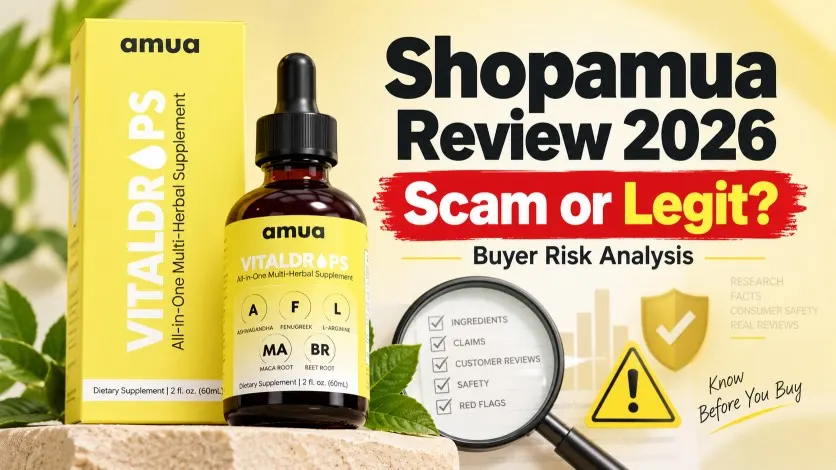
Shopamua.com is an online wellness store selling Amua VitalDrops, a liquid dietary supplement promoted mainly around body confidence, curves, weight distribution, hormone-related benefits, and other wellness goals. The marketing is polished, the store is powered by Shopify, and there are real policy pages, an order-tracking system, customer-support contact information, and some independent customer reviews. At first glance, it looks more developed than the disposable storefronts we often encounter while investigating questionable online shops.
That does not mean I would treat Shopamua as a low-risk purchase without further checks.
When I looked beyond the sales presentation, several issues deserved closer attention. The current shopamua.com domain is very young, automated website-risk services give it weak-to-moderate scores, the business addresses displayed across different sources do not fully match, the refund guarantee contains restrictions that are much less obvious on the sales page, and some of the supplement’s strongest marketing claims are presented without readily visible clinical evidence for the finished product.
At the same time, there are also factors working in Shopamua’s favor. The website is functional, uses HTTPS, operates through Shopify, publishes detailed shipping and subscription terms, provides a domain-based support email, has an external Trustpilot profile, and appears connected to an older Amua storefront using tryamua.com. That older connection matters because it may explain why some customer activity displayed on the current site predates the shopamua.com registration date.
So this is not a case where the evidence supports simply writing “scam” and moving on. The better question is whether Shopamua has established enough transparency and independent evidence to justify the confidence its marketing asks consumers to place in it.
Quick Verdict: Is Shopamua Legit?
Our investigation found… enough evidence to confirm that Shopamua is a functioning e-commerce operation, but not enough independent evidence for us to classify it as a strongly established or low-risk supplement retailer.
The domain shopamua.com was created on June 9, 2026, making it only around three months old at the time of this review. Find The Scam currently gives the domain a 46/100 score and labels the profile “High Risk,” while also confirming positive technical signals such as valid HTTPS, available DNS records, an online storefront, and accessible WHOIS information. The Scam Detector score supplied for this investigation is lower at 26.7/100.
Those automated scores should never be treated as proof of fraud. They are more useful as prompts telling us what needs additional verification. In Shopamua’s case, that additional verification produces a mixed picture.

My overall assessment is medium-to-high buyer risk, with further verification recommended before purchase, especially if someone is considering a large multi-bottle order or recurring subscription. I would not describe Shopamua as a confirmed scam based on the evidence available, but I also would not recommend buying purely because of the attractive website, large customer-count claims, or money-back-guarantee banners.
Shopamua Quick Facts
| Detail | What We Found |
|---|---|
| Website | shopamua.com |
| Brand/Company Name Shown | Amua / AMUA VITALDROPS |
| Main Product | Amua VitalDrops |
| Product Category | Dietary supplements / wellness |
| support@shopamua.com | |
| Public Phone Number | No clear public customer-service phone number found during our review |
| Website Registration | June 9, 2026 |
| Domain Expiry | June 9, 2027 |
| Scam Detector Score | 26.7/100, based on the research supplied for this review |
| Find The Scam Score | 46/100, High Risk |
| Trustpilot | Approximately 3.9/5 from 21 reviews when recently checked |
| U.S. Delivery Estimate | 4–7 calendar days standard after processing |
| Processing Time | Around 1 business day |
| Refund Offer | Conditional 90-day satisfaction guarantee |
| Advertised Maximum Sale | Up to 67% off |
| Store Platform | Shopify |
| Main Address Shown | 4008 Laramie Street, Cheyenne, Wyoming |
| Subscription Available | Yes |
What Exactly Does Shopamua Sell?
The main product being promoted is Amua VitalDrops. The store describes it as a plant-based liquid supplement containing ingredients including maca root, ashwagandha, beet root, fenugreek, and L-arginine. The primary sales page promotes the product to women who want fuller hips, thighs, and glutes, while other versions of the product page use similar ingredient combinations for menopause-related concerns or men’s circulation and performance.
The standard VitalDrops listing we examined showed a sale price of $39.99 compared with a claimed regular price of $59.99, roughly a 33% reduction. The wider storefront has also displayed sale banners advertising discounts of up to 67%.
This type of marketing is common in direct-response supplement stores. Large discounts, transformation-oriented messaging, testimonials, countdown-style promotions, bundled purchases, and subscription options are all designed to reduce hesitation and increase average order value. None of those tactics automatically indicate fraud, but they do make the underlying terms more important because the emotional sales message can easily receive more attention than the policy details.
The Domain Age Deserves Attention, but There Is More Context
The current shopamua.com domain was registered on June 9, 2026 and is due to expire on June 9, 2027. Find The Scam independently reports the same dates and describes the domain as having limited public history.
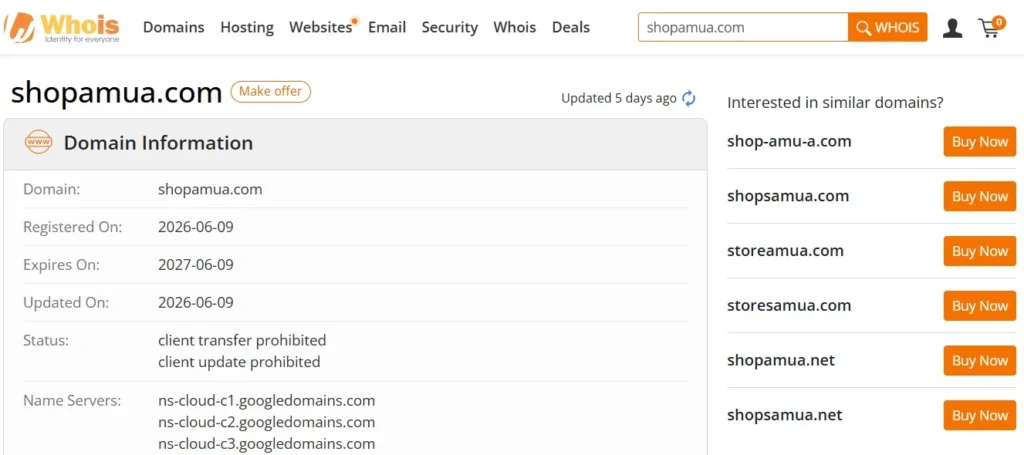
A newly registered domain is one of the first things I check with unfamiliar online stores. Scam operations frequently use young domains because they can abandon one address and reopen elsewhere after complaints accumulate. But legitimate startups also begin with new domains, so domain age alone should never decide the verdict.
There is an interesting additional detail here. Amua also operates or has operated through tryamua.com, which carries the same VitalDrops branding and lists a Cheyenne address. That domain existed before shopamua.com and appears to be part of the same brand ecosystem. The older Amua site currently lists 4008 Laramie Street, Suite B, Cheyenne, Wyoming and uses support@tryamua.com.
That older storefront is relevant because the product page on shopamua.com contains testimonials displaying purchase dates from 2025, before the current Shopamua domain existed. Taken alone, that timing looks strange. But the presence of the earlier tryamua.com store provides a plausible explanation: Shopamua may represent a domain migration or newer version of an existing Amua business rather than the absolute beginning of the brand.
I would therefore count the young shopamua.com registration as a risk factor, but not as proof that the entire Amua operation only appeared in June 2026.
Scam Detector and Find The Scam Scores
The Scam Detector score provided for Shopamua is 26.7/100. That is clearly on the lower end of the platform’s scoring system and deserves attention, although automated scoring models can be influenced heavily by domain age, traffic history, ownership signals, and other technical indicators.
Find The Scam currently gives shopamua.com 46/100 and classifies it as “High Risk.” Its report identifies several positive factors, including a valid HTTPS certificate, working DNS infrastructure, accessible WHOIS information, an online storefront, and a safe signal from McAfee SiteAdvisor. It also flags the young domain, low or unavailable public reputation footprint, incomplete Safe Browsing verification, and limited public history.
This difference between 26.7 and 46 illustrates why I do not recommend judging a website from one automated score. The proper approach is to treat these ratings as one evidence category and then inspect customer feedback, policies, product claims, company identity, payment protections, and consistency across the site.
Trustpilot Reviews Tell a More Nuanced Story
Shopamua has an external Trustpilot profile under the Amua name. During a recent check, Trustpilot displayed a rating around 3.9/5 from 21 reviews and identified the business profile as claimed in June 2026. The listed support email matches the website.
The review content is more informative than the headline rating.
Several consumers praise fast or friendly customer-service responses. Some reviewers specifically say their questions or cancellation requests received prompt attention. That is a positive operational signal because completely unresponsive support is one of the most common warning signs we see with questionable online shops.
On the other hand, a surprising number of reviews were written before the customer had enough experience to judge the product itself. Some reviewers said they had not yet received their bottle, had used the drops for only a few days, or were waiting to see whether results would appear.
That distinction matters. Good customer service is useful evidence about support responsiveness, but it does not prove the health or body-shaping claims made for the supplement.
During testing, we observed… that Shopamua’s own website presents dramatically larger social-proof numbers than independent review platforms. Depending on the page or version indexed, the site has displayed figures such as hundreds or thousands of product reviews, tens of thousands of happy customers, more than 80,000 customers, and tens of millions of Instagram views.
These numbers may come from internal customer data, advertising campaigns, older storefront activity, social media engagement, or different landing-page datasets. I cannot verify that from the information publicly displayed. For that reason, I would give independently hosted reviews greater weight than marketing counters controlled by the seller itself.
The Business Address Is Not Completely Consistent
This was one of the more important transparency issues I noticed.
The Shopamua footer and several policy pages list:
4008 Laramie Street
Cheyenne, WY 82001
USA
The privacy policy, however, has displayed a variation using 4008 Laramie St, Suite B, Cheyenne, WY 82009. The older tryamua.com site also uses the Suite B version and the 82009 ZIP code.
Trustpilot presents yet another contact address: 312 W 2nd St Unit 8601, Casper, United States.
An address inconsistency does not prove fraudulent activity. Companies can have mailing addresses, registered offices, fulfillment addresses, previous addresses, and customer-support locations. Still, a wellness business asking customers to ingest a supplement should make its responsible business identity unusually easy to verify.
Themakerdepot researchers noticed… that the 4008 Laramie Street address is not unique to Amua. Search results associate the same commercial address with other unrelated businesses as well. That makes it possible the address serves as a commercial office, mailbox, suite, registered-business location, or shared facility rather than a dedicated Amua manufacturing site.
I would like to see Shopamua state clearly which address is its legal business address, which entity operates the store, and where the supplement is actually manufactured. That would remove unnecessary uncertainty.
No Obvious Public Phone Support
The site prominently provides support@shopamua.com, which is preferable to a free Gmail-style address. I did not find a clearly published customer-service phone number on the primary contact and policy pages we reviewed.
Email-only support is common among small e-commerce brands, so this is not automatically suspicious. The more relevant question is whether support actually replies, and several independent Trustpilot reviewers do report reasonably quick responses.
Consumers placing a large order should still save every email, order confirmation, shipping notice, cancellation request, and screenshot of the checkout terms. This becomes particularly important if the order involves a subscription.
Subscription Terms Need Careful Reading
Shopamua allows recurring subscriptions, and this is one area where buyers should slow down before clicking the purchase button.
The subscription policy says recurring charges can occur at the selected frequency and continue until canceled. Customers are responsible for canceling before the next billing date. The policy also states that processed subscription charges generally cannot be reversed or refunded and that cancellation applies only to future billing cycles.
The policy says customers can manage subscriptions through their account or by contacting support, and cancellation should be completed at least 24 hours before the next billing date.
This is not unusual for subscription commerce, but it creates a practical risk. A customer may think they are simply testing a wellness product, while the financial commitment becomes recurring if the subscription option was selected.
Before ordering, confirm whether the checkout button says one-time purchase or subscription. Take a screenshot showing the selected option, price, billing frequency, and cancellation conditions. That small habit prevents a lot of later confusion.
The 90-Day Refund Guarantee Has Important Fine Print
This is probably the biggest policy issue I found.
The storefront uses reassuring language suggesting that customers can try the product risk-free and return it within 90 days for a full refund. That sounds broad and simple.
The dedicated refund policy is considerably narrower.
According to the policy, the 90-day guarantee applies only to customers who purchased a full 90-day supply, either through a three-bottle package or three separate one-bottle purchases. A single bottle by itself does not qualify. The customer is instructed to use the product consistently for the full 90 days and then submit the guarantee request with proof of purchase. Requests before the required period can be excluded.
That difference matters.
A shopper reading “90-Day Money-Back Guarantee” on a sales page may reasonably assume that buying one bottle allows them to test it and request a refund within 90 days if they are dissatisfied. The detailed policy says otherwise.
I would like to see the eligibility restriction placed immediately beside the guarantee claim rather than requiring shoppers to discover it in a separate policy page. Clearer disclosure would reduce the chance of disappointment and disputes.
Shipping and Delivery Terms
Shopamua publishes a relatively detailed shipping policy. It states that orders are normally processed within one business day. For customers in the United States, standard delivery is estimated at 4–7 calendar days, while express delivery is estimated at 3–6 calendar days. Orders under $50 may incur a $3.99 shipping fee.
The policy also contains several conditions worth knowing. Missing or damaged products generally need to be reported promptly, order changes or cancellations must be requested within 12 hours, and shipped orders cannot be canceled. If tracking records show an order as delivered, the policy places significant responsibility on the customer to pursue the carrier.
These terms are more detailed than those found on many throwaway stores, which is a positive point. Still, buyers should treat delivery times as estimates rather than guarantees.
The Supplement Claims Deserve More Scrutiny Than the Store Design
This is where my concern moves beyond ordinary website legitimacy.
VitalDrops marketing contains strong claims around where the body stores fat, hormone signals, fuller hips and thighs, belly fat, menopause symptoms, circulation, libido, and other physiological outcomes. Some product pages say the supplement supports fuller curves or that plant ingredients can influence where weight is stored. Other pages present versions aimed at menopause or blood-flow concerns.
The website does include an FDA disclaimer stating that the claims have not been evaluated by the Food and Drug Administration and that the product is not intended to diagnose, treat, cure, or prevent disease. It also advises certain customers to consult a healthcare professional.
That disclosure is appropriate, but consumers need to understand what phrases such as “FDA-registered facility” do and do not mean.
The FDA specifically explains that it does not approve dietary supplements for safety and effectiveness before they are marketed. The agency also says registration of a manufacturing establishment does not mean that the facility or its products have been independently “approved” by FDA.
Therefore, an “FDA-registered facility” statement should not be interpreted as evidence that FDA has tested or endorsed Amua VitalDrops.
What About “Third-Party Tested”?
The Shopamua product presentation has included “third-party tested” among its comparison claims.
During our review, I did not find an easily accessible certificate of analysis, named independent laboratory, batch-testing database, or finished-product clinical study linked from the public pages we examined.
That does not prove testing has not occurred. The documents could exist without being publicly linked. But if a supplement seller uses third-party testing as a major trust indicator, publishing the testing laboratory, batch number, contaminant results, ingredient verification, and certificate of analysis would make the claim far more useful to consumers.
For a product designed to be taken daily for approximately three months, that level of transparency would be valuable.
Testimonials Are Not the Same as Scientific Evidence
Testimonials are emotionally powerful because they show people describing outcomes in familiar language. Shopamua makes extensive use of this technique.
But testimonials cannot establish that a supplement causes the outcome described.
The Federal Trade Commission says objective health and safety claims should be supported by competent and reliable scientific evidence. The FTC also makes clear that customer testimonials do not substitute for substantiation of the underlying health claim.
This is especially relevant when a marketing claim involves changes that may also be influenced by diet, exercise, hormonal status, total calorie intake, medication, genetics, age, pregnancy history, or many other variables.
Until product-specific evidence is presented, I would treat before-and-after stories and customer testimonials as individual experiences rather than predictable outcomes.
Why the Marketing Style Raises Additional Questions
The sales funnel uses several behavioral triggers commonly found in aggressive direct-response marketing: limited-time discounts, large social-proof counters, transformation messaging, emotional body-confidence language, risk-free guarantee wording, comparisons with alternatives, and recommendations to continue for multiple months.
This style is effective because it addresses two natural consumer fears at the same time. First, the shopper worries that the product may not work. The guarantee reduces that fear. Second, the shopper worries that waiting will mean missing the discount or transformation opportunity. The promotional messaging increases urgency.
These techniques are not automatically deceptive. Established brands use similar tactics every day.
The problem comes when emotional reassurance is easier to understand than the contractual details. Shopamua’s refund policy is a good example: “90-day satisfaction guarantee” sounds simple, but qualification depends on purchasing a 90-day supply and following the policy conditions.
A cautious shopper should therefore evaluate the policy page as seriously as the product page.
Positive Trust Indicators We Found
Shopamua is not missing every trust signal. Far from it.
The website uses a valid HTTPS connection, is hosted through Shopify, publishes shipping, privacy, refund, subscription, and terms-of-service pages, provides an order-tracking feature, and uses an email address on its own domain. Find The Scam also detected normal DNS infrastructure and a functioning storefront.
There is also an external Trustpilot footprint with both positive and critical reviews rather than a completely blank reputation profile. Several customers specifically describe helpful customer service.
The older tryamua.com storefront provides additional continuity for the Amua brand. This is particularly relevant when interpreting testimonials or customer activity dated before the newer domain registration.
These are meaningful positives and are why I would not classify Shopamua as a proven fraudulent operation based solely on the evidence available.
Warning Signs and Unanswered Questions
The risk side of the assessment is still substantial. The domain is very new, third-party reputation history remains limited, automated trust services show weak scores, the business address is inconsistent across the website and Trustpilot, no obvious public phone number was found, and the strongest supplement claims are not accompanied by easily accessible finished-product clinical evidence.
There is also a notable gap between independent review volume and the much larger customer and review numbers displayed through the seller’s own marketing. Those numbers might have legitimate internal sources, but consumers cannot independently validate them from the storefront alone.
Most importantly, the 90-day refund offer is much more conditional than the simplified guarantee language may suggest.
None of these factors individually proves fraud. Together, though, they justify a higher level of verification before spending money.
How I Would Verify Shopamua Before Ordering
Start by deciding whether you are comfortable with the product claims themselves. Do not make that decision from testimonials alone. If you take prescription medications, have a medical condition, are pregnant or nursing, or are considering the menopause or circulation-focused versions of the product, discuss the ingredients with a qualified healthcare professional.
Next, read the refund and subscription policies in full. If you are buying only one bottle, understand that the published 90-day satisfaction policy currently says a single-bottle purchase does not qualify for the main guarantee.
Then contact support@shopamua.com before purchasing and ask three direct questions: whether your exact order qualifies for the guarantee, whether your checkout selection creates recurring billing, and which legal business entity is processing the transaction. Save the response.
Finally, use a credit card or another payment method that gives you meaningful dispute protection. Avoid irreversible methods such as cryptocurrency, wire transfers, gift cards, or direct transfers when dealing with a young online merchant.
Who Should Avoid Shopamua?
I would avoid ordering if you are uncomfortable purchasing supplements from a relatively young online storefront, if you require extensive published clinical evidence before trying a wellness product, or if you are relying heavily on the advertised money-back guarantee to protect a single-bottle experiment.
Consumers who frequently forget subscription renewal dates should also be especially careful. Shopamua’s policy makes customers responsible for canceling before the billing date, and processed subscription charges can be difficult to reverse under the seller’s stated terms.
Anyone expecting guaranteed body-shaping, hormone, menopause, weight-distribution, or circulation results should reconsider that expectation. Individual testimonials and marketing statements are not a substitute for medical evidence. You can read more about trywildharvest-dot-com Legit or a Scam?
Our Trust Assessment
From a technical storefront perspective, Shopamua looks more credible than the typical fake shopping website. It works, has normal e-commerce infrastructure, provides policies, has customer support, uses Shopify, and has some external reputation history.
From a transparency and product-evidence perspective, I still have reservations.
The young domain, inconsistent addresses, low automated trust scores, limited independent review history, refund-policy fine print, varying social-proof numbers, and aggressive physiological claims all increase the level of due diligence I would expect from a buyer.
The correct interpretation is not “Shopamua is definitely fake.” It is that Shopamua has not yet accumulated enough independent history or transparency for me to give it the same confidence level I would give an established supplement retailer with years of verifiable operations, consistent corporate information, extensive independent feedback, published testing certificates, and clearly documented scientific substantiation.
Final Verdict: Shopamua Scam or Legit?
After examining the current Shopamua storefront, WHOIS information, independent website-risk data, Trustpilot feedback, refund terms, subscription conditions, shipping policy, product marketing, contact details, and its apparent connection with the older Amua domain, we do not have sufficient evidence to call shopamua.com a confirmed scam.
There are genuine positive signals. The store is functional, customer support appears responsive in several independent reviews, policies and tracking tools exist, and the Amua brand appears to have an online history that predates the current shopamua.com domain.
The concerns are also meaningful. Shopamua remains a very young domain. Independent reputation data is still small compared with the enormous customer figures shown in its marketing. The addresses shown across different sources are inconsistent. Its refund guarantee requires careful reading. Subscription purchases involve recurring-billing obligations. Most importantly for a supplement seller, the website makes strong physiological claims without presenting easily accessible finished-product clinical evidence or detailed third-party laboratory documentation during our review.
My assessment therefore falls into the “verify carefully before buying” category rather than either extreme.
If you still want to try Amua VitalDrops, start by confirming your exact refund eligibility and whether you are making a one-time or subscription purchase. Use a payment method with buyer protection, retain screenshots of the offer and policies, and do not assume that phrases such as “FDA-registered facility,” testimonials, large customer counts, or a money-back banner guarantee either product effectiveness or a trouble-free refund.
For now, Shopamua needs more time, more independent customer history, more consistent business information, and stronger publicly verifiable evidence around its product claims before I would consider it a low-risk purchase.