Fake online stores rarely look fake at first glance. That is the part many shoppers underestimate. The modern fraudulent shopping site is often clean, mobile-friendly, filled with professional product images, equipped with a checkout page, and covered in familiar trust signals such as secure-payment icons, customer testimonials, refund promises, and even social media links. Some look more polished than small legitimate businesses that have been operating for years.
After reviewing questionable shopping websites over time, I have learned that the appearance of professionalism is one of the weakest indicators of legitimacy. A convincing storefront can now be assembled very quickly using ready-made e-commerce themes, copied product descriptions, inexpensive domains, imported reviews, AI-generated branding, and advertising accounts that send buyers directly to carefully designed landing pages.
The more useful question is not simply whether a store “looks trustworthy.” It is whether the business behind that appearance can be independently verified.
This article explains how scammers create fake online stores, the psychological techniques often used to move visitors toward checkout, the warning signs investigators examine, and the verification process consumers can use before sending money or payment information to an unfamiliar seller.
Fake Stores Usually Begin With a Business Opportunity, Not a Website
When people imagine someone creating a fraudulent store, they may picture a person building an entire website from scratch. That is no longer necessary.
A basic online shop can be launched using an e-commerce template and populated with dozens or even hundreds of products in a surprisingly short period. Product photographs can be copied from manufacturers, marketplaces, legitimate retailers, social media accounts, or wholesale catalogs. Descriptions can be duplicated or lightly rewritten. Privacy policies, shipping pages, terms of service, and refund policies can also be copied from unrelated businesses.
The result can look substantial even when almost nothing behind the store is substantial.
In many cases, the real work is not building the website. The real work is creating enough credibility to persuade someone to make the first purchase.
That distinction matters because scammers do not need to convince every visitor. A site receiving thousands of visitors through social media advertising may only require a small percentage of people to place orders for the operation to become profitable.
Step One: Choosing Products That Are Easy to Sell Emotionally
Fake stores are rarely built around completely random products. Operators often select merchandise that benefits from excitement, urgency, or difficult price comparisons.
Trending gadgets are an obvious example. A product shown in a short social media video may appear revolutionary even when the buyer has never heard of its manufacturer. Portable air conditioners, smart health devices, mini projectors, beauty products, unusual kitchen tools, wearable electronics, pet accessories, and viral household gadgets frequently fit this pattern.
Fashion creates another opportunity because consumers cannot always compare an identical model across several stores. A seller can display attractive dresses, shoes, jackets, or accessories without buyers immediately knowing the normal retail price.
High-demand branded products create a different psychological effect. A shopper who sees a normally expensive item discounted by 70% may focus more on securing the bargain than investigating the seller.
That emotional shift is important.
The scammer wants the buyer asking, “Should I buy this before the offer disappears?” rather than, “Who actually owns this business?”
Step Two: Registering a Disposable-Looking Domain
The domain is the foundation of the operation, but it does not have to remain active for years.
Operators can register a new domain cheaply, attach an e-commerce storefront, advertise aggressively, collect orders, and later abandon the domain if complaints begin to accumulate. A new store may then appear under a different name.
This is why domain registration history is one of the first things I check when reviewing an unfamiliar online retailer.
A domain registered three weeks ago does not automatically indicate fraud. Legitimate businesses launch every day. The problem appears when a very young domain is presented as though the company has a long established history.
Imagine a store claiming, “Serving customers since 2014,” while publicly available registration records indicate its domain was created in July 2026. There may be an innocent explanation, such as a business changing domains, but the discrepancy deserves verification.
What matters is consistency between the website’s story and independently available evidence.
Step Three: Building a Professional Storefront
Modern website tools have eliminated one of the barriers that once made fraudulent websites easier to identify: poor design.
A decade ago, obvious spelling errors, broken pages, ugly layouts, and strange checkout forms were common warning signs. Those clues still appear, but relying on them alone is outdated.
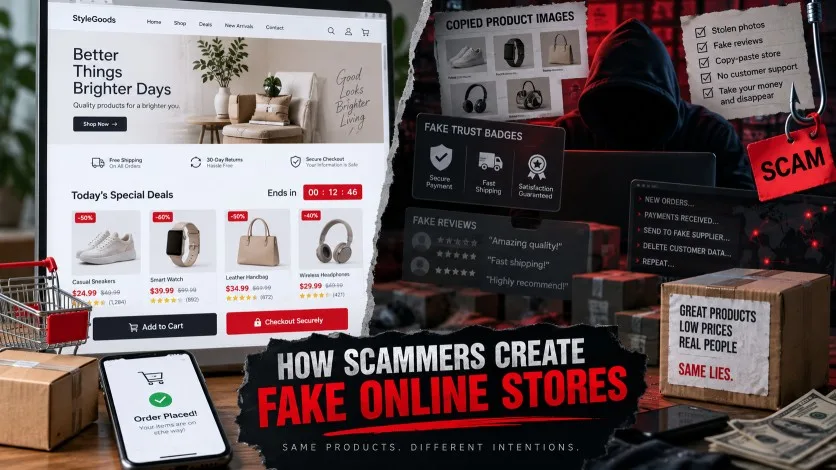
Today, a suspicious store may have responsive design, polished product galleries, animated banners, countdown timers, currency selectors, shopping-cart notifications, and legitimate SSL encryption.
During testing, we observed… that some questionable stores can appear considerably more professional on the homepage than they do once you start examining less visible pages such as Contact Us, Terms and Conditions, Shipping Policy, or Returns.
That is why I often move away from the homepage almost immediately.
The homepage is marketing. The policy and identity pages are where inconsistencies often become easier to see.
Step Four: Borrowing Product Images and Descriptions
One of the simplest ways to create the illusion of inventory is to use material that already exists elsewhere.
Suppose a store claims to sell an innovative rechargeable cleaning tool. The product photography may actually belong to a manufacturer, an Amazon seller, an AliExpress listing, or another unrelated retailer. The fraudulent or low-quality seller does not necessarily possess the product shown.
Reverse-image searching can therefore be surprisingly useful.
If identical photographs appear on numerous unrelated websites under different brand names, the product may simply be a generic item being rebranded. That does not automatically make the seller fraudulent. Dropshipping businesses legitimately use supplier imagery all the time.
The concern becomes stronger when the store claims exclusive technology, proprietary development, or unique manufacturing while its supposedly original product can be traced to existing generic listings.
Our investigation found… that inconsistencies between marketing claims and the wider product footprint can reveal more than the visual quality of the website itself.
Step Five: Manufacturing Trust Before the Visitor Starts Asking Questions
A fraudulent shop cannot simply display products. It needs signals that make visitors feel comfortable enough to pay.
This is where fake or unverifiable trust indicators become useful.
A page may display statements such as “10,000+ happy customers,” “Trusted worldwide,” “Rated 4.9/5,” or “Thousands sold.” Those claims may be legitimate, but the numbers themselves are not evidence unless they can be independently checked.
Testimonials deserve similar scrutiny.
A row of perfect five-star reviews beneath a product can look convincing, yet those reviews may have been imported manually, copied from another retailer, generated automatically, or collected through an internal review system controlled entirely by the seller.
TrickyMagazine researchers noticed… that the strongest-looking trust element on a shopping page is sometimes the least useful one because shoppers often mistake presentation for independent verification.
An internal five-star badge tells you what the website wants you to believe. An established third-party review history can provide additional context, although even external review platforms should not be treated as infallible.
Fake Stores Often Borrow Familiar Security Symbols
Payment logos can create an especially powerful impression.
Visa, Mastercard, American Express, PayPal, Apple Pay, Google Pay, Norton, McAfee, SSL, or “secure checkout” graphics may appear in the footer. Their presence does not necessarily prove the corresponding company has reviewed or approved the store.
Images are easy to copy.
HTTPS is another misunderstood signal. A padlock in the browser means the connection between your browser and the website is encrypted. That is useful, but encryption does not establish the honesty of the person receiving your information.
A fraudulent site can use HTTPS just as a legitimate site can.
I would consider missing HTTPS a serious security problem, but I would never use HTTPS alone as proof that an online seller is trustworthy.
Step Six: Creating Artificial Urgency
The psychological side of fake e-commerce deserves more attention because the technical website is only part of the operation.
Many questionable sellers want to shorten the period between discovery and purchase.
A visitor who has twenty-four hours to research a company may find warning signs. A visitor who believes the price will disappear in four minutes may not check anything.
That is why countdown clocks, low-stock messages, “20 people are viewing this,” flash-sale banners, and rapidly changing inventory notices are so common in aggressive e-commerce marketing.
Some legitimate retailers use these techniques as well. Urgency by itself is not evidence of fraud.
The distinction comes from whether the urgency appears genuine and whether it is combined with other questionable signals.
One simple test is to return to the page later. If a “sale ending in 08:42” resets every time the page is refreshed, the countdown may be a marketing device rather than an actual deadline.
How Scammers Use Pricing to Override Skepticism
Pricing is one of the most effective persuasion tools because a bargain can make people rationalize warning signs they would normally notice.
A shopper may think, “The company is unfamiliar, but perhaps that is why the price is so low.”
That explanation can sometimes be true. New retailers do discount products to attract customers.
The problem is unrealistic economics.
If every premium product on a site is permanently discounted by 70% to 90%, I want to know how that seller is acquiring inventory, paying payment-processing fees, covering shipping, handling returns, and still remaining profitable.
A price does not become fraudulent because it is low. It becomes a risk signal when the economics appear implausible and the retailer provides no credible explanation for them.
Fake Company Identity Can Be More Important Than Fake Products
When investigating an unfamiliar seller, I spend considerable time looking for the actual operator.
A legitimate business does not always publish the owner’s personal name. Privacy is not suspicious by itself. Small home businesses may also avoid displaying a residential address publicly.
Still, there should usually be some coherent business identity.
Look for the company name, registered entity where applicable, business address, working support email, telephone number, and consistent information across the site’s legal pages.
One pattern I see repeatedly is inconsistency.
The homepage may use one brand name. The refund policy may mention another company. The terms page may contain a third domain. The contact address may point to a residential home, unrelated office building, virtual mailbox, or location that cannot be connected to the seller.
None of these observations independently confirms deception. Taken together, they can materially increase risk.
Copied Policies Can Reveal a Hastily Built Store
Policy pages are surprisingly valuable during an investigation.
Many shoppers never read them, which may be exactly why low-effort operators neglect them.
I search for another company name inside the Terms of Service, Privacy Policy, Shipping Policy, and Refund Policy. I also look for conflicting return windows, unexplained addresses, strange jurisdiction clauses, incomplete template text, and email addresses belonging to different domains.
For example, a store might advertise a “30-day money-back guarantee” prominently on its product page while its refund policy says customers must request authorization within seven days.
Another may advertise “easy returns” while requiring buyers to ship merchandise internationally at their own expense to an address disclosed only after contacting support.
That does not necessarily make the business fraudulent, but it can dramatically change the real cost and practicality of obtaining a refund.
Social Media Advertising Plays a Major Role
Many fake or short-lived stores do not depend on people discovering them through Google.
They buy attention.
A polished video advertisement on Facebook, Instagram, TikTok, YouTube, or another platform can send users directly to a product page. Because the ad appears inside a familiar platform, some shoppers subconsciously transfer part of their trust in the platform to the advertiser.
That is a mistake.
Advertising platforms have review systems, but the presence of an advertisement should not be interpreted as an independent endorsement of the merchant.
When I see an unfamiliar product through an ad, I prefer to search for the seller separately rather than purchasing through the advertisement immediately. That small interruption breaks the urgency cycle and gives you time to investigate.
The Fake Store Funnel: From Advertisement to Payment
Consider a realistic example.
A consumer sees a video showing a compact device that supposedly cools an entire room. The advertisement claims a normal price of $199, currently reduced to $59. A countdown indicates the sale ends tonight.
The shopper clicks.
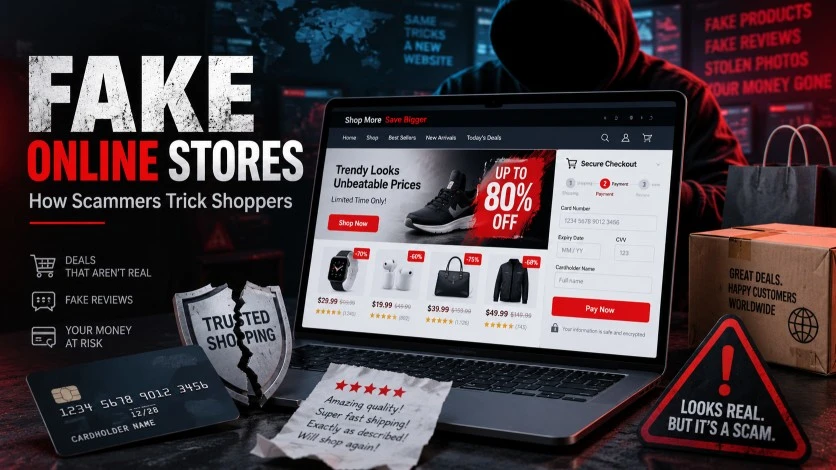
The landing page contains dramatic demonstration videos, hundreds of positive testimonials, “limited stock” messaging, and a guarantee badge. Buying two units provides a larger discount. Buying three provides free shipping.
At this point, almost everything on the page is designed to answer one question: “Why should I buy?”
Very little helps answer the more important question: “Who am I buying from?”
That imbalance is something I pay close attention to. Established retailers normally have a commercial footprint extending beyond a single aggressively optimized landing page.
Some Fake Stores Actually Ship Something
This is where online shopping investigations become more complicated.
Not every problematic store simply takes money and disappears.
Some customers may receive a product, but it can be significantly cheaper, smaller, lower-quality, or materially different from what was advertised.
That type of operation can generate confusing review patterns. One buyer says, “Mine arrived, so the website is legitimate.” Another says the product was completely different from the advertisement. Someone else reports never receiving anything.
The existence of delivered orders therefore does not settle every question about reliability.
A useful investigation considers product accuracy, shipping reliability, refund accessibility, customer support, recurring billing risks, and advertising claims—not merely whether a parcel can arrive.
Common Warning Signs and How Much Weight I Give Them
No single red flag should normally decide a case. I prefer cumulative analysis.
| Observation | What It May Mean | Investigative Weight |
|---|---|---|
| Very recently registered domain | New business or temporary operation | Moderate |
| Huge discounts across most products | Aggressive marketing or unrealistic pricing | Moderate |
| No identifiable company information | Limited transparency | Moderate to strong |
| Copied or inconsistent policy pages | Poor setup or reused website template | Moderate |
| No independent review history | Business may simply be new | Low to moderate |
| Fake-looking countdown timers | Artificial urgency marketing | Moderate |
| Product photos found on many unrelated stores | Dropshipping or reused supplier content | Low to moderate |
| Business claims many years of history despite a new domain | Possible credibility discrepancy | Strong |
| Contact email does not match the business | Outsourced support or identity inconsistency | Moderate |
| Only irreversible payment methods accepted | Higher consumer recovery risk | Strong |
| Multiple unrelated concerns occurring together | Increased overall risk | Strong |
This cumulative approach prevents two common mistakes: declaring every new business fraudulent and trusting every professionally designed website.
A Step-by-Step Method for Verifying an Online Store
Check the Domain History First
Start with the domain because it gives you an independent piece of information the seller cannot easily rewrite on its About Us page.
Check approximately when the domain was registered and compare that date with claims made on the website. A young domain is not automatically bad, but a mismatch between domain history and claimed business history deserves further investigation.
Also search the domain name itself rather than relying exclusively on automated reputation scores.
Identify the Company Behind the Store
Next, find the legal or operating identity.
Check the footer, Contact page, Privacy Policy, Terms and Conditions, Refund Policy, and About page. Compare the company name, email address, phone number, and physical location.
If the same information appears consistently, that is useful. If every page seems to tell a different story, keep investigating.
Search the Address Separately
Copy the business address into a search engine or mapping service.
An address belonging to a shared office or residential building does not prove fraud. Many legitimate online businesses operate from small offices or homes.
What you are looking for is whether the location has any reasonable connection to the business and whether the website describes it accurately.
Investigate the Product Outside the Store
Search the product name and use image-search tools where appropriate.
If a supposedly proprietary product appears under twenty different brand names, you have learned something important about the marketing claim.
Compare specifications carefully. Sometimes an advertiser describes a basic generic product using language that makes it sound technologically unique.
Examine Independent Customer Feedback
Search beyond testimonials displayed on the merchant’s own website.
Look for reviews across several platforms, forum discussions, social media comments, complaint sites, and search results. Pay attention to patterns rather than one dramatic review.
New businesses may genuinely have little feedback. That absence should be treated as uncertainty rather than automatic evidence of wrongdoing.
Read the Refund Terms Before Paying
This is one of the most practical checks consumers skip.
Find out how long you have to request a return, who pays return shipping, where the product must be returned, whether clearance items are excluded, whether original packaging is required, and how refunds are processed.
A refund policy can look generous in a headline while being extremely restrictive in the details.
Evaluate the Payment Method
Whenever possible, use a payment method that provides meaningful dispute or chargeback protection.
Be far more cautious if an unfamiliar online store insists on cryptocurrency, wire transfers, gift cards, or other payment methods that are difficult to reverse.
A legitimate-looking checkout does not eliminate transaction risk. You can read more about Signs an E-Commerce Website May Be a Scam.
Trust Signals That Actually Carry More Weight
Not every positive indicator is cosmetic.
A long and consistent business history is meaningful. So is a domain that has been associated with the same retailer for years, established social profiles with genuine historical activity, responsive customer support, consistent legal information, realistic pricing, and independent customer feedback accumulated over time.
Recognized payment processors can also reduce certain risks, although they do not personally guarantee every merchant.
I also pay attention to whether the company behaves like a real business when nobody is trying to sell me something.
Does the support team answer a specific question clearly? Are shipping estimates understandable? Is the refund address disclosed? Are policy pages written for the actual business rather than copied from an unrelated store? Can the company’s identity be independently connected to its website?
These boring details usually tell me more than a giant “100% Secure Shopping” badge.
Understanding the Scammer’s Behavioral Strategy
A fake online store is ultimately a persuasion system.
The operator wants to reduce skepticism while increasing emotional momentum. That usually means combining credibility signals with urgency, attractive pricing, visual demonstrations, social proof, and low-friction checkout.
The shopper is gradually moved from curiosity to desire and then from desire to action.
This is why aggressive stores often answer objections directly on the product page. Worried about quality? There is a guarantee. Worried about popularity? Thousands supposedly bought it. Worried about waiting? Stock is almost gone. Worried about price? The discount ends tonight.
Each element removes a reason to delay.
From a consumer-protection perspective, delaying is exactly what you should do when the seller is unfamiliar.
Five minutes of independent research can completely change the decision.
When Warning Signs Do Not Automatically Mean Scam
Balanced analysis matters because legitimate small businesses can look suspicious.
A new company may have a recently registered domain, few customer reviews, a basic website, and a residential business address. That combination may simply describe a genuine startup.
Dropshipping also creates false positives. A legitimate dropshipping retailer may use supplier photographs, sell generic products, and have longer shipping times without intending to defraud customers.
Even hidden domain registration details are common because privacy services are widely used by ordinary website owners.
This is why I dislike verdicts based on one automated score or one technical indicator.
Risk analysis works better when evidence is combined.
A two-month-old domain with transparent ownership, responsive support, ordinary pricing, protected payment methods, clear policies, and verifiable business records presents a very different picture from a two-month-old domain claiming ten years of experience while displaying copied policies, unrealistic discounts, unverifiable testimonials, and no identifiable operator.
Context changes the conclusion.
What to Do If You Already Ordered From a Suspicious Store
If you have already made a purchase and then discovered warning signs, preserve your evidence.
Keep the order confirmation, product page screenshots, advertisement, receipt, tracking information, emails, refund terms, and any correspondence with the seller. Website content can change quickly, so having a record of what was promised can become important later.
Contact the seller first when appropriate and document the response.
If merchandise never arrives, arrives materially different from what was advertised, or the seller refuses to honor clearly stated terms, contact your payment provider and ask about available dispute procedures.
Monitor your payment account afterward as well. If you believe card information has been compromised, contact the card issuer rather than simply waiting to see whether another transaction appears.
Consumers should also report suspected fraud through the appropriate consumer-protection or law-enforcement channels in their country when the circumstances justify it.
Security Habits That Reduce Shopping Risk
One useful habit is separating discovery from purchasing.
You may discover a product through an advertisement, influencer video, email, search result, or social post, but that does not mean you need to purchase through the first link you see.
Search for the product independently. Compare retailers. Check whether the manufacturer is identifiable. Look for normal market pricing and examine the seller separately.
Using unique passwords is also important. Never reuse the password for your email, banking account, or major online services on an unfamiliar shopping site.
And if a checkout page asks for information that seems unrelated to the transaction, stop and reconsider what you are being asked to provide. You can read more about Is TrySoluma dot com Legit or a Scam Website?
The Difference Between a Risky Store and a Confirmed Scam
Consumer websites need to be careful with this distinction.
A risky store is one where the available evidence raises meaningful uncertainty about reliability, transparency, advertising practices, fulfillment, or consumer protection.
A confirmed scam requires much stronger evidence.
That might include documented fraudulent transactions, verified impersonation, proven false business information, systematic non-delivery supported by substantial evidence, regulatory action, law-enforcement findings, or other reliable documentation.
Without that level of evidence, wording matters.
It is more accurate to say that a website shows multiple warning signs, has limited transparency, presents elevated purchasing risk, or lacks enough independent evidence to establish confidence.
That may sound less dramatic than simply calling everything a scam, but it is far more useful to consumers.
Why Fake Online Stores Continue to Work
The uncomfortable answer is that these stores often exploit normal human behavior rather than technical ignorance.
People like bargains. We trust attractive design. We are influenced by social proof. We dislike missing limited opportunities. We assume advertisements have been checked. We become less analytical when we strongly want a product.
Scammers understand those tendencies.
Their advantage disappears somewhat when the consumer changes the order of operations.
Instead of falling in love with the product and then investigating the seller, investigate the seller before deciding how much you want the product.
That simple reversal makes emotionally driven manipulation much less effective.
Expert Verdict: Treat the Business Behind the Website as the Product You Are Evaluating
TrickyMagazine researchers noticed – understanding how scammers create fake online stores reveals why visual inspection alone is no longer enough. Building a polished storefront has become cheap and accessible. Product photography can be borrowed, testimonials can be manufactured, countdown timers can be automated, legal pages can be copied, and professional checkout systems can be added without proving anything meaningful about the people running the business.
The most reliable investigation therefore happens outside the sales page.
Check how long the domain has existed. Identify the operator where possible. Compare the site’s claims with independent records. Investigate the products elsewhere. Examine pricing realistically. Read the refund policy carefully. Look at independent customer history and choose payment methods that preserve your ability to dispute a transaction.
At the same time, avoid assuming that every new, small, foreign, dropshipping, or privacy-protected business is fraudulent. Those characteristics may increase uncertainty, but uncertainty is not proof.
What matters is the overall pattern.
When one questionable detail appears, investigate it. When several unrelated warning signs begin reinforcing each other—young domain, unverifiable business history, unrealistic discounts, copied policies, unclear ownership, artificial urgency, weak customer support, and risky payment methods—the purchasing risk becomes much harder to ignore.
That is ultimately the habit I would encourage every online shopper to develop. Do not ask only whether a website looks legitimate. Ask whether the business behind it survives basic independent verification.
A professional website can be created in a day. A trustworthy business history cannot.
1 thought on “How Scammers Create Fake Online Stores: Inside the Playbook Behind Fraudulent Shopping Sites”