A suspicious online store rarely introduces itself as suspicious. Quite the opposite. Some of the questionable shopping websites I have examined over the years were visually impressive, loaded quickly, accepted major cards, displayed professional product photography, and had all the familiar pages shoppers expect to see. At first glance, nothing looked obviously wrong.
That is exactly why checking an unfamiliar e-commerce website requires more than looking for spelling mistakes or a padlock beside the URL. Modern website templates allow almost anyone to build a convincing storefront quickly, and basic HTTPS encryption is available to legitimate businesses and dishonest operators alike. The Federal Trade Commission makes this distinction clearly: HTTPS protects information while it travels between you and a website, but encryption alone does not prove the seller itself is legitimate.
The more useful question is not, “Does this website look professional?” It is, “Does the business behind this website make sense when I independently verify it?”
That changes the investigation completely.
Our investigation found… the strongest warning cases usually involve several inconsistencies appearing together: an unusually new domain, prices far below normal market value, vague company information, copied policies, questionable reviews, limited payment protection, and customer service that becomes difficult to reach after payment. Any one of these can have an innocent explanation. When five or six appear together, the risk picture becomes much harder to ignore.
This guide explains the signs an e-commerce website may be a scam, how those signs should actually be interpreted, and the verification process I would use before giving an unfamiliar store my card information.
One Red Flag Is Not Enough to Call a Website a Scam
This is the first principle I use when reviewing online stores because it prevents a lot of bad conclusions.
A newly registered domain is not automatically fraudulent. A small business may have launched last week. Private WHOIS information is not automatically suspicious either; legitimate website owners often use domain privacy services to reduce spam and protect personal information. Even poor grammar has limited value by itself because plenty of genuine international retailers have imperfect English.
What matters is whether the facts work together.
Imagine two stores registered three months ago. The first clearly identifies the company running the business, provides verifiable contact details, has consistent social-media activity going back to launch, accepts credit cards through a recognizable processor, explains its shipping process, and sells products at normal market prices. The second has no identifiable operator, advertises expensive products at 70% to 90% discounts, uses a residential address belonging to someone unrelated to the store, has copied legal pages, and asks customers to pay using a method with limited buyer protection.
Technically, both domains are equally young. Their risk profiles are completely different.
That distinction is important because consumer-safety research should identify evidence, not manufacture certainty where certainty does not exist.
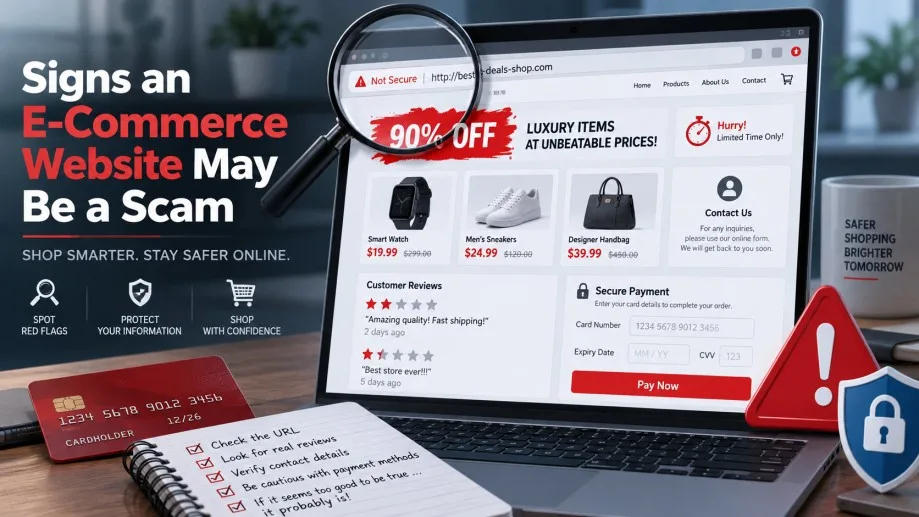
Extremely Low Prices Deserve More Attention Than Most Shoppers Give Them
Price is often where the persuasion begins.
There is nothing suspicious about a normal sale. Retailers liquidate inventory, run seasonal campaigns, issue coupons, sell refurbished products, and occasionally undercut competitors. What interests me is not simply whether an item is discounted, but whether the discount makes commercial sense.
If a product normally sells for $400 across five established retailers and an unknown website suddenly offers the identical new product for $79 with free international shipping, I would want an explanation before entering payment details.
How is the seller obtaining the product that cheaply? Is it refurbished? Is it a replica? Is the photograph merely illustrative? Is a subscription buried in the checkout terms? Is the item actually in stock? Does the advertised model number match the product description?
The FBI has previously identified heavily discounted merchandise as one of the indicators associated with fraudulent online shopping websites reported by victims. Its warning also described victims being directed to questionable retailers through social-media ads and shopping-related search results.
During testing, we observed… that aggressive pricing becomes considerably more concerning when it appears alongside fake scarcity. Countdown timers that reset after refreshing the page, permanent “closing down” banners, nearly every product showing a massive discount, or messages claiming that dozens of people are viewing an obscure item can create psychological pressure without providing meaningful information about the seller.
The price is therefore not the verdict. It is the invitation to investigate further.
Check Whether the Domain History Matches the Story the Store Tells
Domain-age research is one of the first technical checks I perform, but it needs to be interpreted carefully.
Suppose a store claims on its About Us page that it has been “serving customers worldwide since 2014,” while domain registration records indicate that its current domain appeared only two months ago. That mismatch deserves an explanation.
There may be one. A genuine company could have rebranded, changed domains, purchased a better web address, or moved away from an older domain. In that situation, I would look for evidence of the previous business: archived websites, company registrations, historical social-media accounts, press mentions, an older domain redirect, or established customer reviews.
If none of that exists, the claimed history becomes less convincing.
The FBI has specifically recommended reviewing WHOIS information when researching unfamiliar online retailers and has previously noted recently registered domains among reported indicators in online shopping scam cases.
Still, domain age should never be treated like an automatic legitimacy score. I have seen old domains repurposed for questionable activity, and brand-new websites belonging to perfectly real businesses. Age is context, not proof.
The Contact Page Can Reveal More Than the Homepage
I spend surprisingly little time admiring a store’s homepage. The contact page is usually more interesting.
A functioning business should normally provide customers with a realistic way to resolve payment, delivery, warranty, or return problems. Depending on the size and location of the company, this might include a business email, phone number, physical address, support portal, registered company details, or some combination of them.
The key word is realistic.
A street address printed on a website proves very little until it is verified. Search the exact address independently. Does it lead to the company, an office building, an unrelated family home, a warehouse, an empty lot, or another business entirely?
The FBI has documented online shopping complaints involving websites that displayed valid U.S. addresses and phone numbers that were unrelated to the retailers using them. Investigators also found some contact details appearing across multiple apparently different stores.
That is why simply writing “address found” in a website review is not enough. The useful question is whether the address appears connected to the business.
Email addresses deserve similar scrutiny. A Gmail or Outlook address does not automatically make a small seller illegitimate, particularly for a new sole trader. Yet a large-looking international retailer claiming years of operation while providing only a generic free email account creates a different impression.
TrickyMagazine researchers noticed… that contact information becomes most useful when treated as something to verify rather than something to merely locate. A beautifully formatted address, phone number, or support email can still be meaningless if nobody can connect it to the actual business.
Read the Return Policy Like a Dispute Has Already Happened
This is one of my favorite checks because questionable stores often concentrate their effort on product pages and neglect the boring legal sections.
Open the refund policy. Then actually read it.
Does the policy explain how many days customers have to request a return? Is there a clear return address? Who pays return shipping? Are sale products excluded? Are there restocking fees? Does the customer need authorization before returning an item? Are refunds sent to the original payment method?
Then compare that information with other pages.
I have seen websites where the shipping page names one company, the privacy policy names another, the terms refer to a completely different domain, and the refund page contains a support email unrelated to the store being reviewed. These inconsistencies can appear when a site has copied template content without properly adapting it.
BBB specifically recommends examining contact information and store policies and suggests searching copied policy text when legitimacy remains uncertain.
For U.S. shoppers, FTC consumer guidance also recommends checking shipping and refund terms before purchase. The FTC states that sellers must ship within the time they promise and, when no shipping time is stated, generally must ship within 30 days after receiving the required order information and payment authorization.
A strict refund policy is not necessarily dishonest. A contradictory or practically unusable one is more concerning.
Copied Product Images and Descriptions Need Context
Reverse-searching product images can be revealing, especially when an unfamiliar brand claims to have created an exclusive product.
Finding the same photograph elsewhere does not automatically prove deception. Manufacturers distribute official images to authorized retailers, wholesalers reuse supplier photography, and dropshipping sellers often work from common catalogs.
The problem begins when the store makes claims that conflict with what you find.
For example, imagine a website describing a generic mass-market device as a proprietary product developed by its own engineering team. You reverse-search the image and discover the identical device sold under fifteen unrelated names on wholesale marketplaces, with none of the claimed proprietary technology mentioned by the original suppliers.
That discrepancy matters more than the duplicate photograph itself.
The same logic applies to customer photographs. If supposed customer review images appear on unrelated stores published years earlier, the credibility of the testimonials deserves closer examination.
Watch for a Storefront That Seems to Have No Commercial Logic
Sometimes the strongest clue is simply that the catalog makes no sense.
I have reviewed stores where a single website appeared to sell chainsaws, wedding dresses, children’s toys, sofas, luxury watches, power tools, and medical accessories under one unknown brand. Large marketplaces can obviously sell across hundreds of categories, but they also have logistics, corporate identities, seller systems, and years of operating history supporting that scale.
An obscure store launched weeks ago does not receive the same assumption.
Another pattern is inconsistent pricing. A business might sell a $1,200 generator, a $600 gaming console, and a $900 patio set for almost the same $69 promotional price. At that stage I am no longer evaluating whether one item happens to be discounted. I am examining whether the website’s entire commercial model is believable.
This kind of reasoning is difficult to reduce to an automated “trust score,” which is why manual review still matters.
Social-Media Advertising Is a Traffic Source, Not a Trust Signal
One mistake consumers repeatedly make is assuming that an advertisement on a major social network has been independently verified by that platform.
An advertisement proves that someone purchased advertising access. It should not be treated as a certificate of business legitimacy.
Social-media advertising can be particularly effective for questionable retailers because the buying process begins emotionally. A shopper sees a visually impressive gadget, unusual fashion item, viral beauty product, or heavily discounted tool while casually scrolling. The advertisement creates curiosity before the consumer has ever heard of the company.
The next stage is often urgency: “Last day,” “90% sold,” “warehouse clearance,” “only four remaining,” or a countdown clock.
The shopper has now moved from investigating a seller to trying not to miss an opportunity.
That behavioral shift matters.
The FBI has previously reported victims being directed to fraudulent retail websites through social-media platforms and online search results. That does not make social advertising inherently dangerous, but unfamiliar sellers discovered through ads deserve the same independent verification as businesses found anywhere else.
Reviews Matter, but the Pattern Matters More Than the Rating
A five-star rating can look reassuring until you examine how that rating was created.
I generally search several independent sources rather than relying entirely on testimonials embedded on the retailer’s own website. The FTC recommends reviewing customer feedback across different sources and specifically warns consumers not to rely on star ratings alone because reviews and ratings can be fake or misleading.
Look at timing. Did dozens of glowing reviews appear within a few days? Look at language. Do unrelated reviewers repeat identical phrases? Look at history. Have reviewers discussed other businesses in realistic ways, or does each account appear to exist solely to praise one company?
Negative reviews also require judgment. Every legitimate retailer eventually receives complaints. Delivery delays, damaged goods, misunderstood return conditions, and customer-service disagreements happen to established businesses too.
What interests me is repetition.
If unrelated customers repeatedly describe the same issue—items never arriving, completely different products being delivered, unexpected recurring charges, non-working tracking numbers, or support refusing refunds—that pattern carries more weight than a single angry review.
Conversely, the complete absence of independent reviews is not proof of wrongdoing. A newly launched business may simply be new. In that case, uncertainty itself becomes part of the risk decision.
HTTPS and the Padlock Are Security Features, Not Character References
This misconception still causes trouble.
HTTPS encrypts the connection between your browser and the website. That is important because it reduces the chance of data being intercepted while being transmitted.
What it does not tell you is whether the person receiving that encrypted information is trustworthy.
The FTC explicitly warns that scammers can use encrypted websites too. BBB similarly notes that a website can use security features and still be fake.
I would therefore treat HTTPS as a basic requirement for entering payment information, not as evidence that a company has been verified.
A store without HTTPS at checkout is a serious security concern. A store with HTTPS has simply passed one technical check.
Payment Methods Can Change the Entire Risk Calculation
A questionable website becomes much more concerning when it tries to separate the customer from normal payment protections.
For unfamiliar retailers, I generally prefer credit cards because they may provide dispute rights when merchandise is not delivered, is materially different from what was promised, or unauthorized charges appear. Exact protections depend on the country, card issuer, and transaction circumstances, so shoppers should check their own provider’s rules.
FTC guidance for U.S. consumers recommends paying by credit card when possible and warns against online sellers insisting on gift cards, wire transfers, payment apps, or cryptocurrency because recovering money can be much harder through those methods.
This does not mean every merchant accepting cryptocurrency is fraudulent. The issue is coercion.
If a supposedly mainstream clothing retailer refuses ordinary card payments but tells customers that payment must be made by bank transfer, gift card, or crypto, I would want to know why.
Payment friction sometimes reveals what the polished homepage hides.
Scam Behavior Often Exploits Speed, Emotion, and Friction
Understanding the psychology behind questionable retail schemes makes many warning signs easier to recognize.
The first objective is usually to reduce thinking time. Heavy discounts create excitement. Scarcity creates urgency. Social proof creates reassurance. A countdown timer creates the impression that verification itself has a cost: every minute spent researching feels like a minute closer to losing the deal.
After payment, the incentive can reverse.
Instead of speed, the customer may encounter delay. Support representatives might ask the buyer to wait a few more days, contact another department, accept a partial refund, or return an inexpensive product internationally at disproportionate shipping cost.
The FBI has documented complaints involving customers receiving unrelated low-value products and later being offered partial reimbursements or being told to return items overseas at significant postage cost.
Not every delayed refund is part of a scheme, obviously. Genuine businesses experience logistics failures. What deserves attention is a repeated pattern in which the seller was extremely efficient at taking payment but becomes structurally difficult to deal with once the customer wants money returned.
My Step-by-Step Method for Checking an Unknown Online Store
When I investigate an unfamiliar retailer, I prefer a repeatable process rather than relying on instinct. The following sequence usually exposes major inconsistencies without requiring specialized cybersecurity knowledge.
- Read the domain carefully. Check spelling, unusual characters, extra words, misleading subdomains, and whether the address actually belongs to the brand you intended to visit. Lookalike URLs are a documented impersonation tactic.
- Check domain history. Review the registration date and compare it with claims about how long the business has operated. Treat privacy-protected registration as a data point, not proof of fraud.
- Search the company identity. Look independently for the legal business name, address, phone number, company registration, and credible references outside the seller’s own website.
- Verify contact information. Search the address and phone number separately. Check whether they are actually associated with the business rather than simply existing somewhere in the real world.
- Compare the pricing. Find the identical model at established retailers. A small discount is ordinary; a huge unexplained price gap deserves investigation.
- Inspect policies manually. Read shipping, privacy, terms, cancellation, subscription, warranty, and return pages. Search distinctive sentences to see whether the text appears copied from another store.
- Research independent reputation. Search the business name and domain alongside terms such as “reviews,” “complaints,” “refund,” and “scam.” Read patterns rather than trusting a single score.
- Examine product evidence. Reverse-search unusual images when appropriate, compare specifications, and investigate claims of exclusivity or proprietary technology.
- Check payment protection. Prefer payment methods that give you meaningful recourse. Be particularly careful if an unfamiliar retailer insists on irreversible or difficult-to-dispute payment methods.
- Save evidence before paying. Keep screenshots of the product page, advertised price, delivery promise, refund policy, order confirmation, and communication with the seller. FTC guidance specifically recommends keeping transaction records and seller communications.
This process normally takes only a few minutes once it becomes a habit. More importantly, it moves the decision away from appearance and toward independently verifiable evidence. You can read more about Is getstryde.co Legit or a Scam? (Complete Analysis)
What Genuine Trust Indicators Look Like
Trust is usually boring.
A credible retailer does not need twelve flashing security badges to convince you it exists. What matters more is whether the business leaves a consistent footprint.
The company name should make sense across its website, payment records, emails, policies, and external business references. Customer service should be reachable. Prices should have a commercial explanation. Returns should be realistically possible. Social-media history should resemble an actual business rather than an account created primarily to push advertisements.
Independent reputation is particularly valuable when it develops over time.
A company with reviews scattered across several years, customer discussions on multiple platforms, archived versions of its website, established social accounts, and consistent contact information presents a fundamentally different profile from a two-week-old store whose entire reputation consists of testimonials displayed on its own homepage.
Still, legitimate businesses are not required to be large, old, or famous. Small sellers deserve fair analysis too. The objective is to determine whether the available evidence supports the story the business is telling. You can read more about How to Identify Fake Shopping Websites.
Three Situations That Look Similar but Carry Different Risks
A New Boutique With Almost No Reviews
Imagine finding a clothing boutique whose domain was registered four months ago. It has only a handful of independent reviews.
That is uncertainty, but not automatically high risk.
If the operator can be identified, the address checks out, original social-media posts show the business developing over time, prices look realistic, card payments are available, and return instructions are clear, I might classify it as a new business with limited track record rather than a likely scam.
The lack of history still matters. It simply does not override everything else.
A New Electronics Store Selling Products at 80% Below Market Price
Now imagine another four-month-old domain offering current gaming consoles, laptops, cameras, and smartphones at extraordinary discounts.
The contact address belongs to an unrelated residence. The support email uses a free provider. The About Us page claims the business was founded ten years ago. Independent reviews are absent, and checkout encourages payment through a method with weak recovery options.
That is not one red flag. It is a cluster.
I still would not write “confirmed scam” without evidence establishing that conclusion, but I would consider the purchasing risk substantially elevated and would not personally submit payment until the inconsistencies were satisfactorily explained.
An Established Store With Many Complaints
The third situation is more nuanced.
Suppose a retailer has existed for eight years, maintains real business information, accepts protected payment methods, and has thousands of customers, but recent reviewers complain about slow shipping and poor customer support.
That may indicate a struggling retailer rather than a fake retailer.
The practical question becomes whether you are willing to tolerate delivery and refund risk, not whether the company exists at all.
Consumer-safety analysis improves when those distinctions are preserved.
How I Think About Risk Instead of Declaring “Scam or Legit” Too Early
I tend to think in ranges rather than binary labels.
A lower-risk profile has a verifiable identity, reasonable history, consistent policies, realistic prices, protected payments, established independent feedback, and contact information that survives basic verification.
A middle-risk profile might involve a legitimate-looking new business with limited history, few reviews, and incomplete public information. There may be no strong evidence of fraud, but there also may not be enough evidence to justify confidence.
A higher-risk profile usually contains several reinforcing concerns: implausible pricing, contradictory business claims, recently created infrastructure, copied content, questionable contact information, manipulated-looking reviews, urgency tactics, and payment methods that weaken the customer’s ability to recover money.
That approach is less sensational than stamping every unfamiliar store “SCAM,” but it is far more useful for consumers.
If You Already Paid a Suspicious Online Store
Do not spend several weeks merely hoping the problem will disappear if there are already clear signs something is wrong.
Save the order confirmation, website screenshots, tracking information, emails, advertisements, payment records, refund policy, and any communication with the merchant. Contact the seller through the available official channels and keep a record of your attempts.
If the merchandise does not arrive, the seller refuses to resolve the issue, or unauthorized charges appear, contact your card issuer, bank, or payment provider promptly and ask what dispute or fraud procedures apply to the transaction.
For U.S. consumers, the FTC advises contacting the seller first when appropriate and reporting unresolved fraud-related problems through ReportFraud.ftc.gov. The FBI also recommends contacting your financial institution promptly after discovering fraudulent or suspicious activity and reporting relevant internet crime through IC3.gov.
If you reused a password on the questionable store, change it anywhere else you used the same password. Monitor the payment account involved, and be particularly skeptical of anyone who later contacts you claiming they can recover your lost money for an upfront fee.
Security Habits That Reduce the Damage Even When You Misjudge a Store
Nobody identifies every bad retailer correctly. Good security therefore assumes that eventually you may trust the wrong website.
Use a unique password for shopping accounts instead of recycling the password used for your primary email, banking, or social-media accounts. Enable two-factor authentication where available, especially on the email account connected to online purchases.
Avoid saving payment information with unfamiliar stores unless there is a genuine reason to do so. If your card issuer provides virtual or disposable card numbers, consider whether that feature makes sense for purchases from new merchants.
Pay attention to the information requested at checkout as well. A retailer needs enough information to process payment and deliver the order. Requests for unrelated sensitive information deserve an explanation.
Most importantly, preserve evidence when buying from an unfamiliar merchant. Screenshots may feel unnecessary while everything is going well; they become much more valuable once a product page changes or disappears.
Expert Verdict: Look for the Story Behind the Store
The biggest mistake shoppers make when looking for signs an e-commerce website may be a scam is searching for one magical indicator that delivers a definitive answer.
There usually isn’t one.
A recent domain does not prove fraud. WHOIS privacy does not prove fraud. A massive discount does not prove fraud. Poor grammar does not prove fraud. Negative reviews do not prove fraud. Even copied-looking product photographs may have legitimate explanations.
The analysis becomes meaningful when those details are connected.
I want to know who operates the website, whether that identity can be verified, whether the business history matches its claims, whether pricing makes economic sense, whether customers can realistically return a purchase, whether independent reviewers describe consistent experiences, and whether the payment process gives the shopper reasonable protection.
A professional-looking storefront should receive exactly the same scrutiny as an ugly one. The FBI’s advice on this point remains useful: consumers should not judge a company simply by how impressive its website looks because attractive websites can be created and removed quickly.
My final assessment is therefore simple but deliberately cautious. If you discover one minor inconsistency, investigate it. If you discover several unrelated warning signs pointing in the same direction, treat the combined pattern seriously. And when the evidence remains too thin to establish either trust or wrongdoing, remember that you do not have to solve the mystery before making a consumer decision.
You only have to decide whether the available evidence is strong enough to justify risking your money and personal information.
Sometimes walking away from an unexplained bargain is not an accusation against the seller. It is simply sensible risk management.
1 thought on “Signs an E-Commerce Website May Be a Scam: An Investigative Consumer Safety Guide”