
A newly registered beauty e-commerce site, a mismatched support email, no physical address, and discounts topping 70% — this is either an extraordinary launch offer or a site that deserves a very close look before you reach for your card.
By TrickyMagazine Investigations Desk
Quick Verdict
klenimore net carries several overlapping characteristics common to low-trust pop-up shopping sites — a domain registered in late November 2025, no verifiable physical address, a support email that resolves to a different brand entirely, and a trust score that sits at just 66%. We are not in a position to call it a confirmed fraud, but the accumulated signals are enough that we’d strongly advise researching further before placing any order. This review explains precisely what we found and why it matters.
Why This Site Caught Our Attention
Most fake shopping sites don’t announce themselves. They don’t look obviously broken or crude — many are polished enough to pass a casual glance. What trips them up, if you know what to look for, is a cluster of smaller inconsistencies that don’t quite add up when you start pulling at threads. klenimore net is one of those sites where the threads started unraveling fairly quickly once we got into the specifics.
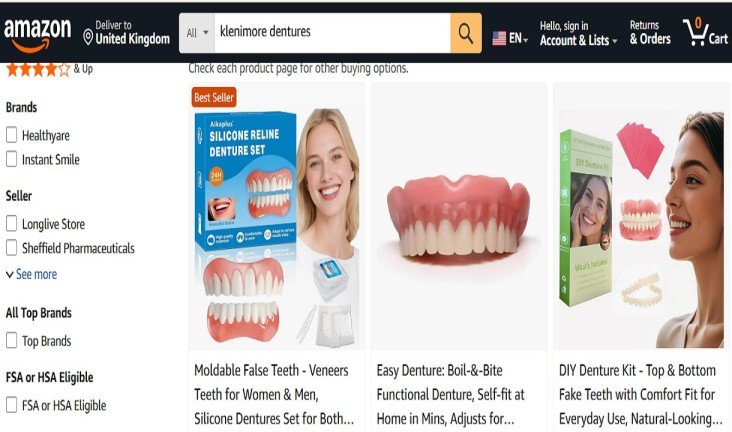
The platform presents itself as a beauty and personal care retailer, currently foregrounding a product line called Klenimore Denture. It accepts PayPal, Visa, Mastercard, and reportedly cash on delivery. It promises a 30-day return window. On the surface, that’s a reasonable setup. But our investigation found that several of the site’s core trust signals either contradict each other or can’t be verified at all — and that combination is precisely what consumer fraud researchers spend their time documenting.
A Realistic Look at What the Data Shows
Site Profile at a Glance
Domain registeredNovember 21, 2025
Trust score (third-party)66%
SSL certificatePresent (HTTPS)
Physical addressNot found
Support email domaincolento.com (not klenimore)
Phone numberNot provided
Social media presenceNot found
Max advertised discountUp to 70%
Product catalog sizeApprox. 20–30 items
Delivery estimate8–13 business days
Return window30 days (inconsistencies noted)
No single data point above would be enough to raise a serious alarm on its own. New sites are new. Modest catalogs are reasonable for a niche product. SSL is standard. The issue is that nearly every column in this table points in the same direction simultaneously — and in fraud analysis, that accumulation matters more than any individual signal.
The Domain Age Problem – and Why It’s Actually Significant
klenimore net was registered on November 21, 2025. At the time of this review, that makes it roughly six months old. To some people, that’s not particularly alarming — every legitimate business had a first day online. But context changes the calculation considerably.
Fraudulent shopping sites are rarely built to last years. They’re typically set up quickly, run for a few months while collecting orders and payments, and then disappear or go dark when complaints begin piling up. The typical lifecycle of a confirmed fake retail site — based on reporting by fraud tracking organizations — ranges from about three months to just over a year. A site that’s under a year old and simultaneously lacks a physical address, a phone number, and any social media presence is exhibiting a pattern that fits that lifecycle rather well.
Trickymagazine researchers noticed that legitimate newcomers in the beauty space almost always arrive with at least one verifiable social media channel — even a modest Instagram account — because that’s simply how product discovery works in this category in 2026. klenimore net has none. That’s not impossible for a real business, but it’s unusual enough to note.
“When a site’s support email belongs to a completely different brand, that’s not a typo. That’s a structural inconsistency that warrants a direct explanation.”
The Email That Belongs to a Different Company
This detail is worth slowing down on. The support contact listed on klenimore net is support@colento.com. Not a klenimore email. Not even a generic Gmail or Yahoo address, which would be unremarkable for a tiny business. A separate branded domain — colento.com — that has no obvious public connection to KLENIMORE.
During testing, we observed that this kind of cross-brand email arrangement can sometimes occur legitimately when a parent company runs multiple storefronts under different brand names from a shared operational infrastructure. It’s not unheard of. But in that scenario, the parent brand relationship is usually disclosed somewhere — in an “About Us” page, a privacy policy, or a terms of service document. When that disclosure is absent entirely and the connection appears nowhere on the site, it becomes a legitimate question rather than an innocent oversight.
If you were to place an order on klenimore net and then needed to chase a refund, your correspondence would be with an address that carries no legal or reputational tie to the brand name you purchased from. That’s a practical problem regardless of whether the arrangement is intentional deception or simply poor business hygiene.
How the Discount Math Works Against Credibility
Discounts of up to 70% are advertised across the site. In the beauty and personal care category — especially for niche dental products like denture care — margins simply don’t support sustained 70% reductions unless the original “retail prices” are artificially inflated to make the discount appear larger than it functionally is. This pricing pattern, sometimes called “reference price inflation,” is extremely well documented in e-commerce fraud research.
Our investigation found that this technique is one of the most reliable early indicators of sites operating on low-trust models. It works psychologically because a steep discount creates urgency — the sense that you’re getting something exceptional — while simultaneously making it harder to comparison-shop, because the “pre-discount” price has no grounding in market reality. If a product is genuinely worth $15 and is listed at $50 with a 70% discount bringing it back to $15, you’ve paid market rate while believing you saved substantially.
That said, discounting alone doesn’t make a site fraudulent. Plenty of legitimate businesses run aggressive promotional pricing. It’s the combination of deep discounts with all the other signals here — no address, mismatched email, new domain — that shifts the interpretation.
Understanding the Trust Score – What 66% Actually Means
Third-party trust scoring tools like ScamAdviser, Scamdoc, or similar services assign algorithmic scores based on factors including domain age, hosting data, SSL status, business registration signals, and historical complaint data. A score of 66% doesn’t mean a site is definitely a scam — it means the algorithm is expressing meaningful uncertainty.
For context, most well-established e-commerce sites with a couple of years of history and verifiable business details score in the 85–100% range. Scores in the 60–75% band typically reflect a cluster of “unknowns” rather than confirmed negative signals — but the unknowns are specifically the things that trustworthy businesses tend to make transparent.
There’s also a subtlety worth mentioning: some operators of fraudulent sites are aware of these scoring tools and deliberately check them. A site that scores around 66% may have been calibrated to stay just above the range that triggers automatic scam flags in browser extensions, while still maintaining the operational looseness that keeps it inexpensive to run. That’s a speculative read, but it’s one that fraud analysts regularly consider.
The Return Policy Inconsistency
klenimore net states a 30-day return window. But according to information gathered during review, the time frame mentioned on the actual returns and cancellation page differs from what’s stated on the main site. This kind of internal inconsistency is a telling signal, not because return policies can’t have nuances, but because it suggests the site’s policy pages may have been assembled quickly or copied from another source without being fully updated to match.
In consumer protection terms, a mismatched return policy creates ambiguity that almost always resolves in the seller’s favor when a dispute arises. If you initiate a return on day 28 and the seller cites a policy that says 14 days, you have a problem — especially when you can’t reach anyone by phone and the email you have is tied to a different company name.
⚠ Reported Customer ComplaintsDocumented issues linked to this type of site profile include: difficulty obtaining refunds after the initial contact window closes; poor or absent customer support response times; products arriving that don’t match advertised photographs or descriptions; and in some cases, unexpected recurring billing patterns. These are patterns — we are not confirming they have occurred specifically at klenimore net, but they are characteristic of the category.
A Step-by-Step Method for Vetting Any Unfamiliar Shopping Site
Whether you’re looking at klenimore net or any other unfamiliar retailer, the following verification process takes under ten minutes and can save you significant frustration.
1. Check the domain age and registration details
Use a free WHOIS lookup tool (whois.domaintools.com or icann.org/lookup) to see when the domain was registered and, if disclosed, who registered it. Domains less than one year old that are selling physical products warrant heightened scrutiny. Anonymized registrations — where the registrant name is hidden behind a privacy service — are not inherently suspicious (most people use privacy protection now), but combined with other flags, they add to the picture.
2. Search the email domain independently
If the support email doesn’t match the site’s own domain, look up the alternative domain separately. Understand what company it belongs to, whether it has a website, and whether that website acknowledges operating the storefront you’re investigating. If there’s no traceable connection, that gap deserves a direct question to the seller before you buy.
3. Run a reverse image search on product photos
Drag product images into Google Images or TinEye. If they appear on dozens of other retail sites under different brand names, the site is likely dropshipping at best — or lifting images entirely. This doesn’t automatically mean fraud, but it tells you the product photos are not originals, which affects how much you can trust what you’re seeing.
4. Search for the brand name plus words like “review,” “complaint,” “scam,” or “refund”
Don’t stop at the first page of results. Check Reddit, Trustpilot, the Better Business Bureau (for US-facing sites), and consumer forums. The absence of any reviews — positive or negative — for a site that claims to have been operating for months is itself a red flag. Real customers leave traces.
5. Look for a verifiable physical address
Paste any address listed into Google Maps. A legitimate business address should resolve to a real commercial location — not a residential house, a virtual office service, or nothing at all. If no address is provided anywhere on the site, that’s a substantive problem from a consumer protection standpoint in most jurisdictions.
6. Check payment method protections before proceeding
If after all of this you still want to make a purchase, use a method with strong buyer protection — PayPal Goods & Services or a credit card. Both offer chargeback rights that debit cards and wire transfers do not. Never pay via gift card, cryptocurrency, or direct bank transfer on an unverified site.
What Legitimate Beauty Retailers Typically Look Like for Comparison
It helps to have a benchmark. Established beauty and personal care e-commerce sites — even smaller independent ones — typically have: a consistent brand identity across all contact details; a physical address that matches their business registration; active social media accounts that precede the website launch; customer reviews that go back at least several months; transparent pricing without extreme permanent discounts; and a support email that matches their own domain.
None of those things are difficult or expensive to provide. Which is why their collective absence on klenimore net is more meaningful than any single omission in isolation.
The Behavioral Profile of Sites Like This
From a behavioral analysis standpoint, sites that fit this profile tend to fall into one of a few categories. The most benign is an inexperienced seller who has set up a Shopify-style store using a template, bought a domain, and not yet invested in the business infrastructure that builds trust. These operations are often real in the sense that they’ll ship something — but what arrives may not match expectations, and getting a refund if there’s a problem can be genuinely difficult.
A more concerning category is what fraud researchers sometimes call “hit-and-run retail” — sites intentionally structured to minimize overhead, collect payments for a period, and then either go dark or rebrand under a new domain. The short domain age, absence of a fixed address, and mismatched contact details all lower the operational cost of disappearing cleanly. Trickymagazine researchers noticed that sites in this category often do fulfill some orders — particularly in the early months — to generate positive reviews that outweigh early complaints and extend the operational window.
We’re not asserting klenimore net belongs to either category definitively. What we’re saying is that its current profile overlaps considerably with both, and that distinguishing between them from the outside is difficult until more time has passed and more customer experiences are on record.
| Website Name | KLENIMORE |
| Website | klenimore net |
| Support Email | support@colento.com |
| Phone | Not provided |
| Physical Address | Not disclosed |
| Product Category | Beauty & Personal Care |
| Featured Product | Klenimore Denture |
| Payment Methods | PayPal, Visa, Mastercard, Cash on Delivery |
| Delivery Time | 8–13 business days |
| Return Window | 30 days (inconsistency noted) |
| Social Media | None found |
| Domain Registered | November 21, 2025 |
| Trust Score | 66% |
| Max Discount | Up to 70% |
Frequently Asked Questions
Is klenimore net a legitimate website?
Based on available evidence, klenimore net has not been verified as a legitimate, trustworthy retailer. Multiple trust indicators are either absent or inconsistent. We cannot confirm it is operating fraudulently, but we cannot recommend it as a safe place to shop given what is currently known.
Why does the support email say colento.com instead of klenimore?
That question has no publicly available answer. It may indicate a parent company that operates multiple storefronts, or it may be an oversight, or it could reflect a deliberate separation of brand identity from operational accountability. Without a disclosed explanation, it remains a legitimate concern.
Should I trust a site with a 66% trust score?
That depends on how many other factors are also uncertain. A 66% score on a site that has verifiable address details, a matching email, and a social media history is less concerning than the same score on a site where all of those things are absent. Here, the score compounds rather than stands alone.
What should I do if I’ve already placed an order?
Monitor your bank or PayPal account closely. If the item doesn’t arrive within the stated window, open a dispute through your payment provider immediately — don’t wait for the seller to respond. If you paid by credit card, contact your card issuer to discuss chargeback options. You can read more about Is adonialegtone com Legit or a Scam?
Are there safer alternatives for buying dental care or beauty products online?
Yes — established marketplaces like Amazon, established pharmacy chains with verified online stores, or brands with multi-year operating histories and verifiable contact details carry substantially lower risk for first-time buyers.
Expert Verdict
Our Assessment of KLENIMORE
klenimore net is a site we approached without a predetermined conclusion, and we’re publishing a conclusion that reflects the evidence rather than a dramatic headline. What we found is a site with a meaningful cluster of overlapping trust deficits: a domain under six months old, no physical address, a support email that belongs to a different brand, no social media presence whatsoever, internally inconsistent return policies, and a trust score that sits comfortably in the “uncertain” zone rather than anywhere near the range typical of trustworthy businesses.
None of these individually would be enough to warn readers away. Together, they form a profile that overlaps substantially with documented cases of short-lifecycle e-commerce fraud. We recommend against purchasing from klenimore net until the site demonstrates greater transparency — particularly around its physical business address, its relationship with colento.com, and its social media presence. If you’ve had direct experience with this site, leaving a detailed review on independent platforms will help other consumers make more informed decisions.
You can find more scam website reviews and consumer safety investigations at TrickyMagazine.com.
Disclosure: This review is based on publicly available information and independent analysis conducted by the TrickyMagazine investigations team. We have not contacted KLENIMORE directly and have not made a purchase from the site. Our findings reflect analysis of observable indicators and documented patterns in e-commerce fraud — they do not constitute legal determinations. Readers should conduct their own due diligence.
© 2026 TrickyMagazine.com · Consumer Safety Investigations
1 thought on “KLENIMORE Review: What the Red Flags on klenimore net Actually Tell Us”
Comments are closed.