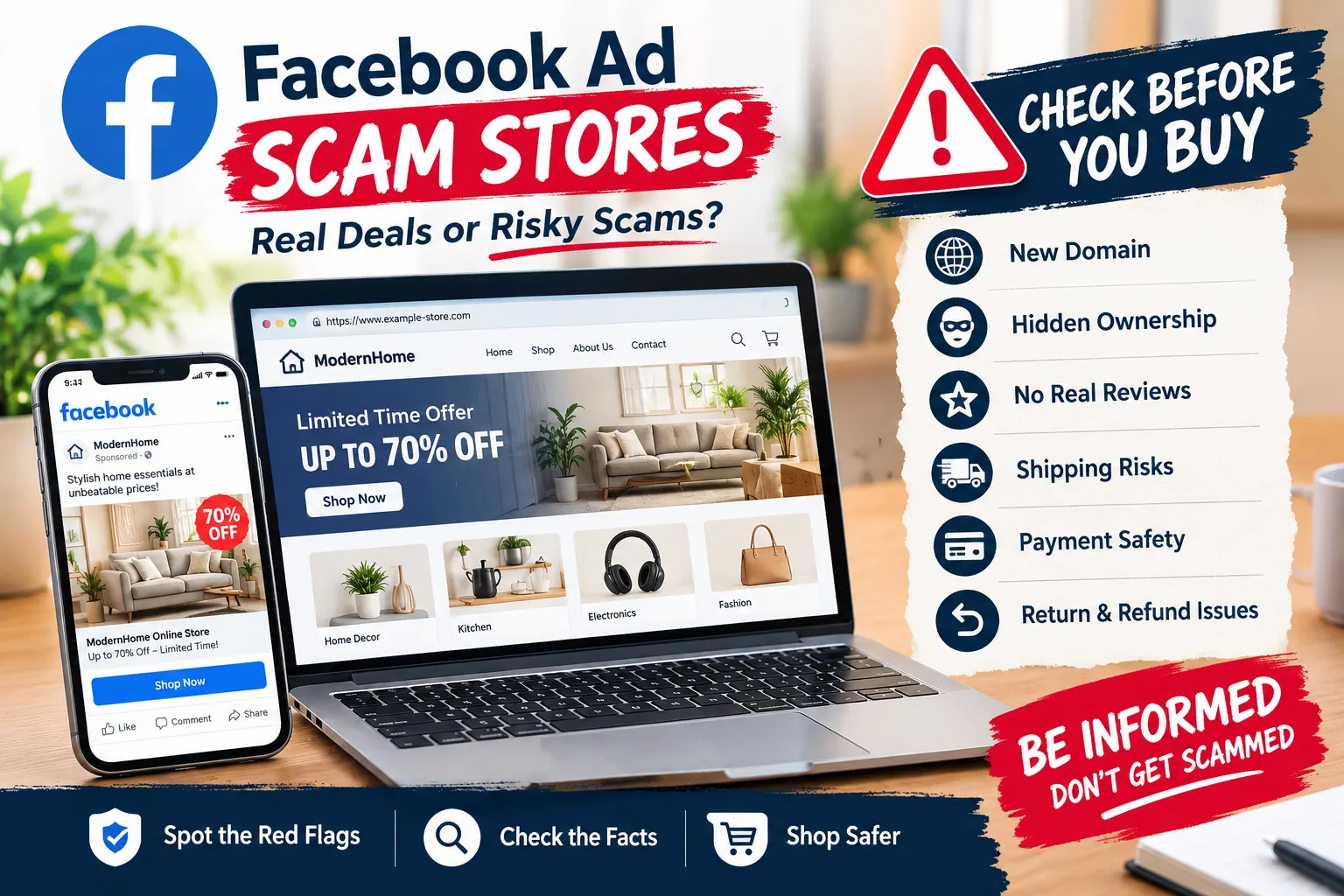
Current verdict: RISKY CATEGORY, NOT EVERY STORE IS A SCAM. Facebook itself is a legitimate advertising platform, and many genuine businesses sell products after advertising there. The problem is that scammers also use Facebook ads to send shoppers to fake or misleading online stores, and recent government, consumer-protection and Meta data confirm that this is a real and continuing problem. In April 2026, the FTC reported that Facebook was the social platform associated with the highest reported losses among social-media scams in 2025, while BBB research has found that Facebook and Instagram ads account for a large share of reported online-shopping fraud.
So, if you clicked a Facebook ad and are wondering whether the store behind it is safe, do not treat the fact that the advertisement appeared on Facebook as proof that the retailer is legitimate. The ad is only the starting point of your investigation. You still need to check the actual website, domain history, company information, reviews, policies, payment options and reputation before handing over your money.
Research updated: October 5, 2026.
Quick Verdict: What We Found About Facebook Ad Scam Stores
| Finding | Assessment |
|---|---|
| Overall category risk | High caution |
| Are all Facebook ad stores scams? | No |
| Can legitimate businesses advertise on Facebook? | Yes |
| Can scammers buy Facebook ads? | Yes |
| WHOIS check | Depends on the individual store |
| Trustpilot check | Must be performed on the individual domain |
| ScamAdviser/Gridinsoft | Useful supporting evidence, not final proof |
| Common warning sign | Newly registered domain with little history |
| Another major warning sign | Huge discounts or unrealistic product claims |
| Customer complaints | Vary by store; must be independently checked |
| Payment risk | Higher when sellers demand irreversible payment |
| Recommended action | Investigate the store before buying |
There is an important point here that gets lost in a lot of scam warnings: “I found it through a Facebook ad” is not enough information to call a particular store fraudulent. It is a reason to investigate more carefully.
Why We Investigated Facebook Ad Scam Stores
This investigation started with a broader question we see repeatedly in online shopping: Why does a store that looks completely normal in a Facebook advertisement turn out to be difficult to verify once you start checking it?
The answer is partly the way modern advertising works. A scammer does not need to build a famous website or attract organic search traffic for years. They can create a storefront, produce an attractive advertisement, target people who are likely to be interested in the product and send those shoppers directly to the checkout page.
BBB has documented this pattern extensively. Its research found that many online-shopping fraud reports involved people responding to ads on Facebook and Instagram, with victims reporting situations where they received nothing, received counterfeit merchandise or received something substantially different from what was advertised.
There is also fresh evidence that this remains an active problem in 2026. Meta said it removed more than 159 million scam ads in 2025 for violating its policies and took action against millions of accounts associated with scam centers. Meta also reported that between January and June 2026, information shared by Singapore authorities helped it take action against more than 113,000 entities and pages connected to fraud and scams, including tens of thousands connected to ecommerce scams.
That doesn’t mean Facebook is inherently unsafe. It means the platform is large enough to attract both legitimate advertisers and criminals.
What Exactly Is a Facebook Ad Scam Store?
A Facebook ad scam store is generally an online retailer promoted through Facebook advertising where the advertisement, website, seller identity, product or transaction turns out to be deceptive or fraudulent.
The store may take several different forms.
Sometimes the website is completely fake and exists mainly to collect payments or personal information. In other cases, the seller may actually send something, but it can be a cheap substitute, counterfeit product or item that bears little resemblance to the advertisement.
There are also less obvious versions. A store might deliver a legitimate-looking product but make refunds extremely difficult. Another may advertise a very low introductory price and then enroll the customer into a recurring subscription. Meta described a 2026 case involving deceptive ads offering heavily discounted branded products, where consumers were redirected to websites, asked for credit-card details and ultimately faced unauthorized recurring charges.
That is why the word “scam” needs to be used carefully. A disappointing purchase, poor-quality product or slow shipment isn’t automatically evidence of criminal fraud. A pattern of deception, fake identities, non-delivery, unauthorized charges or other strong evidence is much more significant.
WHOIS Investigation: Why the Domain Matters
There is no single WHOIS record for “Facebook ad scam stores” because this is a category rather than one website. Every store advertised through Facebook has its own domain, and that domain should be checked individually.
For example, suppose a Facebook ad sends you to a clothing store you’ve never heard of. The first thing I would want to know is when the domain was registered.
A company claiming to have been “serving customers for 15 years” but operating through a domain registered only a few weeks ago deserves additional scrutiny. That doesn’t prove fraud because a legitimate company can launch a new domain, rebrand or move to a new website. But the seller should be able to explain the discrepancy.
Here is the basic domain checklist:
| WHOIS Finding | What It Can Tell You |
|---|---|
| Domain registered yesterday | Very limited operating history |
| Domain registered several years ago | More history, but not proof of legitimacy |
| Ownership publicly identifiable | Easier to investigate the operator |
| WHOIS privacy enabled | Common and not automatically suspicious |
| Domain expires soon | Worth monitoring, but not proof of fraud |
| Company claims don’t match domain history | Requires further investigation |
| Registrar/infrastructure associated with many questionable sites | Supporting warning sign |
WHOIS privacy is especially easy to misunderstand. Many legitimate businesses and individuals use privacy protection. I would never call a store a scam simply because the registrant’s name is hidden.
The stronger warning comes from multiple mismatches: a brand claiming a long history, a domain created recently, no verifiable company registration, copied website content and no independent customer history.
Website Platform and SSL: Don’t Mistake Security for Trust
Many Facebook ad stores use mainstream ecommerce platforms such as Shopify or other hosted storefront systems. That is neither good nor bad by itself.
Likewise, a padlock icon and HTTPS certificate only show that the connection between your browser and the website is encrypted. They do not tell you whether the company will deliver your order.
This is one of the most common mistakes I see when evaluating unfamiliar stores. Someone checks the address bar, sees HTTPS and concludes, “It’s secure.”
Technically, the connection may be secure. The business can still be unreliable.
A safer evaluation combines technical security with business verification, reputation checks and transaction safeguards.
Trustpilot: Useful, But Don’t Stop There
Trustpilot can be helpful when investigating a store, especially if the company has a substantial history of reviews from identifiable customers.
But there are two mistakes to avoid.
The first is assuming that no Trustpilot profile means scam. A small or recently launched business may simply not have enough customers to generate a meaningful review history.
The second is assuming that a high Trustpilot rating automatically means safe. Reviews need context. Look at the number of reviews, how long the profile has existed, whether complaints are answered, whether reviews appear natural and whether the feedback relates to actual transactions.
For Facebook ad stores, I would search for the exact domain and business name rather than relying on a broad Google search for the brand.
If you find hundreds of genuine reviews over several years, that’s useful evidence. If you find only a handful of generic five-star comments on the store’s own website, that’s much weaker.
ScamAdviser, Gridinsoft and Other Reputation Services
Automated reputation services can be useful because they combine technical and reputation signals that would otherwise take considerable time to collect.
But I would never use a single score as the entire verdict.
A service may lower a website’s score because it is new, has low traffic, hides WHOIS information or has limited reputation history. Those factors can also occur with perfectly legitimate new businesses.
On the other hand, a very low score becomes more meaningful when it agrees with other evidence.
For example:
New domain + hidden ownership + no independent reviews + copied content + suspicious payment methods + impossible discounts is much more concerning than a new domain by itself.
The same principle applies to malware scanners. A clean technical scan does not prove that the seller is honest, while a malware warning is certainly something that deserves attention.
The Products: What Are Facebook Ad Stores Selling?
There is no single product category associated with these stores.
Facebook ads can promote clothing, shoes, furniture, tools, electronics, jewelry, home décor, beauty products, personalized gifts, automotive accessories and practically anything else that can be sold online.
The product itself can sometimes provide the first clue.
Be particularly careful when an advertisement combines a familiar brand with an unusually steep discount. Meta reported in 2026 that scam advertisers had used celebrity and brand impersonation alongside deeply discounted products to direct consumers toward deceptive websites.
BBB has also documented fake online retailers that use photographs and other material taken from legitimate businesses, then advertise those products through Facebook and Instagram. The customer may believe they are buying from the genuine company when the payment actually goes somewhere else.
Before buying, compare the product photographs and description with the manufacturer’s official website. If the same images appear under completely different company names, that’s worth investigating.
Pricing: When Is a Facebook Deal Too Good?
A discount isn’t automatically suspicious. Real companies run clearance sales, introductory promotions and seasonal campaigns.
The problem is pricing that doesn’t make commercial sense.
Imagine a product normally sold for $200 suddenly appearing for $19.99 with a countdown clock, “only three left” messaging and another 20% discount if you purchase immediately.
That combination is much more concerning than a normal 15% sale.
BBB specifically warns consumers about fake deals designed to create urgency and encourage shoppers to click, provide information or make a purchase before researching the seller.
My rule is simple: never let the discount determine how quickly you investigate the seller.
A bigger discount should make you investigate more, not less.
Company Transparency and Contact Information
This is one of the most important parts of a Facebook ad store investigation.
Look for:
- A legal business name
- Physical business address where appropriate
- Working customer-service email
- Telephone number if claimed
- Company registration where applicable
- Clear returns address
- Terms and privacy policy
- Consistent company information across the website
Then compare those details.
If the footer says one company name, the terms mention another, the payment receipt shows a third name and the contact address leads to an unrelated business, I would stop.
A residential address isn’t automatically suspicious either. Small businesses can operate from homes. What matters is whether the information is consistent and verifiable.
If the store provides an address but we could not independently verify this information, the article should say exactly that rather than claiming the address is fake.
Shipping: Where Many Problems Become Visible
Shipping promises deserve careful reading.
A Facebook ad might imply “fast US shipping,” while the actual policy says orders can take several weeks to process and ship internationally.
That doesn’t necessarily make the store fraudulent. But the customer should understand what they’re agreeing to before paying.
Check:
- Processing time
- Shipping time
- Shipping origin
- Tracking availability
- Customs responsibility
- Lost-package procedure
- What happens if the parcel is marked delivered
- Whether the shipping address can be changed
Be especially careful if the advertisement suggests domestic fulfillment but the terms indicate that products may be shipped internationally.
BBB has documented cases where consumers responding to social-media advertisements received nothing or received merchandise substantially different from what was advertised.
Returns and Refunds: Read the Small Print
A store can advertise a “30-day money-back guarantee” while making the actual return process difficult.
Before purchasing, look for the exact answers to these questions:
- How many days do you have to request a return?
- From which date is the period calculated?
- Who pays return shipping?
- Is the return address domestic or international?
- Are sale items excluded?
- Are personalized products excluded?
- Does the seller require photographs?
- How long does inspection take?
- How long does a refund take?
- Are original shipping fees refundable?
A return policy that looks generous at first glance may be considerably less attractive once you read the conditions.
If the store does not clearly explain the process, we could not independently verify this information is the correct conclusion. Don’t fill the gap with assumptions.
Payment Safety
Payment method matters enormously when you’re dealing with an unfamiliar Facebook ad store.
A credit card can offer dispute rights in qualifying situations. PayPal may also provide a dispute mechanism depending on the transaction and applicable rules.
That doesn’t mean every dispute will automatically succeed.
What I would avoid is paying an unfamiliar seller through an irreversible method such as cryptocurrency, gift cards or direct transfers when there is no established reason to trust the business.
Save evidence before you pay. Take screenshots of the advertisement, product page, price, shipping promise and return policy. Keep your receipt and confirmation email.
The BBB’s online-shopping research has specifically noted that payment methods with stronger consumer safeguards can give shoppers more options when a fraudulent transaction occurs.
Customer Service: Test It Before Buying
Here’s a simple step many shoppers skip.
Contact the store before placing the order.
Ask a specific question about a product, shipping time or return procedure. Don’t judge the company solely by whether it replies. Look at how it replies.
A genuine business should normally be able to provide a relevant answer without directing you to another suspicious payment page.
Warning signs include:
- No response
- Generic copy-and-paste replies
- Broken email addresses
- A WhatsApp number that changes frequently
- Pressure to purchase immediately
- Requests for payment outside the normal checkout
- Refusal to answer basic questions about returns
A functioning contact form is a positive sign, but it is not proof of legitimacy.
Red Flags to Watch For
| Red Flag | Risk Level | Why It Matters |
|---|---|---|
| Facebook ad leads to a brand-new domain | High | Very little history is available |
| Huge discount on branded goods | High | Could indicate counterfeit or deceptive advertising |
| Countdown timer on every visit | Moderate | Can create artificial urgency |
| No verifiable company identity | High | Difficult to establish who operates the store |
| No independent reviews | Moderate | Limited customer history |
| Copied product images | High | May indicate the seller isn’t the original retailer |
| Website uses generic policies | Moderate | Could make accountability difficult |
| Return address is unclear | High | Refunds may become difficult |
| Shipping origin is hidden | Moderate | Delivery expectations may be misleading |
| Only irreversible payment methods | High | Harder to recover money |
| HTTPS certificate | Positive | Encrypts the connection but doesn’t prove trust |
| Established independent reviews | Positive | Provides transaction history |
| Long-standing domain | Positive | Gives more historical context |
What Looks Normal
Not everything about a Facebook ad store should be treated as suspicious.
A legitimate retailer can have:
- Facebook and Instagram advertising
- A Shopify or other hosted ecommerce store
- WHOIS privacy
- A recently redesigned website
- Promotional discounts
- A countdown for a genuine sale
- International fulfillment
- A small number of reviews
- A home-based business address
- HTTPS encryption
The question is how these details fit together.
For example, a new company with a new domain, transparent ownership, real customer-service information, realistic pricing and genuine independent reviews could be perfectly legitimate.
The problem is when the site has many negative signals at the same time.
What We Could Not Verify
Because “Facebook ad scam stores” refers to thousands of different websites rather than one specific domain, several checks cannot be applied universally.
There is no single WHOIS record, Trustpilot score, ScamAdviser rating, company registration, shipping policy or return address for the entire category.
For any individual store, we could not independently verify this information unless the relevant business and domain records could be located and matched.
That distinction matters. It would be irresponsible to say that every Facebook ad store hides its ownership, copies products or fails to deliver orders.
The evidence supports a narrower conclusion: Facebook advertising is a documented channel through which online-shopping scams reach consumers, so the retailer behind the advertisement must be investigated separately.
What Makes a Facebook Ad Store Look More Trustworthy?
I would be more comfortable with a store when several independent signals line up.
A healthy profile might include an established domain, consistent company details, realistic prices, detailed product information, a genuine return address, responsive customer service, clear shipping terms and years of independent customer feedback.
None of these guarantees a good purchase. Together, however, they provide much more evidence than a polished advertisement.
Meta itself is also increasing advertiser verification and says it is working toward having verified advertisers account for 90% of its ad revenue by the end of 2026.
That is encouraging, but consumers should still perform their own checks. Platform enforcement can reduce scam advertising; it cannot replace individual due diligence.
How to Check a Facebook Ad Store Before Buying
Here is the process I recommend.
Step 1: Don’t buy directly from the ad. Open a new browser tab and search for the company independently.
Step 2: Check the domain. Look at the registration date and compare it with whatever history the business claims.
Step 3: Search the exact company name. Look for independent reviews, complaints and business records rather than relying only on testimonials published by the store.
Step 4: Inspect the contact page. Make sure the email, address and telephone details are consistent.
Step 5: Read the return policy before paying. Pay particular attention to international return addresses and who pays shipping.
Step 6: Compare product photographs. Reverse-image searching can help reveal whether product images appear on unrelated websites.
Step 7: Check the price elsewhere. If every established retailer sells something for $150 and the Facebook ad offers it for $12, slow down.
Step 8: Use a payment method with appropriate consumer protections. Keep all evidence of the transaction.
For additional checks, our Scam UPI Payment Tricks: How Fraudsters Manipulate Digital Payments and How to Stay Safe covers the basic steps before ordering from an unfamiliar retailer.
You can also review our guide to Refund Scams Explained: How Fake Refunds and Recovery Schemes Really Work if the website already feels suspicious.
Already Bought From a Facebook Ad Store?
If you already placed an order, don’t assume immediately that you’ve been scammed. First check the confirmation email, merchant name on your payment statement, shipping information and promised delivery period.
If the promised delivery window has passed, contact the seller and keep a record of the response.
If the seller does not respond or the transaction appears fraudulent, contact your payment provider promptly and ask about the available dispute process. Credit-card and PayPal protections can vary depending on the transaction, circumstances and deadlines.
If the advertisement itself was misleading, report it through the platform’s reporting tools. If money was lost, consider reporting the incident to the appropriate consumer-protection authority in your country.
Most importantly, preserve evidence. Save the original advertisement if possible, along with screenshots of the website, order confirmation, product description, payment receipt and correspondence. These records can become important if the advertisement disappears or the website later changes.
Final Verdict: Are Facebook Ad Stores Legit or Scams?
Some are legitimate. Some are not. The advertisement itself does not tell you which one you’re dealing with.
The evidence available in 2026 makes it clear that social-media advertising is a significant channel for online-shopping fraud. The FTC reported that nearly 30% of people who reported losing money to scams in 2025 said the scam started on social media, with reported losses of about $2.1 billion. Facebook was the individual social platform associated with the highest reported losses.
BBB has separately documented thousands of complaints involving misleading Facebook and Instagram advertisements, while its online-shopping research describes patterns involving fake retailers, copied product images, non-delivery, counterfeit products and merchandise that differs substantially from what was advertised.
Meta is clearly aware of the problem and has increased enforcement, removed enormous numbers of scam ads and taken legal action against deceptive advertisers.
But the continuing presence of scam advertisements means shoppers still need to investigate the store behind the ad.
My bottom line is simple: don’t trust a Facebook ad; trust the evidence you can independently verify. A legitimate-looking advertisement, professional website, HTTPS certificate or impressive discount is not enough. Check the domain, company identity, reviews, policies, payment method and independent reputation before you buy.
Frequently Asked Questions
Are Facebook ads safe to buy from?
Facebook ads can promote legitimate products, but the platform also carries deceptive advertisements. The safest approach is to investigate the seller independently rather than treating the presence of an advertisement as an endorsement.
How can I tell if a Facebook ad store is a scam?
Look for a very new domain, unrealistic discounts, copied product photographs, missing company information, unclear returns, suspicious payment methods and a lack of genuine independent reviews. One warning sign alone is not proof; several together deserve serious caution.
Does Facebook verify every online store advertised on its platform?
You should not assume that appearing in a Facebook advertisement means a store has been fully vetted. Meta says it is expanding advertiser verification and other anti-scam measures, but consumers should still research individual sellers.
Can a legitimate store have a new domain?
Yes. A new domain is not proof of fraud. It becomes more concerning when the company claims years of history or when the new domain is combined with other warning signs.
Does HTTPS mean a Facebook ad store is legitimate?
No. HTTPS encrypts the connection but does not verify the identity or honesty of the merchant.
Should I trust reviews on the store’s own website?
Treat them as seller-provided information rather than independent evidence. Look for reviews on established third-party platforms and search for the exact company and domain.
What should I do if a Facebook ad promised one product but I received something completely different?
Document the advertisement and product listing, photograph what you received, contact the seller, and contact your payment provider if the problem isn’t resolved. Keep all records in case you need to dispute the transaction.
Are extremely cheap Facebook deals always scams?
No. Genuine clearance sales and promotions exist. But an unusually large discount combined with urgency, brand impersonation or an unknown seller should trigger additional research.
Is Facebook responsible if I lose money through a store advertised there?
Responsibility can depend on the specific circumstances and applicable law. Meta says it takes enforcement action against scam advertisers, while regulators and consumer organizations continue to examine the role of online platforms in facilitating deceptive advertising. The safest approach is not to assume that a platform’s advertising system guarantees a seller’s reliability.
What is the safest way to shop after finding a product through Facebook?
Use the advertisement as a discovery tool, then investigate the retailer independently. Check the domain, company identity, independent reviews, return policy, shipping information and payment protections before completing the purchase.