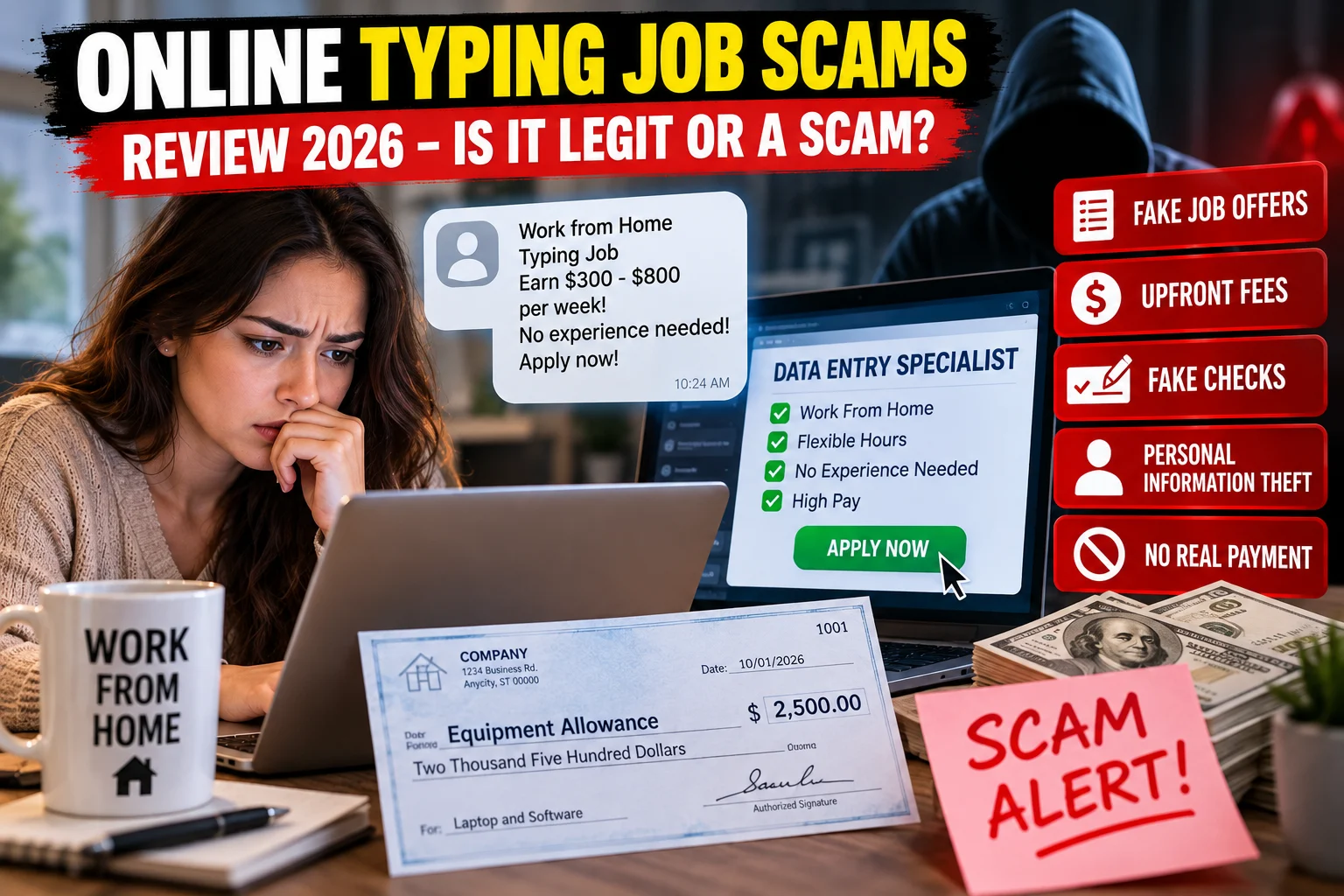
Verdict: Online typing jobs are not inherently scams, but “easy typing work from home” offers are a well-established vehicle for employment fraud. The biggest warning signs are promises of unusually high pay for simple work, unsolicited recruitment, requests for upfront payments or personal information, fake checks for equipment, and “training” or software fees. Current 2026 warnings from the FTC and BBB show that fake remote data-entry and work-from-home positions remain an active scam pattern, so an unfamiliar typing-job offer should be independently verified before any personal information or money is provided.
This review is about the online typing-job scam category, not one specific website. There is therefore no single domain, WHOIS record, Trustpilot page, shipping policy or company behind “online typing job scams” as a whole. Instead, this investigation examines how these offers operate, what legitimate typing work normally looks like, which claims should raise suspicion, and what current consumer reports reveal about fake data-entry and remote-work opportunities.
Research updated: October 8, 2026.
Quick Risk Check
| Check | Finding |
|---|---|
| Scam category | Online typing, data-entry and work-from-home job scams |
| Is typing work itself a scam? | No. Legitimate data-entry and transcription jobs exist |
| Typical promise | Flexible remote work, simple typing tasks and attractive pay |
| Common recruitment methods | Text messages, social media, fake job listings, email and messaging apps |
| WHOIS | Not applicable to the category; individual scam domains require separate investigation |
| Trustpilot | No category-wide rating |
| ScamAdviser/Gridinsoft | Scores apply to individual websites, not the entire job category |
| Major warning sign | Paying money to obtain a job, equipment, training or access |
| Another major warning sign | Employer sends a check and tells applicant to buy equipment or send money elsewhere |
| Personal-information risk | Identity and financial information may be requested during fake onboarding |
| Customer/job reviews | Must be verified against the specific employer and position |
| Overall assessment | High-risk scam category; legitimate typing jobs do exist |
The distinction between a genuine typing job and a scam is important. Simply seeing the words “data entry,” “typing,” “transcription,” or “work from home” does not prove anything about the employer. The problem arises when the job offer is paired with deception or financial demands.
What Are Online Typing Job Scams?
Online typing job scams are fraudulent employment offers that use simple computer-based work as the hook.
The supposed role might be called:
- Data entry clerk
- Typing specialist
- Document processor
- Form-filling assistant
- Remote administrative assistant
- Transcriptionist
- Online typist
- Data processing associate
- Document verification assistant
- Work-from-home assistant
The job description often sounds appealing because the required work appears straightforward.
A typical pitch may promise flexible hours, no previous experience, remote working and unusually high earnings. The applicant may be told that the company urgently needs people and that the hiring process is extremely simple.
The actual objective can be very different.
The scammer may want the applicant’s money, identity information, banking details, access to accounts or personal documents.
The FTC warns that scammers advertise fake work-from-home jobs promising substantial earnings for little effort and may ultimately seek money or personal information instead of providing employment.
Why We Investigated Online Typing Job Scams
Typing and data-entry work is particularly attractive to scammers because it sounds accessible.
Someone may reasonably think:
“I already know how to type. Why would I need specialist training?”
That makes the offer easy to understand and easy to advertise.
The scam can also be adapted to different groups. A fake recruiter might target students, people seeking a second income, unemployed workers, parents looking for flexible schedules, or anyone searching for remote work.
Recent evidence shows the tactic remains active.
In April 2026, the FTC warned about fake recruiters sending job offers by text and presenting remote positions with vague descriptions and attractive pay. The agency specifically warned that some scams eventually ask targets to deposit money or participate in fake online tasks.
BBB’s 2026 employment-scam update reported that employment scam reports to its Scam Tracker had surged, with nearly 50,000 reports over the preceding three years. The BBB also highlighted newer task-style schemes where victims are shown supposed earnings and then pressured to send their own money to unlock those earnings.
That makes online typing offers worth examining carefully, particularly when the recruiter approaches the applicant first.
WHOIS and Domain Investigation
There is no single website behind online typing job scams, so a category-wide WHOIS investigation is impossible.
Domain creation date: Not applicable.
Registrar: Not applicable.
Domain expiration: Not applicable.
WHOIS privacy: Not applicable.
If a specific typing-job website is presented to a job seeker, those checks become relevant.
A suspicious employment website might have a domain that was created very recently, private registration details, an unusual domain name that imitates a legitimate employer, or a website that does not match the company name used by the recruiter.
A new domain does not automatically mean the employer is fraudulent. A legitimate company can launch a new recruitment website.
The useful question is whether the domain can be connected to the real employer independently.
For example, if a recruiter claims to represent a large company, the job should be independently located through that company’s official career channels rather than relying on the link supplied by the recruiter.
BBB specifically recommends confirming that a position exists on the employer’s official website when a job appears on a social platform or third-party job board.
What Does a Legitimate Online Typing Job Look Like?
A genuine typing or data-entry position can exist.
Real work may involve:
- Entering information into databases
- Formatting documents
- Transcribing recordings
- Updating spreadsheets
- Processing invoices
- Maintaining records
- Checking forms
- Administrative data processing
- Converting documents into digital records
The exact work varies considerably by employer.
A legitimate employer should be able to explain what you will actually do.
There should normally be a recognizable business, a coherent job description, an identifiable hiring process and reasonable expectations about compensation.
A legitimate employer does not need to make the job sound like a shortcut to wealth.
That is one of the clearest distinctions.
Products, Prices and Offers
A conventional product-pricing investigation does not apply here because the “product” is employment.
Instead of asking whether a $20 product is suspiciously cheap, the relevant question is whether the promised compensation is plausible for the work being described.
A typing offer becomes more questionable when it makes claims such as:
- Very high daily earnings for basic typing
- Guaranteed income regardless of experience
- Large weekly payments for only a few hours
- “No interview required”
- Immediate hiring
- No skills necessary
- Limited places available
- Guaranteed payment after completing a small amount of work
The FTC warns consumers to be skeptical of work-from-home opportunities promising big money for little effort.
A high salary is not automatically fraudulent. Specialized transcription, technical documentation or administrative positions can pay legitimate wages.
The problem is when the compensation is wildly disproportionate to the stated work and the employer cannot provide a convincing explanation.
The Most Common Online Typing Scam Patterns
1. The Fake Data-Entry Job
The applicant sees a remote data-entry position, submits a resume and quickly receives an offer.
There may be little or no meaningful interview.
That is a significant warning sign when the position supposedly pays well.
BBB Scam Tracker records include reports of people receiving remote data-entry offers with high hourly rates after minimal screening. In one 2026 report, the applicant described a remote data-entry offer paying $30.79 per hour and later discovered suspicious activity after providing personal information. The report is a consumer account, not independent proof against the named business, but it illustrates the pattern being reported.
2. The Fake Equipment Check
This is one of the most recognizable employment scams.
The supposed employer sends a check and says the applicant should use it to buy:
- A laptop
- Software
- Office equipment
- Training
- Other work supplies
The applicant deposits the check and sends money to a vendor or purchases something at the scammer’s direction.
Later, the check is discovered to be fraudulent.
The applicant may then be responsible for the money withdrawn from the account.
The FTC specifically warns that honest employers do not send checks and then tell new employees to send part of the money elsewhere or purchase gift cards.
3. The Training Fee
Another version says:
“You have been selected, but you must pay for training before you can start.”
This is a major red flag.
The fee may be described as:
- Certification
- Software access
- Typing assessment
- Registration
- Background processing
- Account activation
- Training materials
The wording can change, but the underlying demand is the same: pay money to obtain the job.
The FTC’s advice is direct: don’t pay for the promise of a job.
4. The Fake Software License
Some scams claim the employee must purchase specialized software before beginning.
BBB Scam Tracker contains a report involving a supposed remote data-entry position where the applicant was sent a check to purchase a software license and was told the payment had to be made through cryptocurrency. The applicant became suspicious and stopped the transaction. This is a victim report and should be understood as an example of the reported scam pattern, not proof that every similarly named company is fraudulent.
5. The Fake Interview
A scammer may conduct an interview entirely through text or a questionnaire.
The applicant answers a series of questions and receives an employment offer shortly afterward.
A questionnaire is not automatically suspicious. Some legitimate employers use automated screening.
The warning signs appear when there is no meaningful opportunity to verify the recruiter, the company, the job duties or the employment terms.
BBB has documented reports involving supposed data-entry positions where applicants completed online questions and received offers without a conventional interview.
Website and Security Check
There is no universal website platform used by online typing-job scams.
Individual scams can use:
- Professional-looking corporate websites
- Basic landing pages
- Fake recruitment portals
- Imitation company websites
- Free website builders
- Compromised websites
- Job-board profiles
- Social-media accounts
An HTTPS padlock is not enough to establish legitimacy.
A fraudulent website can have a valid SSL certificate.
Likewise, a professional logo, polished typography or convincing “About Us” page does not prove that the employer exists.
When reviewing a specific recruitment site, the stronger questions are:
Does the company exist independently?
Does the official company’s website list the same job?
Does the recruiter use a genuine company email domain?
Can the person contacting you be verified through the company’s own staff directory or established professional presence?
Does the physical company information make sense?
These checks are considerably more useful than judging the appearance of the website alone.
Trustpilot Reviews and Independent Feedback
There is no Trustpilot rating for “online typing job scams” as a category.
Trustpilot category rating: Not available.
Category-wide review count: Not available.
Individual employers may have Trustpilot profiles, but that profile must be matched carefully to the exact company.
The same problem applies to Reddit, Google reviews, BBB reports and other feedback platforms.
A scammer can impersonate a real employer.
Therefore, a positive review profile belonging to the real company does not automatically validate a separate recruiter or website using that company’s name.
Conversely, one negative report does not automatically prove that a legitimate company is running a scam.
This is why identity matching is essential.
ScamAdviser, Gridinsoft and Other Reputation Services
ScamAdviser, Gridinsoft and similar services can be useful when investigating a particular recruitment domain.
But there is no meaningful category-wide score.
ScamAdviser rating: Not available for the category.
Gridinsoft rating: Not available for the category.
An individual website could receive a poor reputation score because of a new domain, suspicious infrastructure, security detections or other factors. Another site could receive a clean automated result while still being used for impersonation.
The strongest evidence is therefore behavioral and organizational:
- The employer cannot be independently verified
- The recruiter uses a personal email despite claiming to represent a major company
- The job does not appear on the company’s official careers page
- The applicant is pressured to pay
- The applicant receives a suspicious check
- Personal information is requested unusually early
- The work description remains vague
- The recruiter becomes evasive when asked for verification
What Looks Normal?
It is important not to turn every remote typing opportunity into a false alarm.
These features can be perfectly legitimate:
- Remote work
- Flexible schedules
- Online interviews
- Data-entry positions
- Typing assessments
- Skills tests
- Background checks
- Electronic employment contracts
- Payroll information collected after hiring
- Company-provided equipment
- Work performed through an online portal
The existence of these features alone does not prove fraud.
A legitimate employer may require a typing test before hiring someone for a data-entry role.
The key difference is whether the hiring process remains professional and independently verifiable.
What Deserves Caution?
Several behaviors deserve immediate scrutiny.
Unsolicited text messages
In April 2026, the FTC warned about fake recruiters contacting people through text messages with vague remote-job offers. The agency specifically advises people to ignore generic, unexpected job texts and not engage simply because the message looks professional.
Extremely high pay for basic work
If the position promises substantial income without requiring experience, qualifications or meaningful screening, investigate before continuing.
Immediate hiring
A job involving sensitive information or access to company systems normally requires some verification.
An instant offer after a few questions should be treated carefully.
Payment before employment
This is one of the strongest warning signs.
Requests for sensitive information before verification
A fake recruiter may request:
- Government identification
- Bank details
- Tax information
- Personal address
- Copies of documents
- Signatures
Those requests can have legitimate purposes during real employment, but they should come after the employer and hiring process have been verified.
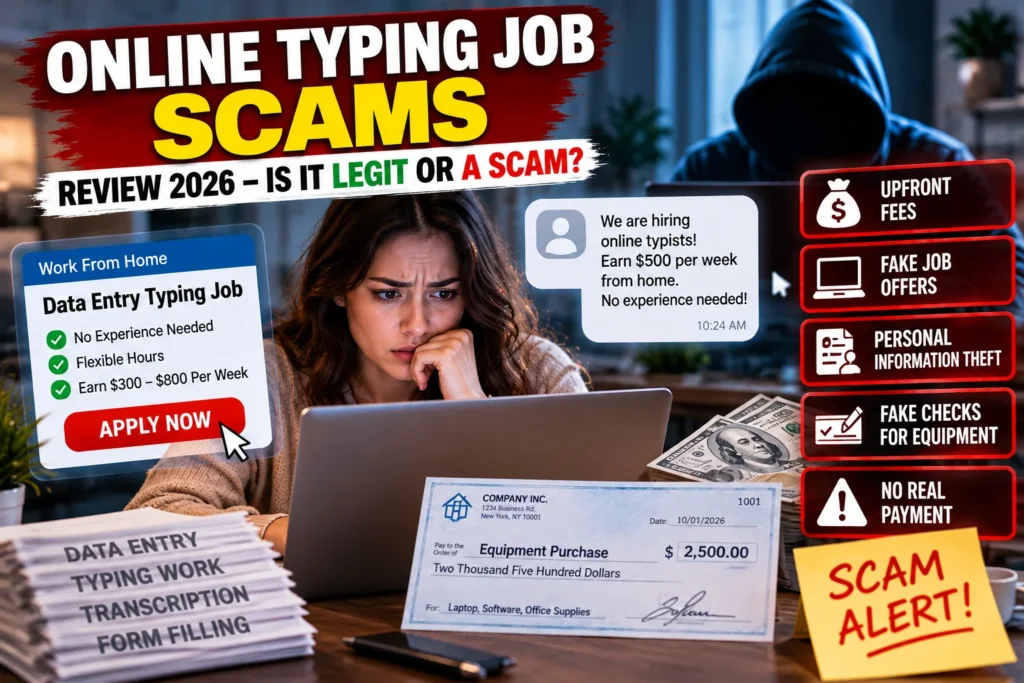
Personal email addresses
A recruiter claiming to represent a major company but using a free personal email address deserves extra scrutiny.
A personal email is not automatically proof of fraud, particularly for small businesses, but the claim should be independently checked.
What We Could Not Verify
Because this is a scam category rather than a single website, we could not independently verify:
- One domain registration date
- One domain registrar
- One WHOIS record
- One company owner
- One headquarters
- One Trustpilot score
- One ScamAdviser score
- One Gridinsoft score
- One shipping policy
- One refund policy
- One customer-support department
- One payment processor
- One social-media profile
- One universal salary range
We could not independently verify this information because online typing-job scams are carried out through many unrelated websites, recruiters, identities and impersonated companies.
That is an important distinction. Information from one fake job website should never automatically be attributed to every typing-job opportunity.
Shipping, Returns and Refunds
Shipping and product returns are not normally relevant to an employment opportunity.
Instead, the equivalent question is:
What happens to money you pay during the hiring process?
A legitimate employer should not make you purchase something from them simply to obtain employment.
If an employer says you must pay for training, equipment, software or access, the offer deserves serious scrutiny.
The FTC states that legitimate employers do not require applicants to pay to get a job.
Likewise, if a supposed employer sends money to your bank account and asks you to forward part of it elsewhere, that is not a normal reason to distrust your bank’s fraud department or “wait for the check to clear.”
A deposited check can appear in an account before the bank discovers that it is fraudulent.
Payment Safety
The safest approach to an online job is straightforward:
You should not have to pay the employer to become an employee.
That includes supposed fees for:
- Registration
- Training
- Equipment
- Software
- Certification
- Background checks
- Payroll activation
- Job placement
There may be legitimate circumstances where a worker independently chooses to pay for professional training or certification, but that is different from a supposed employer requiring payment as a condition of receiving the job.
Be particularly cautious about cryptocurrency, gift cards, wire transfers and other payments that are difficult to reverse.
The FBI has separately warned about fake work-from-home schemes in which victims are told to make cryptocurrency payments to unlock work or increase their supposed earnings. The agency says the interface can display fake earnings even though the money cannot actually be withdrawn.
Customer Service Test
A fake employer may actually be very responsive.
That can make the scam more convincing.
A recruiter might answer questions quickly, provide documents and maintain regular contact during onboarding.
The important test is not simply “Does the recruiter respond?”
Instead ask:
Can the recruiter be independently verified?
A responsive scammer is still a scammer.
A legitimate employer should be willing to explain the job, identify the company and allow applicants reasonable time to verify the opportunity.
Pressure, secrecy or irritation when you ask normal questions is much more concerning than response speed itself.
Pros and Cons
What Looks Legitimate
- Genuine data-entry and typing jobs do exist.
- Remote administrative work is a legitimate employment category.
- Online applications and interviews are normal.
- Typing tests can be legitimate.
- Some employers provide equipment.
- Flexible schedules can be legitimate.
- Electronic employment paperwork is now common.
Major Risks
- Fake recruiters impersonating real companies
- Unrealistically high pay claims
- No meaningful interview
- Immediate job offers
- Upfront training or software fees
- Fake checks for equipment
- Requests to purchase gift cards or cryptocurrency
- Identity-theft risk
- Banking-information theft
- Fake job portals
- Pressure to act quickly
- Vague descriptions of actual work
Red Flags We Found
| Red Flag | Why It Matters |
|---|---|
| “Easy typing” for unusually high pay | Compensation may be designed to attract desperate job seekers |
| Unexpected text or social-media recruitment | Current FTC warnings identify this as a common route into job scams |
| No meaningful interview | Makes employer verification harder |
| Immediate offer | Legitimate hiring can require screening and verification |
| Upfront payment | A major employment-scam warning sign |
| Training fee required | Legitimate employers should not charge applicants to obtain a job |
| Employer sends a check | Can be part of a fake-check scheme |
| Asked to send money elsewhere | Strong financial-fraud warning |
| Asked for cryptocurrency | High-risk and difficult-to-reverse payment method |
| Asked for sensitive data immediately | Potential identity-theft risk |
| Recruiter uses an unverified email | Employer identity may be fabricated |
| Job missing from official company website | Possible impersonation |
| Pressure to accept immediately | Limits independent verification |
| Fake earnings dashboard | May create the illusion of successful work |
| “Unlock” payment | Strong indicator of a task or employment scam |
Positive Signs and What They Actually Mean
A legitimate typing job should not be judged solely by the absence of obvious warning signs.
Some positive indicators include:
The position appears on the employer’s official careers page.
This is much stronger than seeing the same job on an unfamiliar job board.
The recruiter uses a verifiable company email.
The email should correspond to the genuine employer rather than a lookalike domain.
The interview process makes sense.
There is a real explanation of the role, responsibilities, reporting structure and pay.
No payment is required.
This removes one of the strongest warning signs.
The employer can explain how payroll works.
You should understand who employs you and how you will actually be paid.
The company has a genuine operational presence.
Independent records and established business activity provide more confidence than a newly created recruitment page. (How to Identify Fake Shopping Websites Before They Take Your Money)
None of these signs individually guarantees legitimacy, but together they create a much stronger picture than a polished website alone.
What Consumers Should Consider Before Applying
The safest approach is to investigate the employer before the recruiter.
If a message claims to be from a well-known company, do not use the contact details provided by the message as your only verification method.
Instead, independently locate the company’s official website and careers section.
Check whether the job exists.
Check whether the recruiter can be independently associated with the company.
Check whether the salary and responsibilities make sense.
Then ask whether the employer is asking you to do anything unusual.
The FTC recommends researching the company and searching for complaints or scam reports before accepting an unexpected work-from-home offer. It also recommends talking with someone you trust before moving forward.
For additional online-shopping and website-verification principles ,tricky magazine Why Scammers Prefer Crypto Payments: The Real Reasons Behind the Growing Fraud Risk provides a useful framework for evaluating unfamiliar websites.
Its Scam UPI Payment Tricks: How Fraudsters Manipulate Digital Payments and How to Stay Safe is also useful when a supposed employer directs applicants to an unfamiliar website that collects information or payments.
If You Already Provided Personal Information
If you have already sent personal information to someone claiming to be an employer, do not assume the offer is legitimate simply because you received an employment contract or onboarding documents.
Save copies of:
- Emails
- Text messages
- Job advertisements
- Contracts
- Recruiter profiles
- Website addresses
- Payment requests
- Checks
- Invoices
- Screenshots
- Any documents you submitted
If you provided financial information or suspect an account has been compromised, tell a trusted adult and contact the relevant financial institution promptly.
If a supposed employer sent you a check, do not spend the money simply because it appears in your account. Contact your bank and explain the circumstances.
If someone asks you to purchase gift cards, send cryptocurrency or forward money, stop and verify the opportunity independently.
Current Customer Reports Show the Pattern Is Still Active
The strongest evidence against these scams is not that every typing job is fraudulent. It is that very similar fraudulent hiring patterns continue to appear in consumer reports.
A January 2026 BBB Scam Tracker report described a supposed remote data-entry position where the applicant was asked for personal information and told they would receive equipment through a check-based process. The report says the applicant ultimately believed the offer was fraudulent.
A September 2026 BBB report described another supposed remote data-entry opportunity involving a company check, equipment purchases and instructions to send money to vendors. The consumer reported losing $582. (Better Business Bureau)
These are consumer reports, not independently adjudicated findings, so they should not be treated as proof against every company mentioned in them. Their value is in showing that the fake-job pattern remains active and that data-entry roles continue to be used as the lure.
BBB’s broader 2026 employment-scam research similarly reports a sharp increase in employment-scam activity and highlights schemes involving fake online work and requests for victims to provide their own money.
Is an Online Typing Job Legit or a Scam?
The correct answer is both are possible.
Legitimate typing and data-entry employment exists. A real employer can offer remote work, conduct an online interview, use electronic contracts and pay employees through normal payroll.
But online typing jobs are also used as a scam lure because the work sounds simple and accessible.
The strongest warning signs are financial.
If you must pay to receive the job, stop.
If you must buy cryptocurrency to unlock tasks, stop.
If the employer sends a check and tells you to send money elsewhere, stop.
If you are asked for highly sensitive information before the employer can be independently verified, stop and investigate.
If a recruiter contacts you unexpectedly and refuses to let you verify the company independently, treat the offer as high risk. (Refund Scams)
Final Verdict
Online typing job scams are a genuine and active employment-fraud category in 2026.
The important point is not to assume that every remote typing job is fraudulent. Instead, evaluate the employer, recruiter, job description, hiring process and payment arrangement together.
Current FTC guidance warns about fake work-from-home recruiters, unexpected job messages, upfront fees, fake checks and offers promising substantial money for minimal effort. BBB’s recent employment-scam reporting shows that fake remote data-entry positions remain part of the problem.
Risk level for the scam category: HIGH
Verdict: Legitimate typing jobs exist, but any offer involving upfront payment, suspicious checks, cryptocurrency, unexplained fees, unusually high pay or unverifiable recruiters should be treated as a potential scam.
The safest rule is also the simplest:
A genuine employer pays you for your work. You should not have to pay the employer to obtain the job.
Frequently Asked Questions
Are online typing jobs legitimate?
Yes. Legitimate data-entry, transcription and administrative typing jobs exist. The problem is that scammers also use these job titles because they sound easy and accessible.
Is every work-from-home typing job a scam?
No. Remote work itself is not a warning sign. The employer’s identity, hiring process, compensation and payment requirements should be evaluated before accepting the position.
How can I tell if an online typing job is a scam?
Be cautious if the offer promises unusually high pay for simple work, arrives unexpectedly, skips meaningful interviews, demands upfront payment, sends a suspicious check or asks you to buy cryptocurrency or gift cards.
Do legitimate employers charge training fees?
A supposed employer requiring payment before you can start working is a major warning sign. The FTC advises consumers not to pay for the promise of a job.
What is a fake-check typing job scam?
The supposed employer sends a check and tells the applicant to use the funds for equipment or another expense. The check can later prove fraudulent, leaving the applicant responsible for money already spent or transferred.
Can typing jobs really pay high salaries?
Some specialized administrative, transcription or technical roles can pay well, but extremely high compensation for simple work with no experience or meaningful screening deserves independent verification.
Are typing-job websites safe to enter personal information?
Not necessarily. A legitimate employer may eventually need payroll and identity information, but applicants should verify the employer and hiring process before submitting sensitive documents.
What if a recruiter contacts me through WhatsApp or text?
Unexpected job messages deserve caution. The FTC specifically warned in 2026 about fake recruiters contacting people by text with remote-job offers.
What should I do if I already paid a fake employer?
Keep all records and tell a trusted adult or another trusted person. Contact the relevant financial institution or payment provider promptly and explain that the payment was connected to a suspected employment scam.
SEO Information
SEO Title:
Online Typing Job Scams Review 2026: Is It Legit or a Scam?
Meta Description:
Are online typing jobs legit or a scam? Our 2026 review examines fake data-entry offers, upfront fees, fake checks, recruiter scams, crypto tasks and warning signs.
URL Slug:online-typing-job-scams-review
Primary Keyword:
Online typing job scams review
Secondary Keywords:
- online typing job scams
- typing job scam
- online typing jobs scam
- data entry job scams
- work from home typing scams
- typing jobs from home scam
- fake data entry jobs
- remote data entry scams
- online typing job reviews
- typing job scam complaints
- Is an online typing job legit
- Is a typing job a scam
- work from home job scam
- fake remote job scams
- data entry clerk scam
- online job scam warning signs
- typing job fraud
Featured Image Alt Text:
Online typing job scam warning showing a fake remote data-entry offer, suspicious recruiter message, upfront payment request, fake check and work-from-home fraud risks