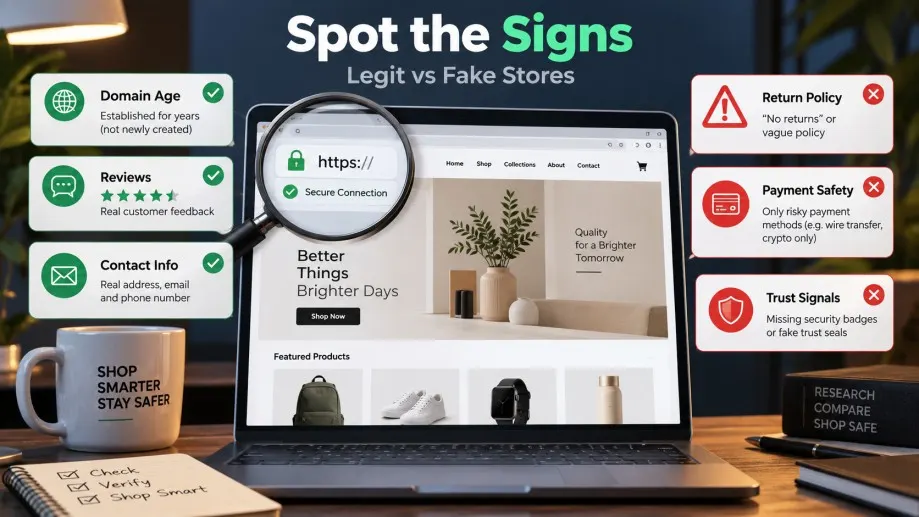
Shopping online has reached a point where appearance alone tells you almost nothing about whether a store deserves your money. A professionally designed homepage, secure-looking checkout page, polished product photographs, customer testimonials and even a functioning order system can now be assembled surprisingly quickly. That makes the difference between legit and fake stores harder to recognize than many shoppers expect.
When I investigate an unfamiliar online shop, I rarely make a judgment from one red flag. A newly registered domain does not automatically make a website fraudulent. A hidden WHOIS record does not prove dishonest intent. A missing Trustpilot profile does not mean customers will lose their money. The real question is whether several pieces of information fit together logically.
Legitimate retailers normally leave behind a reasonably consistent trail. You can identify who operates the business, understand what you are buying, find realistic policies, locate working contact channels and see some evidence that the company exists beyond its own website. Higher-risk stores often look convincing at first but become less convincing the deeper you investigate them.
That difference is what this guide focuses on.
Our investigation found… the most useful warning signs rarely appear in isolation. What matters is the pattern created when domain history, company information, pricing, policies, payment methods, customer feedback and website behavior are examined together.
What Actually Makes an Online Store Legitimate?
There is no single badge that turns an online shop into a legitimate retailer.
A genuine store is better understood as a business whose identity, commercial activity and promises can be independently checked to a reasonable degree. You should usually be able to determine who is selling the product, how customers can contact the seller, what happens if something goes wrong and whether the store’s claims make commercial sense.
Large established retailers obviously have stronger signals because they have years of history. Smaller businesses should not be judged by exactly the same standard. A family-run store launched two months ago may have few reviews, limited social activity and a privately registered domain while still operating honestly.
This is why responsible fraud analysis requires context.
When I investigate a new retailer, I ask a simple question: Does the evidence support the story the website is telling shoppers?
If a site claims it has been a trusted American retailer for 15 years but its domain appeared three weeks ago, there is a contradiction worth investigating. If another store openly says it launched recently, provides identifiable business details, maintains realistic policies and uses established payment processing, its young domain becomes far less concerning.
Consistency matters more than perfection.
Legit Store vs Fake Store: The Difference Is Usually Below the Surface
At first glance, legitimate and suspicious shops may look remarkably similar. Both can have attractive themes, HTTPS encryption, shopping carts, discount codes, product reviews and professional advertising.
The difference usually becomes visible after you start verifying the information.
A legitimate store tends to become easier to understand as you investigate it. A questionable store often becomes more confusing.
For example, imagine two websites selling the same $180 kitchen appliance.
Store A lists the product for $159. It provides a business address, support email, clear delivery estimate and 30-day return policy. Searches for the company reveal several years of customer discussions and a consistent business identity.
Store B lists the same appliance for $39.99 with a countdown timer saying the 78% discount ends in eight minutes. Its contact page contains only a form, its policy mentions a different company name and its domain was registered recently.
None of Store B’s signals individually proves fraud. Together, though, they create a considerably higher-risk picture.
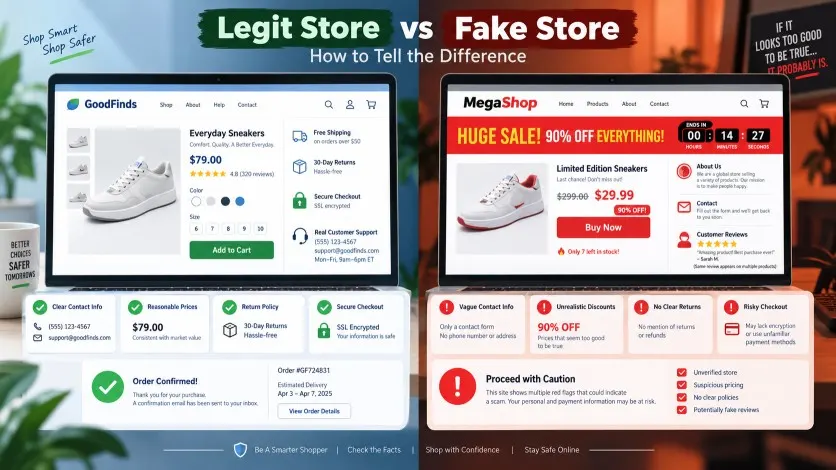
That is the kind of comparison shoppers should learn to make.
The First Thing I Check: Who Is Actually Behind the Store?
One of the most revealing parts of an investigation is often the least exciting: identifying the seller.
A legitimate retailer should normally provide enough information for customers to understand who they are dealing with. That might include a company name, business address, email address, customer-service number or registration information.
Not every store needs all of these, especially a small online business. What concerns me more is when virtually nothing can be verified.
Suppose the footer says:
“© 2026 Premium Lifestyle Store. All rights reserved.”
That tells you almost nothing.
Who owns Premium Lifestyle Store? Where is it based? Who processes returns? Is Premium Lifestyle Store the company’s legal name or merely a website brand?
I also compare the names across the website. Privacy policies, refund policies and terms pages sometimes expose information overlooked during site construction.
During testing, we observed… some questionable storefronts use one brand name on the homepage while their legal pages refer to an entirely unrelated company or website. That can happen because templates were copied without being properly edited.
It is not automatic evidence of fraud, but it suggests the site’s documentation deserves closer inspection.
Domain Age Helps, but People Misuse This Signal
Domain registration information is one of the tools I use when investigating unfamiliar stores, but domain age needs to be interpreted carefully.
A store registered last week obviously has less established history than one that has operated continuously for eight years. What domain age does not tell you is whether the business intends to fulfill orders.
Every legitimate website was new once.
The useful part comes from comparing domain history with marketing claims.
If a retailer says, “Serving customers since 2012,” while available domain records show the website was only recently registered, I would investigate further. The business may have moved domains, purchased an existing brand or previously operated offline, so the discrepancy should be treated as a question rather than proof of deception.
Domain information becomes more meaningful when combined with other findings such as anonymous ownership, extreme discounts, no independent reviews and copied policies.
That combination changes the risk assessment substantially.
Fake Stores Often Borrow Credibility Instead of Building It
One behavioral pattern appears repeatedly across suspicious e-commerce websites: borrowed trust.
Instead of developing genuine credibility over time, operators attempt to create the appearance of credibility immediately.
That might involve displaying hundreds of five-star testimonials, claiming thousands of satisfied customers, placing well-known payment logos in the footer or using phrases such as “America’s #1 trusted store.”
The problem is that graphics and text are easy to publish.
A Visa logo does not prove Visa protects purchases made through the site. A “Secure Checkout” icon does not identify the actual payment processor. A five-star image does not prove customers submitted those reviews.
TrickyMagazine researchers noticed… that the strongest trust signals are usually the ones shoppers can verify outside the seller’s own website.
That is an important distinction.
A company saying it has 20,000 satisfied customers is a claim. Independent evidence showing years of customer activity is verification.
Extreme Discounts Deserve Commercial Analysis
Price is one of the easiest signals for shoppers to evaluate, yet it is also one of the easiest ways to manipulate them.
A discount itself is not suspicious. Retailers legitimately run clearance sales, seasonal promotions, introductory offers and inventory reductions.
The question is whether the price makes economic sense.
Suppose a product normally sells from established retailers for approximately $300. An unfamiliar store suddenly offers what appears to be the identical product for $47 with free international shipping.
I would not immediately call the shop fraudulent, but I would want an explanation.
Could the product be refurbished? Is it a smaller version? Is it a private-label imitation? Is the advertised price only for an accessory? Is this a legitimate liquidation sale?
If none of those explanations fits, the price becomes a meaningful warning signal.
Scammers understand that unusually low prices can override rational decision-making. The shopper begins thinking about losing the deal instead of evaluating the seller.
That is why urgency and discounts are so commonly paired.
Countdown Timers Are More Interesting Than They Look
A countdown timer can be perfectly legitimate. Ticket sales, flash promotions and product launches often have genuine deadlines.
The suspicious pattern appears when the timer is artificial.
You visit a store and see:
“SALE ENDS IN 09:47.”
Come back an hour later and the countdown has restarted.
Return tomorrow and another “final sale” is underway.
This is less about website design and more about behavioral pressure. The purpose is to shorten the amount of time you spend investigating.
The psychological message is simple: buy now, verify later.
That is exactly the opposite of how consumers should approach an unknown seller.
When a website combines dramatic discounts, low-stock warnings, pop-ups showing supposed recent purchases and constantly resetting countdown timers, I increase the site’s behavioral-risk rating even if the store has not yet shown evidence of outright fraud.
Contact Information Can Reveal More Than the Homepage
I always check the contact page, but simply finding an email address is not enough.
Look at what kind of email address is being used. A domain-based address such as support@example-store.com generally looks more established than a random free email account, although either can belong to a legitimate business.
Then inspect the physical address.
Does it exist?
Does it correspond to the business being advertised?
A perfectly real address can still be misleading. Some websites copy residential addresses, warehouses or unrelated businesses to appear established.
Phone numbers deserve similar attention. If a site claims to offer 24/7 customer support but provides no identifiable support channel beyond a form, the claim is difficult to verify.
One technique I find surprisingly useful is sending a basic pre-purchase question.
Ask something specific about sizing, shipping or returns.
The response can reveal a lot. A thoughtful answer from a representative is different from a generic automated message that ignores the actual question.
Policies Are One of the Best Places to Investigate a Store
Most shoppers never read refund policies before purchasing. Fraud researchers often do.
Policies reveal how carefully the business has been built.
A credible return policy should explain basic questions such as how long customers have to request a return, what condition products must be in, who pays return shipping, where returns are sent and how refunds are processed.
Suspicious policies often contain contradictions.
You might see a 30-day return promise on one page and a 14-day limit elsewhere. The terms may mention a company that does not appear anywhere else on the site. A policy may tell customers to contact an email address belonging to another domain.
Copied legal text is not uncommon on legitimate small websites either, so mistakes should be interpreted proportionally. Still, multiple inconsistencies suggest the operator may have spent more effort creating the sales funnel than building the business infrastructure behind it.
That matters when your money is involved.
Product Images Can Expose Recycled Storefronts
Another useful investigation method is checking product photographs.
Suspicious stores frequently reuse images from marketplaces, manufacturers or competing retailers. Of course, legitimate dropshipping stores and authorized resellers may also use supplier photographs, so duplicate imagery alone proves very little.
What interests me is the larger pattern.
Imagine a website claims to manufacture an exclusive orthopedic pillow developed by its own research team. Reverse-image searches reveal the identical product being sold under several unrelated brand names.
Now the marketing claim deserves scrutiny.
The same applies to customer photographs. If supposed buyer photos appear elsewhere online years before the store existed, their authenticity becomes questionable.
Consumers do not need advanced forensic tools for this. Google Lens and other reverse-image tools can quickly show where the same image has appeared.
Reviews Need Context, Not Just Star Ratings
Independent customer feedback is useful, but review analysis has become more complicated.
A five-star rating is not automatically reassuring, and a two-star rating does not automatically mean a company is dishonest.
I usually look at four things: volume, timing, detail and response patterns.
A store with hundreds of reviews created within a very short period deserves a different level of scrutiny from a retailer whose feedback accumulated gradually over years.
Detailed reviews also tend to be more useful than generic comments such as “Amazing product!!!”
Negative reviews can actually make a business appear more credible when the complaints are realistic and the company responds constructively. Real businesses make mistakes. Deliveries get delayed. Products arrive damaged. Customers misunderstand return conditions.
What matters is how the company handles those situations.
A perfect reputation is not necessarily more trustworthy than a messy but believable one.
The Payment Method Changes Your Risk
How you pay can matter almost as much as where you shop.
Credit cards generally offer stronger dispute mechanisms than irreversible payment methods. Established payment processors may also provide additional layers of buyer protection depending on the transaction and jurisdiction.
Be much more careful when an unfamiliar retailer pushes shoppers toward bank transfers, cryptocurrency, gift cards or other payment methods that are difficult to reverse.
That does not mean every store accepting cryptocurrency is suspicious. The concern appears when an unknown seller encourages an irreversible method while offering little independent evidence of legitimacy.
Whenever possible, avoid giving an unfamiliar merchant direct access to payment methods that provide weak recovery options.
Also check the checkout domain. Being redirected to a legitimate payment provider is normal. Being redirected through a sequence of unfamiliar domains deserves attention.
HTTPS Does Not Mean a Store Is Legit
One misconception deserves to disappear completely.
The padlock beside a website address means the connection between your browser and the website is encrypted. It does not mean the business operating the website has been verified as trustworthy.
Fraudulent websites can use HTTPS.
So can phishing sites.
Think of HTTPS as protecting the conversation between you and the website. It does not guarantee that the person on the other end of that conversation is honest.
A missing HTTPS certificate on a shopping checkout is a serious technical concern. Having HTTPS, though, should be treated as a basic requirement rather than evidence of legitimacy.
Social Media Can Strengthen or Weaken the Store’s Story
Social profiles can provide valuable context.
If a retailer claims to have operated for several years, I expect some evidence of activity somewhere. That might include Facebook posts, Instagram content, customer comments, YouTube demonstrations or community discussions.
A recently created social profile with six posts does not prove the business is fake. What matters is whether its history aligns with what the store claims.
Look at engagement as well.
Ten thousand followers with virtually no interaction may deserve closer inspection. Followers can be purchased, and engagement numbers can be manipulated.
Real conversations are harder to manufacture consistently.
Comments asking about delayed orders, customer-service responses and tagged customer photos can sometimes provide more useful information than the follower count itself.
The Behavioral Difference Between Legit Sellers and Scammers
One of the more interesting differences between legitimate sellers and deceptive operators is what they want you to focus on.
A legitimate retailer generally expects comparison shopping. It gives you product specifications, shipping details, return information and enough time to consider your purchase.
A deceptive seller benefits when you stop comparing.
That is why manipulation often centers around urgency, scarcity and emotional pressure.
“You have been selected.”
“Only 2 remaining.”
“Offer expires in five minutes.”
“300 people are viewing this product.”
None of these statements proves anything by itself. Together, particularly on an unknown site offering an unrealistic price, they can indicate a sales strategy designed to reduce deliberation.
The safest response is simple: slow the process down.
If a deal is genuinely valuable, spending five minutes checking the seller should not destroy the opportunity.
A Practical Store Verification Process We Actually Use
You do not need to spend an hour researching every $20 purchase. A structured five-to-ten-minute check can eliminate many obvious risks.
Step 1: Search the Store Name Independently
Do not rely exclusively on links provided by the retailer.
Search the brand name along with terms such as “reviews,” “complaints,” “refund,” “delivery,” or “scam.”
You are not looking for one angry customer. Almost every established company has complaints.
You are looking for patterns.
Step 2: Check the Domain History
Look at when the domain was registered and compare that date with claims made by the company.
A recent domain is a risk factor, not a verdict.
Step 3: Identify the Seller
Find the business name, address, email and customer-service details.
Check whether those details remain consistent across the website.
Step 4: Read the Return and Refund Policies
Pay particular attention to vague wording, contradictory deadlines, unrealistic conditions and unexplained international return addresses.
Step 5: Compare the Price
Check what the same or comparable product costs elsewhere.
Large differences should have a reasonable explanation.
Step 6: Look for Independent Reputation
Check third-party review services, forums, social platforms and search results.
Do not treat any single reputation website as an unquestionable authority. Automated trust scores can be useful signals, but they should be interpreted alongside direct evidence.
Step 7: Inspect the Product Claims
Search important marketing statements.
If the retailer claims its product has certifications, awards or endorsements, see whether those claims can be independently verified.
Step 8: Evaluate Payment Protection
Prefer payment methods that provide reasonable dispute rights when dealing with an unfamiliar merchant.
Step 9: Test Customer Support
For expensive purchases, send a pre-sale question.
How a company responds before receiving your money can reveal a lot.
Step 10: Make a Combined Risk Judgment
Do not ask, “Did I find one red flag?”
Ask, “What does the overall evidence suggest?”
That is the more reliable question.
A Quick Comparison: Legitimate Store vs Higher-Risk Store
| Area | More Typical of a Legit Store | More Typical of a Higher-Risk Store |
|---|---|---|
| Business identity | Clear and reasonably verifiable | Missing, vague or inconsistent |
| Domain history | Consistent with company claims | Very recent despite claims of long history |
| Pricing | Competitive but commercially plausible | Extreme discounts without explanation |
| Contact details | Multiple working contact methods | Form only or unverifiable information |
| Policies | Detailed and internally consistent | Copied, vague or contradictory |
| Reviews | Mixed, detailed and accumulated naturally | Perfect-looking or difficult to verify |
| Payment | Established processors and buyer protections | Pressure toward irreversible payments |
| Product claims | Specific and verifiable | Dramatic claims with little evidence |
| Marketing | Persuasive but informative | Heavy urgency and scarcity pressure |
| External footprint | Some independent history | Almost no presence beyond the website |
The purpose of this comparison is not to create a mechanical scoring system. Real websites do not always fit neatly into columns. It is simply a way to recognize patterns.
Situational Example: The New Store That May Still Be Legitimate
Imagine finding a clothing retailer registered two months ago.
It has no Trustpilot reviews and fewer than 500 Instagram followers.
That might initially look risky.
Now suppose the website clearly says the company launched in 2026, identifies its founder, lists a verifiable business registration, posts original behind-the-scenes production content, uses established payment processors and answers customer questions publicly.
The lack of history still increases uncertainty, but the evidence does not resemble a disposable storefront.
My assessment would probably be something like: new and relatively unproven, but there are several positive legitimacy indicators.
That is more responsible than calling it a scam simply because the domain is young.
Situational Example: The Beautiful Store With a Weak Story
Now consider another website.
The design is excellent. The products look expensive. Every item has hundreds of five-star reviews.
But the domain was registered recently, the company claims 12 years of experience, there is no identifiable legal business, product images appear across unrelated stores, the return policy contains another brand’s name and every product is discounted by approximately 70%.
That situation produces a very different assessment.
Again, none of the findings alone proves fraud.
Together, they substantially increase uncertainty and make purchasing harder to justify, particularly when safer established alternatives exist.
This is what evidence-based scam awareness should look like.
What to Do If You Already Ordered From a Suspicious Store
Do not automatically assume the worst because you discovered warning signs after purchasing.
Start documenting everything.
Save the order confirmation, screenshots of the product listing, advertised delivery dates, refund policy, payment receipt and any correspondence with the seller.
If the merchant provides tracking information, check whether it corresponds to your destination and order.
Contact the company through its official support channel and keep copies of your messages.
If the product never arrives, is materially different from what was advertised or the seller refuses a refund that should reasonably apply, contact your payment provider and ask about available dispute options.
You should also monitor your financial account for unauthorized activity if you entered card details directly into a website you later consider suspicious.
Changing reused passwords is sensible as well. Never use the same password for an unfamiliar shopping site that you use for email, banking or major accounts. You can read more about Glov Beauty a Scam or Legit?
Security Habits That Reduce Shopping Risk
Fraud prevention is easier when a few habits become automatic.
Use unique passwords or a password manager. Enable transaction alerts on payment accounts. Avoid clicking shopping links from unsolicited messages when you can manually navigate to the retailer instead.
Be skeptical of advertisements that promise branded products at impossible prices.
Check the full domain name carefully. Lookalike websites may use small spelling changes, extra words or unusual domain extensions to imitate established retailers.
For expensive purchases, spend more time verifying the seller than you would for a low-value item.
There is no perfect formula, but increasing the investigation effort in proportion to the amount of money at risk is common sense.
Some Red Flags Are Stronger Than Others
One mistake in online store analysis is treating every warning sign equally.
They are not equal.
A spelling mistake in a privacy policy is weak evidence.
A recently registered domain is moderate evidence of limited history.
A fake physical address, deceptive company identity or fabricated certification would be significantly more concerning.
Risk assessment should reflect that difference.
I generally think of warning signs in three categories.
Minor signals include grammar mistakes, generic themes and limited social activity.
Moderate signals include very recent domains, extreme discounts, limited contact options and little independent reputation.
Stronger signals include false business claims, impersonation of existing companies, manipulated payment instructions, misleading certification claims or evidence that customer information is being harvested.
The more serious signals deserve far greater weight. You can read more about The “China Domain Registration” Email Scam Explained!
Why Automated Scam Scores Should Never Be Your Entire Investigation
Website reputation services can be helpful. They often look at domain age, technical infrastructure, blacklists, traffic patterns and other signals that ordinary shoppers may not notice.
But a trust score is an assessment, not a court judgment.
Different services can produce dramatically different scores for the same website because they use different datasets and methodologies.
A low score should encourage further investigation.
A high score should not make you switch your brain off.
The safest approach is to use automated reputation tools as one part of a wider evidence set that includes business identity, website history, policies, customer experiences and commercial logic.
That produces a much fairer review.
Final Verdict: The Real Difference Between Legit and Fake Stores
Our investigation found the difference between legit and fake stores is rarely one magical red flag. It is usually the difference between a business whose story becomes more believable as you verify it and a storefront whose story begins falling apart under basic scrutiny.
Legitimate stores can be new. They can have negative reviews. They can make website mistakes. They can even provide poor customer service without being fraudulent.
At the same time, a polished website should never be confused with a trustworthy business.
When I assess an unfamiliar retailer, I give the most weight to verifiable identity, consistency, realistic pricing, transparent policies, independent reputation and payment protection. I also pay attention to behavior. Stores that aggressively pressure visitors to buy before they have time to think deserve additional scrutiny.
The goal should not be to label every unfamiliar website a scam. That would be inaccurate and unfair to legitimate new businesses. The better approach is to identify how much uncertainty remains and whether taking that risk makes sense when other purchasing options are available.
If several warning signs appear together—particularly an unverifiable company identity, recently created domain, unrealistic pricing, copied content, questionable policies and weak customer protections—I would personally avoid making a significant purchase until those concerns can be resolved.
On the other hand, when a store provides transparent business information, consistent policies, realistic offers, independent history and responsive support, those signals give consumers stronger reasons to trust the transaction.
That is ultimately what good scam research should accomplish: not telling readers what to fear, but giving them enough evidence and practical knowledge to make a safer decision for themselves.